


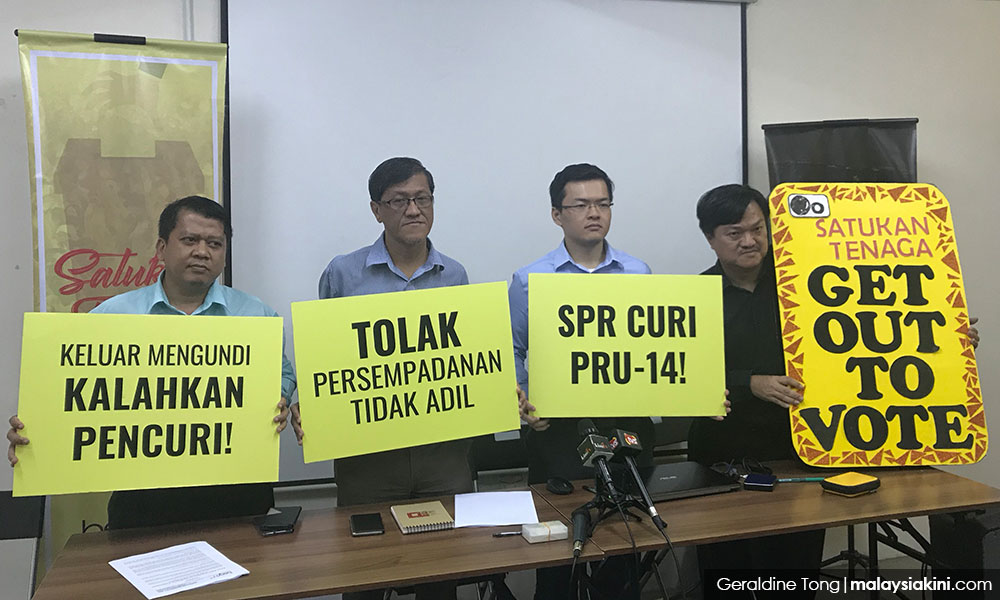

Bersih: GE14 can be won with only 16.5pct popular vote
GE14 | The 14th general election can theoretically be won with a simple parliamentary majority comprising a mere 16.5 percent of the popular vote.
This is according to electoral watchdog Bersih's outreach officer Chan Tsu Chong, who pointed out that under the current “first past the post” electoral system in Malaysia, 112 seats are needed to win a simple parliamentary majority...
GE14 | The 14th general election can theoretically be won with a simple parliamentary majority comprising a mere 16.5 percent of the popular vote.
This is according to electoral watchdog Bersih's outreach officer Chan Tsu Chong, who pointed out that under the current “first past the post” electoral system in Malaysia, 112 seats are needed to win a simple parliamentary majority.
As such, under the new delineation of electoral boundaries, the smallest 112 parliamentary constituencies have a total of 4,469,621 voters, or 33 percent of total voters nationwide, he said.
By winning these 112 seats with slightly more than half the number of voters in each constituency, a party can already form a simple majority government, Chan said.
"In the most extreme of cases, a simple parliamentary majority could theoretically be won with just 16.5 percent of the popular vote, that is by obtaining 50 percent plus one vote for each of the 112 smallest constituencies," Chan said at a press conference at the Bersih headquarters today.
The figure may even be smaller if the votes end up being split in multi-cornered fights, he added.
At the other end of the spectrum, the largest 112 constituencies have a total of 9,072,280 voters, or 68 percent of the total voters nationwide.
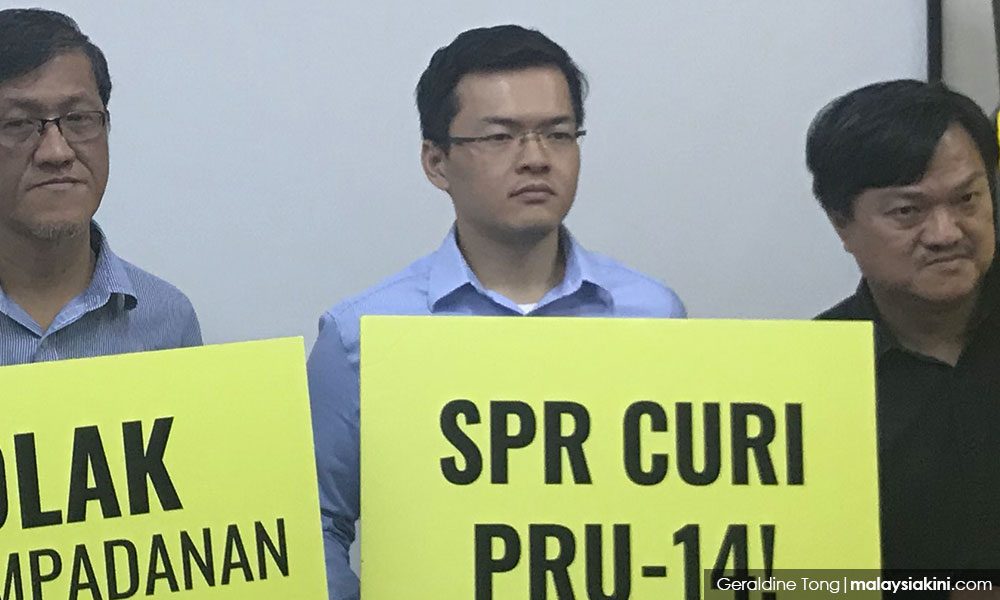
These figures show that the redelineation is a "complete subversion" of democracy, Chan (centre in photo) said, as it "crowns the loser".
"And when the voters' mandate for the Parliament and government is insidiously distorted, the legitimacy of the entire political system is called into question, undermining political and economic stability," he added.
This is the result of worsening malapportionment in the redelineation, he said, which was passed by the Dewan Rakyat last Wednesday and gazetted in 24 hours.
The purpose of redelineation is to reduce malapportionment and ensure that the number of voters in constituencies are approximately equal, as stated in the Federal Constitution.
However, Chan said, the ratios between the smallest and largest parliamentary constituencies were amplified from the redelineation exercise in several states, such as Selangor, Johor, Kedah and Malacca.
For example, while the smallest constituency in Kedah remained the same at 37,645 voters, the biggest constituency had increased from 95,131 voters to 101,829 voters, which caused the ratio to jump from 2.53 to 2.70.
Penang Institute fellow and Bersih steering committee member Wong Chin Huat also pointed out that the average number of voters for parliamentary seats in Selangor is 94,469, which means the number of voters in constituencies in the state should hover near that number.

However, Wong (photo) said, the largest constituencies in the country are Petaling Jaya Utara, which has since been renamed as Damansara, which has 150,439 number of voters, far higher than the state average.
This pattern occurred with the next few top largest constituencies in the country as well, he said.
Gerrymandering along partisan lines
Chan said there were also signs of gerrymandering along partisan lines, which he said was an attempt to manipulate the elections.
He cited the example of the Bukit Katil parliamentary constituency, now renamed Hang Tuah Jaya, in Malacca.
Five polling districts with strong opposition support were transferred out from the constituency, which was won by PKR vice-president Shamsul Iskandar Mohd Akin in GE13, and transferred to the opposition stronghold of Kota Melaka, he said.
"Based on a re-simulation of GE13 voting patterns with the new boundaries after redelineation, Bukit Katil will switch from an opposition constituency into a ruling government constituency," Chan said.
He added that similar gerrymandering was detected in several other states such as Perak, Selangor and Johor.
Aside from partisan gerrymandering, he also criticised the ethnic gerrymandering in the redelineation exercise.

The Election Commission (EC) chairperson Mohd Hashim Abdullah (photo) had stated that ethnicity was one of the criteria considered during the redelineation, he said, and Bersih rejects the institutionalisation of race and ethnicity in the electoral system at the expense of local ties.
"This (ethnic-based transfer of voters) has resulted in 15 parliamentary constituencies, which were previously mixed constituencies before redelineation, being transformed into eight Malay dominant constituencies and seven Chinese dominant constituencies," he said.
Another issue with the redelineation exercise, Wong said, is that 59 percent of parliamentary constituencies were excluded from the exercise, including the whole of Perlis, Penang and Pahang.
"The EC states that the redelineation was done based on demographic and population changes over time due to development, but it failed to propose any changes... for the states of Perlis, Penang and Pahang," he said.
The exclusion of Penang and Pahang are unjustified, he said, as EC stated the number of voters in Penang and Pahang had increased by 31.6 percent and 33.5 percent respectively since the last redelineation.
"Keeping the same boundary hence sustains the severe malapportionment of parliamentary constituencies in Pahang and state constituencies in Penang, with the largest-to-smallest constituency ratio at 2.93 times and 3.27 times respectively," Wong said.
Also, he said, 10 parliamentary constituencies in Selangor, Kuala Lumpur and Kedah adopted the first recommendations which had been ditched after the first round of inquiry.
EC's U-turn not based on objections
"This means the EC had agreed with the objectors that their first recommendations were ill-planned, yet the same body soon readopted the recommendations.
"Most shockingly, the U-turn was not even based on any solid objections," Wong said.
Lastly, the problem with the redelineation exercise is also the prime minister's failure to table the proposal for Sabah.
Though the redelineation report for Sabah was completed and handed over to Prime Minister Najib Abdul Razak in February 2017, he has chosen not to table the Sabah redelineation report in Parliament without any justification.
"While the second recommendations for Sabah were badly malapportioned, raising concerns the final recommendations may worsen the malapportionment of both parliamentary and state constituencies, the prime minister simply had no right to delay the tabling," he said.
In order to defeat these major violations in the redelineation exercise, Bersih acting chairperson Shahrul Aman Mohd Saari said, Malaysians must come out in droves to vote in the next election.
"Bersih urges all voters to reject electoral manipulation by ensuring that they vote in the coming general election.
"While we may not be able to stop redelineation from being passed, a high voter turnout will be able to reduce the impact of the electoral fraud and manipulation," Shahrul Aman said.


