


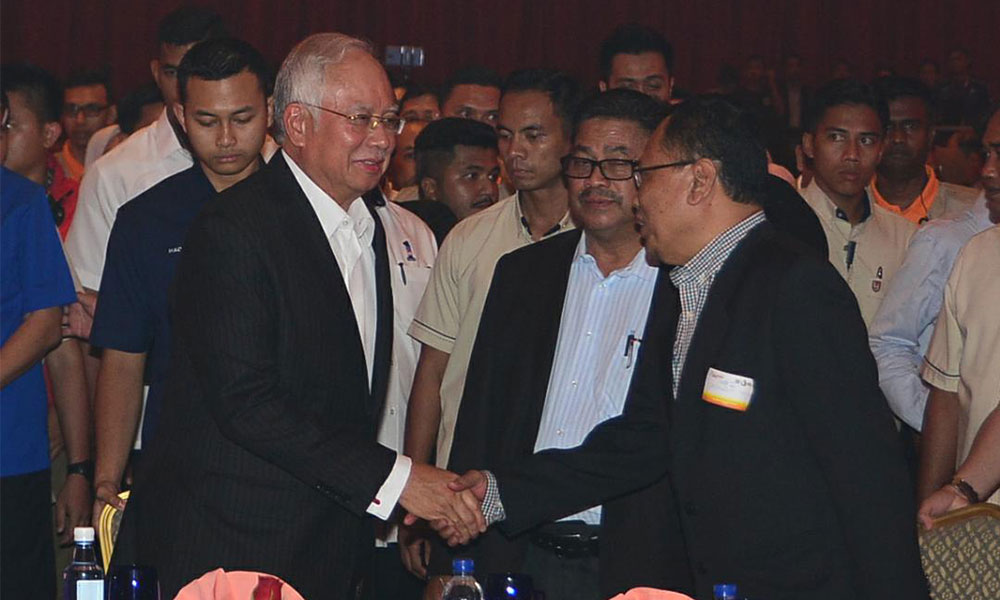

Najib reveals fake news law gazetted at Journalists' Day launch, allays concerns
In an ironic twist, caretaker prime minister Najib Abdul Razak announced that the Anti-Fake News Act 2018 has been gazetted during the launch of the inaugural National Journalists Day in Kuala Lumpur this evening.
Speaking to a room of editors and journalists, he said: "I am delighted to announce that the Anti-Fake News Act 2018 has received royal assent from the Yang di-Pertuan Agong and has been gazetted today...
In an ironic twist, caretaker prime minister Najib Abdul Razak announced that the Anti-Fake News Act 2018 has been gazetted during the launch of the inaugural National Journalists Day in Kuala Lumpur this evening.
Speaking to a room of editors and journalists, he said: "I am delighted to announce that the Anti-Fake News Act 2018 has received royal assent from the Yang di-Pertuan Agong and has been gazetted today.”
However, the act had drawn criticism and concern from press freedom groups, the National Union of Journalists, and global watchdogs.
Acknowledging the concern of media practitioners, Najib vowed that the new law would not restrict their right to report the news.
"I acknowledge that a segment of journalists feel concerned about how the act would supposedly be used to restrict their right to report the news.
"I would like to inform that this view is inaccurate and false, as Section 8A of the Printing Presses and Publications Act 1984 has already made it an offence to publish fake news," he added.
The National Journalists Day will be celebrated on May 29 every year.
Malaysiakini was not invited to an earlier forum featuring top editors from the mainstream press.
Aside from local media, also present today were representatives from Persatuan Wartawan Indonesia and a group of journalists from China.
Freedom, but in a local context
Najib, meanwhile, also underscored that freedom of expression and freedom of the press should be based on three main principles – accountability, truth and the local context.
"It must be understood that the terms freedom of expression and freedom of the press should not be interpreted based on a universal or general interpretation moulded by the west, but instead should be guided according to local culture and sensitivities.
"I would therefore like to summarise, there must be a limit to freedom of expression and freedom of the press, and it should not steered towards spreading of fake or unverified news to the extent of sacrificing the bigger aspects of national security," said Najib.
At the event, the country's founding father, the late Tunku Abdul Rahman, was honored as the first Tokoh Hari Wartawan Nasional for his contributions at the time to launch the national news agency Bernama, among others.
Media council mooted
In his opening address, Bernama general manager Zulkifli Salleh said the group of editors who had met earlier had agreed to the idea of forming a Malaysian Media Council.
Former Media Prima chairperson Johan Jaafar, who spoke on behalf of veteran editors, also concurred with the proposal, and noted it could work as an internal mechanism to address issues surrounding fake news and other concerns raised against the press.
The Anti-Fake News Bill was passed by the Dewan Rakyat on April 2, and was approved by the Dewan Negara a day later.
Press groups have expressed concern that the new legislation will stifle media freedom.
The Act provides a punishment of up to six years' jail, a maximum RM500,000 fine, or both, for the publication of 'fake news'.
The law also allows the government to seek an ex-parte order for articles to be removed, and if done on the grounds of national security, cannot be challenged in court.
The government has denied that it will be the arbiter of what constitutes fake news, pointing out that that responsibility will lay with the courts.
However, critics said a pliant judiciary does not inspire confidence.


Report this comment
Are you sure you want to delete this comment?
This action cannot be undone.