




Politicisation is the root of Felda's woes, study finds
A new study conducted by the Centre to Combat Corruption and Cronyism (C4) has put the spotlight on the politicisation of the federal land development scheme, which it said contributed to the series of scandals that afflicted Felda in recent years.
Among others, the anti-corruption watchdog highlighted that power over Felda had shifted from bureaucrats to politicians since 2001, and later more centralised under the Prime Minister’s Department since it came under caretaker prime minister Najib Abdul Razak’s purview in 2004, when the latter was still deputy prime minister...
A new study conducted by the Centre to Combat Corruption and Cronyism (C4) has put the spotlight on the politicisation of the federal land development scheme, which it said contributed to the series of scandals that afflicted Felda in recent years.
Among others, the anti-corruption watchdog highlighted that power over Felda had shifted from bureaucrats to politicians since 2001, and later more centralised under the Prime Minister’s Department since it came under caretaker prime minister Najib Abdul Razak’s purview in 2004, when the latter was still deputy prime minister.
C4 legal researcher Rahayu Mumazaini, who conducted the study together with University of Malaya economist Edmund Terence Gomez, said the first shift in power in 2001 followed the 1999 general election, where BN suffered a loss of Malay support.
Up to then, she said Felda’s board has almost always been chaired by a person with a professional or civil service background, except for Umno member Musa Hitam, who briefly held the post from September 1971 to December 1972.
From July 2001 onwards, the board has been headed by Umno leaders, starting with Mohd Yusof Noor, and followed by Mohd Isa Abdul Samad, and now Shahrir Abdul Samad.
Umno politicians have also headed Felda’s subsidiaries including Felda Global Ventures, Felda Investment Corporation, and FIC Properties, she added, staying this reached its peak under the previous chairperson Isa.

In 2004, Rahayu (photo) said then prime minister Abdullah Ahmad Badawi had placed Felda under the Prime Minister’s Department purview with Najib in charge of overseeing it.
Najib retained that control when he became prime minister in 2009, she added.
Prior to that, Felda had always been under the purview of a ministry that is responsible for either rural or land development since its inception in 1956.
Read more: Anak chief predicts 20 Felda ‘seats’ could fall to opposition
“What this shows is that although power has always been with politicians with regards to ministerial supervision, it removes one layer in the chain of reporting.
“If the respective minister is supposed to report to the prime minister, now the prime minister having supervision over Felda reports to no one because he sits at the top of the reporting hierarchy,” she said.
Felda’s fall from grace
She was speaking at a briefing organised by C4 in Kuala Lumpur today to present her findings, in the presence of activists, journalists, and foreign embassy officials.
Her presentation traced Felda’s downfall from a body that was once hailed by the World Bank as the world’s most successful land development program and was able to repay its government debt 20 years ahead of schedule in 2000, to one that is RM6.82 billion in debt as of 2016.

This included alleged shoddy investments, such as the public listing of FGV, the boardroom tussles that led to the ousting of then Felda executive director Dzulkifli Wahab, and the seeming lack of accountably highlighted by the Kuala Lumpur Vertical City controversy that came under the media spotlight in December last year.
Rahayu said the problem is facilitated by the Federal Land Development Act 1956, which governs Felda’s conduct as a statutory body.
Among others, she claims there is nothing in the act that bars politicians from joining Felda’s board, while the supervising minister has absolute authority to appoint or sack Felda board members.
It also lacks checks and balances, she said, as Felda companies such as FIC are not required to table their annual reports to parliament, unlike Felda itself.
She then proposed several reforms, among them a full audit of Felda to be conducted and tabled in parliament, Felda companies to be monitored by a parliamentary select committee, and Felda chairperson and supervising minister being made accountable to the select committee.
She also stressed that no politicians should be allowed on Felda’s board of directors, including its subsidiary companies.
Instead, there should be more representation for settlers in the board, which is currently dominated by Umno members.
According to Gomez (photo), the reforms required are long-term.
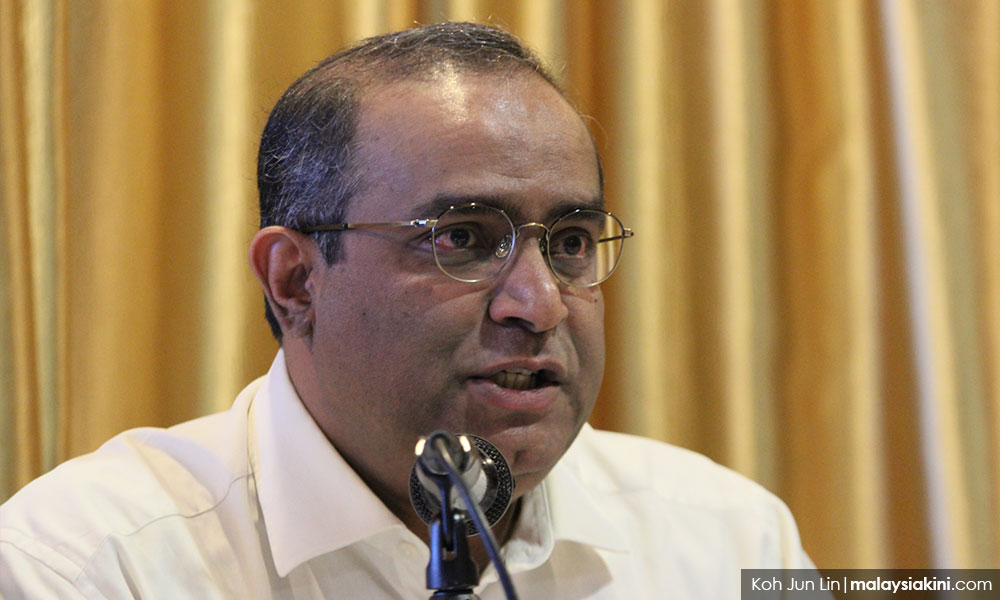
“Whoever comes to power must show the political will to institute these reforms. I hope Felda settlers themselves will hold the politicians accountable for what they have done, and demand these reforms.
“If they do not demand these reforms... then the crisis we have seen in Felda will be manifested in other GLCs too.
“We have already seen 1MDB and now we have seen Felda. I can assure you there are a whole range of other GLCs we can look at,” the economist Gomez added.
Can Harapan be trusted to deliver Felda reforms?
C4 executive director Cynthia Gabriel told Malaysiakini they had approached Gomez to conduct it after the latter launched his book Minister of Finance Incorporated, that highlights the centralisation of power under Najib’s regime.
She added study had then taken four months.
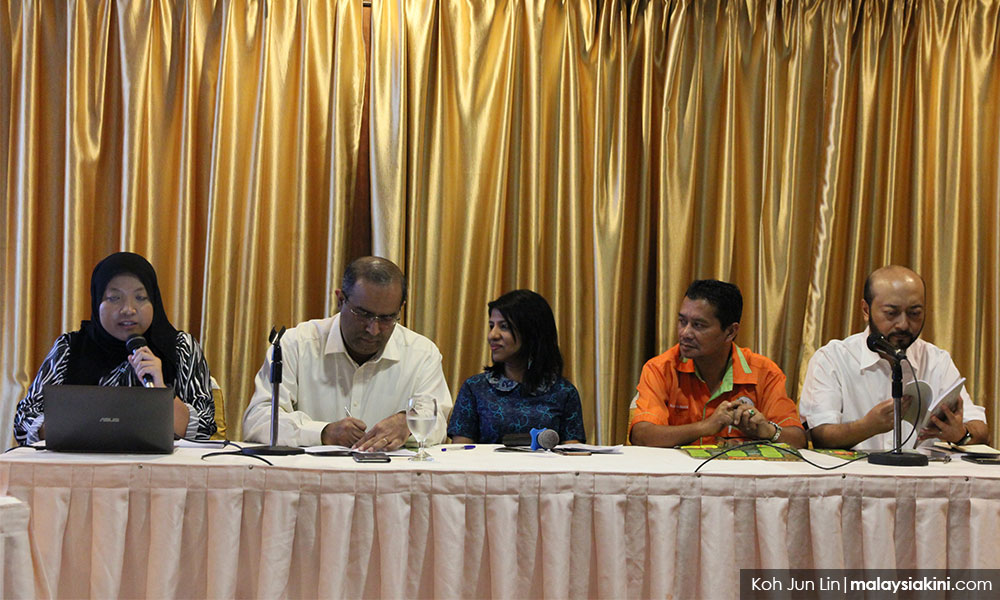
Gabriel (centre in photo) said the full 90-page report is still being finalised for publication next week, but booklets and posters summarising the issue have already been printed for distribution to raise public awareness, particularly amongst Felda settlers.
The Persatuan Anak Peneroka Felda (Anak) chairperson Mazlan Aliman had already committed to helping distribute thousands of copies of these posters and booklets, she said.
Also present at the briefing was Bersatu vice president Mukhriz Mahathir, who read out Pakatan Harapan’s manifesto commitments that pertain to Felda, including reforms.
However, a member of the press questioned how Harapan could be trusted to deliver the reforms as the trend of centralisation started with Yusof's appointment as Felda chairperson, at a time when Harapan chairperson Dr Mahathir Mohamad was prime minister.
To this, Mukhriz said he had asked Mazlan a similar question and was told there were no issues with Yusof's stewardship.
Confirming this, Mazlan said the issue was not whether a politician is helming Felda, but whether the leader has integrity.
This was vehemently objected to by Rahayu and Gomez, arguing that politicians ultimately report to their party leaders rather than shareholders and settlers.
Felda settlers form a significant voting bloc in Malaysian elections and are traditionally seen as a BN vote bank. However, Harapan is hoping to ride on the disgruntlement over low oil palm prices and alleged mismanagement of Felda to woo settlers for support.
Felda settlements are present in 54 out of 222 parliamentary constituencies, and its settlers reportedly form about nine percent of the voting population.


Report this comment
Are you sure you want to delete this comment?
This action cannot be undone.