




Battle for Jempol a sign if Malay tsunami will hit Negeri Sembilan
GE14 | An hour's drive from the capital of Seremban lies Jempol, the largest parliamentary seat in Negeri Sembilan. Jempol will serve as the barometer to gauge if a Malay tsunami would sweep through the state.
The parliamentary constituency comprises four state seats - Serting, Palong, Jeram Padang and Bahau. The voters' breakdown is 64 percent Malays, 23 percent Chinese, 12 percent Indians and one percent other ethnic groups.
Jempol has a total of 14 Felda district polling centers (PDM), the highest among the eight parliamentary seats in the state.
Amid the opposition's strong showing in the last general election, Umno managed to hold on to Jempol with a mere 6.9 percent vote majority, thanks to Felda votes.
GE14 | An hour's drive from the capital of Seremban lies Jempol, the largest parliamentary seat in Negeri Sembilan. Jempol will serve as the barometer to gauge if a Malay tsunami would sweep through the state.
The parliamentary constituency comprises four state seats - Serting, Palong, Jeram Padang and Bahau. The voters' breakdown is 64 percent Malays, 23 percent Chinese, 12 percent Indians and one percent other ethnic groups.
Jempol has a total of 14 Felda district polling centers (PDM), the highest among the eight parliamentary seats in the state.
Amid the opposition's strong showing in the last general election, Umno managed to hold on to Jempol with a mere 6.9 percent vote majority, thanks to Felda votes.
It was the first time BN's popular votes sank below the 60 percent mark since the seat was created in 1986.
Back then, when PAS was still a member of Pakatan Harapan's predecessor Pakatan Rakyat, it only managed to garner 5,359 votes in the 14 Felda PDMs in Jempol, whereas Umno received 18,794 votes.
This helped Umno strongman Mohd Isa Samad to retain the seat with a 8,614 vote majority. Isa is also the former Felda and FGV chairperson.
However, much has changed since then.
The rising cost of living, various Felda scandals and the fall of FGV shares coupled with the Dr Mahathir Mohamad-led Bersatu's presence, Felda votes are no longer considered a fixed deposit for BN.

A week before nomination day on April 28, a Felda-themed ceramah in Air Mawang, Johol, featuring Mahathir, drew a crowd of about 2,000.
Johol is a state seat under Kuala Pilah. The venue was about 40km from Jempol's town of Bahau.
Last-minute switch a hurdle for Bersatu man
As the campaign period entered its fourth day, Bersatu president Muhyiddin Yassin proclaimed that Harapan is confident of taking at least 20 Felda parliamentary seats.
Apart from Jempol, Bersatu would be contesting the Kuala Pilah parliament seat in Negeri Sembilan as well.
Bersatu is also fielding a candidate for the Palong state seat under Jempol. Whereas the other three state seats would be contested by its Harapan partners – Serting (Amanah), Jeram Padang (PKR) and Bahau (DAP).
On the eve of nomination day, Bersatu's Kuala Pilah division chief Kamarulzaman Kamdias (left in photo), who had prepared to contest the Kuala Pilah seat, was informed he would be fielded in Jempol instead, replacing the party's state chief and Jempol division head Baharuddin Ahmad.
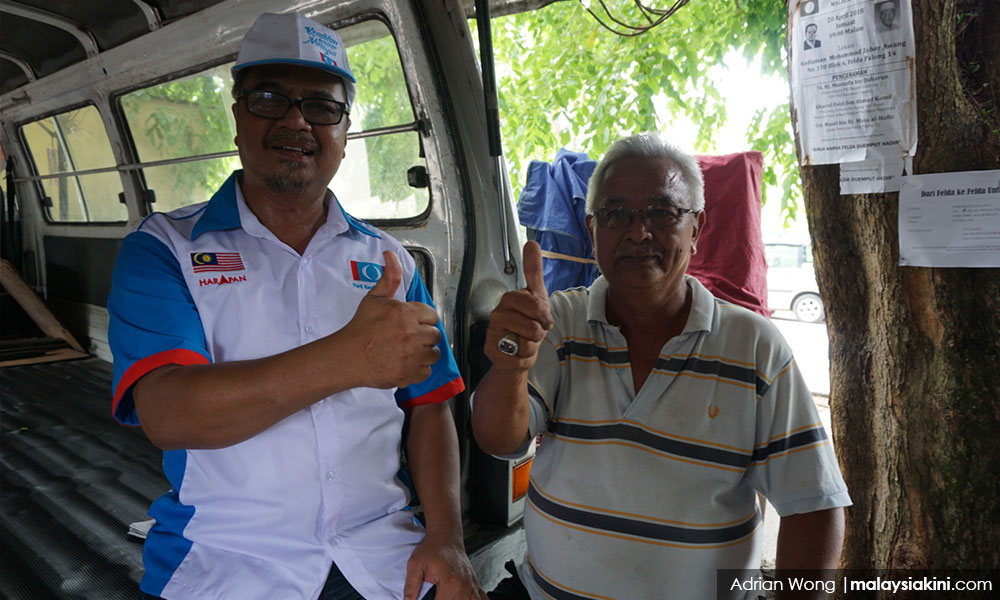
Seen as a "parachute" candidate, Kamarulzaman's first challenge was to crank up the local machinery following the last-minute switch, which has brewed discontent among the grassroots.
Baharuddin, who had been dropped from the candidates' list, appeared reluctant to campaign for Kamarulzaman as well.
Due to this, the candidate had to spend the first few days of campaigning firefighting instead of meeting voters.
Another challenge for Kamarulzaman is how to capture the voters' hearts and minds, especially Malay voters who value the personal touch, within the short period of time before May 9.
On the third day of campaigning, he visited the market at Palong 4 and introduced himself as the candidate. The reception was surprisingly warm.
After Kamarulzaman left, a 64-year-old vendor, who wanted to be known as "Pak Nga", revealed that he was a BN supporter in the past but decided to vote for Harapan in this GE.
He revealed that his son, despite having a degree, could not find employment under the current economic climate and was forced to take up a factory job in Johor.
“This government's policies are only for the rich... (caretaker prime minister) Najib (Abdul Razak's) way is useless... Now it's different, the opposition is strong," he told Malaysiakini.
Two other locals, a perfume vendor and a grocery shop worker, who declined to be named, also shared similar sentiments, complaining about the cost of living and how difficult it is to make ends meet.
The three are Palong voters. Palong 4 is a Felda settlement. In GE13, Umno gained 1,000 votes out of 1,404 votes in this PDM, whereas PAS only received 404 votes.
For the nine Felda PDMs under Palong, BN gained 11,023 votes and PAS 2,620.
Chinese-majority Bahau in the bag
During Kamarulzaman's walkabout in Palong, PAS Jempol candidate Mustaffa Daharun (right in photo) was also distributing leaflets and the party's manifesto at the same place. The two took a photograph.
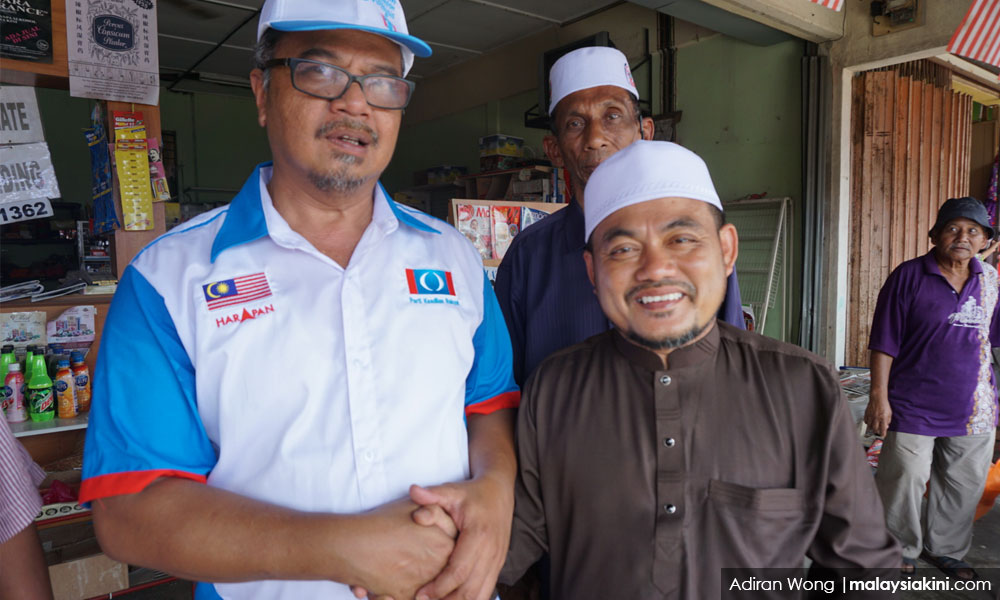
First time candidate Mustaffa, 45, is a local and teaches in a religious school. He has been working the ground since March.
In the last GE, PAS contested three parliamentary seats and 12 state seats in Negeri Sembilan but failed to win a single one. With many in the state having joined splinter party Amanah, PAS is unlikely to pose a serious threat to BN and Harapan.
Though it is uncertain how strong the opposition wind would blow in Palong, the Chinese-majority town of Bahau, is seen as being in Kamarulzaman's bag.
After Palong 4, Kamarulzaman headed to Bahau in the evening to attend a coffee shop talk with DAP leaders such as Lim Kit Siang, Seremban candidate Anthony Loke and Bahau candidate Teo Kok Siong.
Some 400 people packed the coffee shop and although most of them were there because of Lim, the Jempol candidate also received a rousing welcome.
In GE13, 10 PDMs in Bahau contributed close to 10,000 votes to PAS at the parliamentary level, which was twice as high for BN.
This time around, DAP is aiming for an additional 1,000 votes for Harapan.
Umno's candidate is no stranger to locals
On the other side of the fence is Umno candidate for Jempol, Mohd Salim Sharif, who was Isa's former political secretary and was involved in money politics during the 2005 Umno elections, which resulted in Isa being slapped with a three-year suspension.
In 2013, Mohd Salim (left in photo) took over as Jempol Umno division chief and was appointed senator a year later.
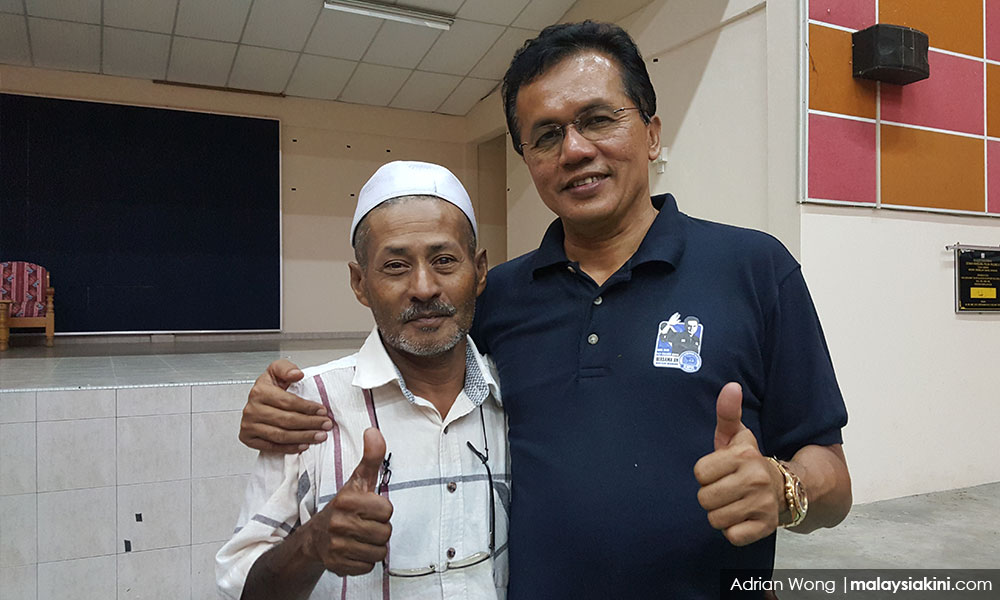
Even before being selected as the candidate, Salim had been engaging the voters and other BN component parties.
Salim has held various positions in several companies such as Tabung Haji Travel and Service and accounting system company ESPEK. He also owns the Bin Salim Curry House in Bahau.
Though making his election debut, Salim is not a stranger to the locals. Not taking things for granted, he continues to work the ground during the ongoing campaign period.
On the third day of the campaign period, Malaysiakini followed Salim's team to Palong 9 to meet with Felda settlers.
The event, themed as "Santai Orang Anak Muda", was organised by the Felda Youth Council of Malaysia (MBFM). BN's Palong candidate Mustapha Nagoor was also present.
During his speech, Salim, whose voice was hoarse due to the long campaign hours, stressed that BN had served Felda for years and its manifesto stated a promise to help the second generation of settlers.
Accusing the opposition of making false promises, he pledged to the youths that BN would walk the talk.
"We don't care about 1MDB, GST, because kampong folk don't feel these issues. The price of palm oil and vegetables are stable," he said.
Second generation Felda settler Sharizan Senem, who runs his own business, said the lives of settlers had seen vast improvements under BN.
"BN has changed my life. BN is able to change our fate," he told Malaysiakini.
Immediately after the event ended at 11.30pm, Salim rushed to Palong 11 to meet those working in BN's operations room.
Meanwhile when contacted, Salim denied Malay voters are swinging to the opposition.
"Malay support is returning to BN...Malay support is increasing.
"The new (BN) candidate is reaching the hearts and minds of the people.
"The people reject outsider (Pakatan Harapan) parliamentary candidates," he said.
Second generation voters
In the last GE, BN received 1,711 votes in Palong 9, 10, 11 PDMs, whereas PAS a mere 306 votes.
For this GE, Jempol has 72,264 voters. Of this, 43 percent are below the age of 40. In Palong and Serting, both Malay majority areas in which the opposition suffered massive defeats, the number of those below 40 is at 50 percent, most of them second generation settlers.
Unlike the first generation, the second generation of Felda settlers work in other places or run their own business.
This group, which is not as reliant on the government as the first generation, is also more connected vis-a-vis social media and therefore, more exposed to what is happening in the nation.
Some are also sore with the government due to the fall of the FGV shares.
And between the two generations, the grievances over economic hardship and the gratitude for government assistance in the past, lies the final outcome for the battle of Felda votes.


