




Detained on strength of mere suspicion
Dr Cecilia Ng Choon Sim was a university lecturer and women's rights activist. Brother Anthony Rogers of the La Salle mission was national director of the National Office for Human Development (NOHD) in the Catholic Welfare Services Malaysia.
For reasons still unknown to them, they were deemed to have had links with the underground communist movement circa October 1987 and detained under the Internal Security Act 1960 (ISA) during Operasi Lalang .
Dr Cecilia Ng Choon Sim was a university lecturer and women's rights activist. Brother Anthony Rogers of the La Salle mission was national director of the National Office for Human Development (NOHD) in the Catholic Welfare Services Malaysia.
For reasons still unknown to them, they were deemed to have had links with the underground communist movement circa October 1987 and detained under the Internal Security Act 1960 (ISA) during Operasi Lalang .
Ng, another academic Chee Heng Leng, Theresa Lim Chin Chin and Irene Xavier were - and still are - active in the women's rights or labour movement.
Spoofing their arrests later, friends dubbed them "the four most dangerous women in the country".
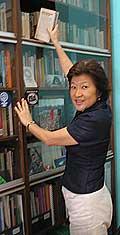 Ng, a soft-spoken retired University Putra Malaysia lecturer, made it clear at the outset of the interview that she was reluctant to talk about her experiences because "many people tend to romanticise detentions under the ISA".
"I don't like to be looked at as a 'somebody'. Seven months (in detention) was not a big deal compared with what happened to the others. Of course, I am still against the ISA . I am still against detention without trial," she says firmly.
Just before Operasi Lalang , she recalls, the Singapore government had carried out a series of crackdowns on dissidents under the security law.
"History told us that, whenever Singapore did so, Malaysia would follow suit. Those of us in non-governmental organisations prepared ourselves when rumours of a crackdown began spreading."
When the arrests began , Ng was evaluating a project in Jakarta. Ten days later, she returned to Kuala Lumpur. She was at the former office of the Women's Development Centre (now Collective) in Petaling Jaya, when five police officers came for her.
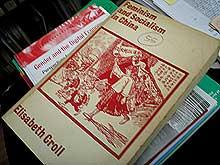 She was taken to her house which was searched for two hours. The officers confiscated "inflammatory books", but these were returned to her upon her release.
So why did she opt to return when she could have avoided arrest by staying out of the country?
"Why should I run away? I did nothing wrong and I did not want to seek political asylum. This is my country," she counters.
"The fear was there when I was arrested. If I say I was not scared, I would be lyingyou don't know what will happen to you (under these circumstances)."
Number, not name
The first 60 days in solitary confinement were the worst part of the detention. Held at an unknown location, she was put in a cell with no window or toilet.
"Until today, I don't know where I was detained," she says.
She was not physically abused but there was plenty of verbal abuse and implicit threats during the interrogations which were conducted around the clock.
"The Special Branch (usually) has a set of conspiracies (framed) and will try to fit you in this," she explains.
Asked to describe the days at the Kamunting detention camp where she was then sent, Ng unhesitatingly replies "It was very nice" before bursting into laughter.
She was in a dormitory with her three women friends and they were able "to see the blue sky and green grass".
 "It was difficult in the sense that you don't have freedom. At 8pm the door is closed, so you can't walk around. You have to bear with the order.
"You are alienated in a depressive environment...not treated as a human being. They (the warders) don't address you by your name but with a number."
To cope with life in detention, Ng says the detainees learnt yoga and meditation, read books and did gardening.
In June 1988, she was released together with Lim, but had to then serve out a Restricted Residence order for about two years.
Rogers' story
Rogers, also a social activist, had better 'luck' than Ng in that he remembers where he was held for interrogation after being picked up at the NOHD office in Jalan Bukit Nanas, Kuala Lumpur.
He was taken to the Sentul police remand centre (PRC), but the conditions immediately reminded him of the days of his early religious training in a monastery.
(PRCs are highly secret locations where ISA detainees are held for the first 60 days.)
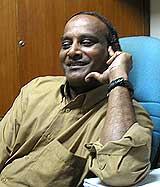 He jokes: "Because of my religious background, the prison never took away my freedom from me...what's the big deal-
lah
?"
He jokes: "Because of my religious background, the prison never took away my freedom from me...what's the big deal-
lah
?"
Accordingly, he used the time during detention to pray and for inward reflection.
"When I was in a cell, I told myself 'Very good, at least I have shelter, food and clothing'. You know, not every Malaysian has a blanket."
Sadness, rather than anger, was the overwhelming emotion.
"I was not frightened, but very sad. The ISA is inhumane as it creates fear. Fear is not a positive human quality. My sense of the matter is that the ISA is a manifestation of the internal insecurity of the authorities," he says.
'I repeatedly asked myself: Why do those in authority want to put these people in jail when all they want to do is make the country better? The ISA dehumanised the officers as well. Who wants a mother or father (whose job is) to instil fear all the time?"
Recalling his nine months in Kamunting, Roger says he experiences "real Malaysian life".
 "We (detainees) got along very well. I even prayed with the so-called Islamic extremists from PAS. We played badminton, played the guitar and did gardening, and shared food whenever someone's family members came for a visit."
Over-arching the days was the defiant knowledge gained by detainees that "no one can make us prisoners".
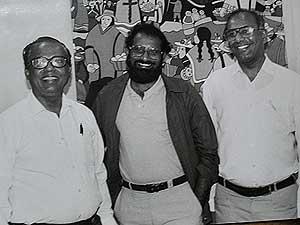
Rogers was released in August 1988 and welcomed back by friends who had been anxious about his safety ( photo).
Inner faith
Today, both Ng and Rogers remain active in social development work targeted at the public good.
As Ng puts it: "If you believe in something, you have to accept the consequences. My idea of freedom is pursuing what is right, including justice for the common good. I don't see this as a personal sacrifice, but as part of a struggle."
Rogers' view is equally forceful: "Putting you in jail does not mean that you lose your freedom...a prison could never take away your freedom."
Their convictions, no doubt, have kept them strong and kept them going.


