


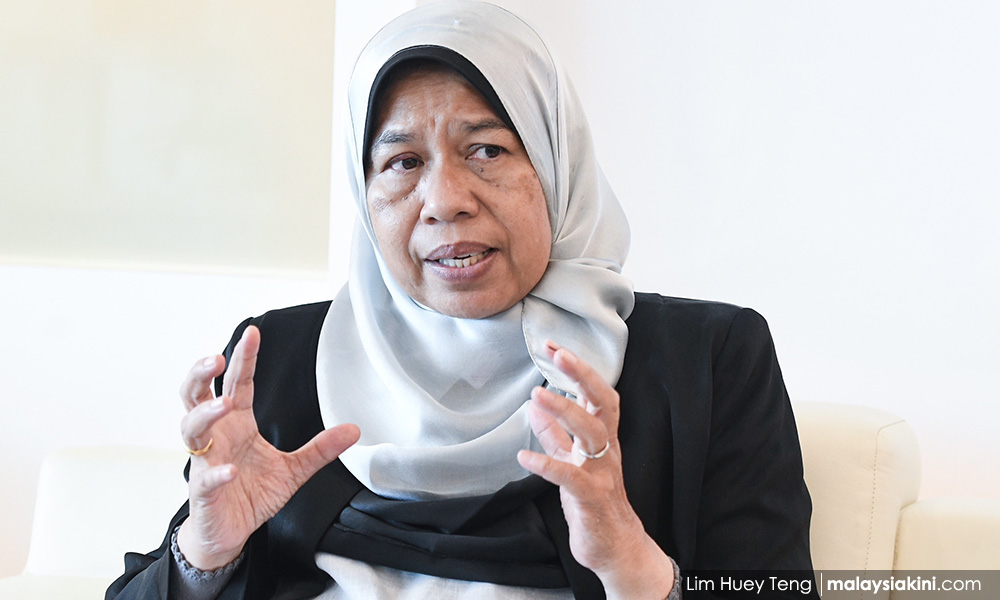

Zuraida targets nationwide plastic bag ban within a year
INTERVIEW | Newly appointed Housing and Local Government Minister Zuraida Kamaruddin has set her sights on banning plastic bags around the country within the space of a year.
However, as she said in an interview with Malaysiakini, the government can only introduce such a policy when the people understand the rationale behind the move.
Zuraida believes that awareness levels are still low, despite Kuala Lumpur, Putrajaya, Selangor, Malacca and Johor enforcing their own bans on petroleum-based plastic bags.
"Even then, the awareness and the understanding of the reason why (the government) wants to do it is very low.
"Malaysians still have the attitude of wanting everything so easy, they want to have plastic bags so they can bring their items home," she said.
As such, Zuraida’s priority is to educate the public before introducing the policy nationwide.
"Give us time to have public engagements and educational programmes.
"In terms of no plastic bags, people have heard about it, a few states have started it. Maybe it can be implemented faster.”
Asked how soon a plastic bag ban can be expected, she said: “Give me like within a year”...
INTERVIEW | Newly appointed Housing and Local Government Minister Zuraida Kamaruddin has set her sights on banning plastic bags around the country within the space of a year.
However, as she said in an interview with Malaysiakini, the government can only introduce such a policy when the people understand the rationale behind the move.
Zuraida believes that awareness levels are still low, despite Kuala Lumpur, Putrajaya, Selangor, Malacca and Johor enforcing their own bans on petroleum-based plastic bags.
"Even then, the awareness and the understanding of the reason why (the government) wants to do it is very low.
"Malaysians still have the attitude of wanting everything so easy, they want to have plastic bags so they can bring their items home," she said.
As such, Zuraida’s priority is to educate the public before introducing the policy nationwide.
"Give us time to have public engagements and educational programmes.
"In terms of no plastic bags, people have heard about it, a few states have started it. Maybe it can be implemented faster.”
Asked how soon a plastic bag ban can be expected, she said: “Give me like within a year.”
Going plastic-free
Penang was the first to start the ‘no free plastic bags’ policy in July 2009, by charging 20 sen for each plastic bag on Mondays.
This was later extended to three days (Monday to Wednesday) the next year, followed by a total ban in 2011. The state has also banned the use of polystyrene food containers.
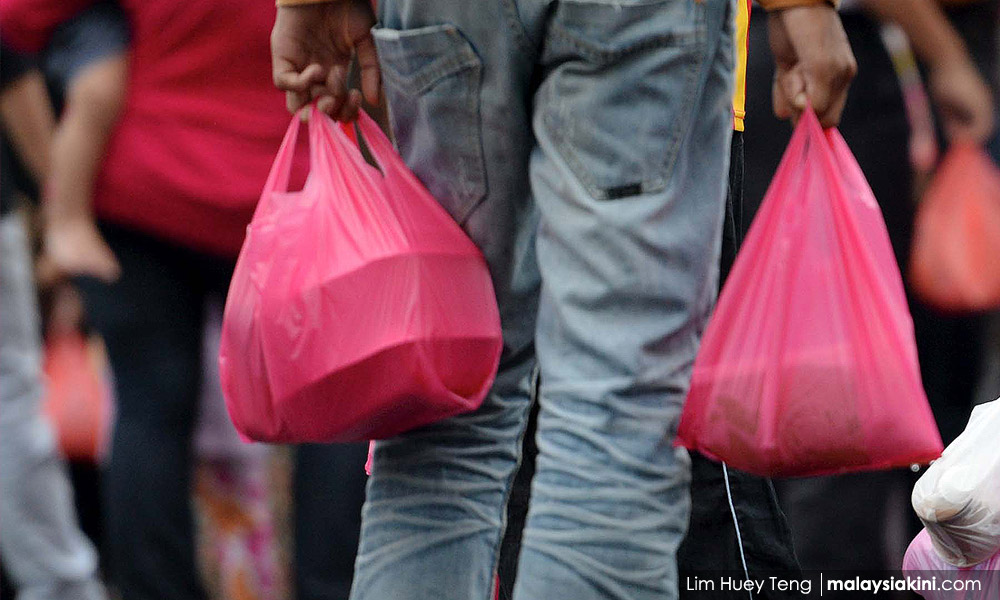
Selangor implemented a similar ruling for Saturdays in 2010, also making consumers to pay 20 sen per plastic bag.
The state moved to ban all retailers from providing polystyrene containers and free single-use plastic bags in January last year.
Putrajaya was the next to adopt the policy for Saturdays in 2011.
At the end of 2015, Malacca instituted a total ban on petroleum-based plastic bags, after initial bans for Fridays and Saturdays.
Johor followed suit in July last year.
Negeri Sembilan refused to impose a similar ban, fearing that the policy would burden the rakyat.
Perak put its plan for a ban on plastic bags and polystyrene containers on hold in June 2017, citing the need to come up with a “correct alternative” first.
Implementing the ban
Despite the efforts of various local authorities to enforce the ban in their jurisdictions, some retailers have reverted to using petroleum-based plastic bags, which are generally cheaper than biodegradable alternatives.
The Star reported earlier this year that the Kuala Lumpur City Hall found that less than 20 percent of eateries were abiding by the ruling.
According to Zuraida, Malaysia has many green initiatives lined up – such as those adopted in developed countries – but is hamstrung in terms of implementation and public readiness.
"It’s too bad. In terms of programmes, in terms of adaptation, in terms of adoption of these programmes compared to other countries, we are there, we are number one.
"But in terms of implementation, in terms of our readiness, in terms of the capacity of the people, we are not there yet," she said.
Zuraida stressed that the government has to conduct more awareness programmes to drive the message home.
While carrying out these programmes, she added, the ministry will gauge acceptance levels to see if the public is ready for new environmentally-friendly policies.
"We will monitor how much the community understands these programme and projects. Once we reach the level of at least 50 percent or 60 percent (readiness), then we can implement it successfully, and the rest will follow."
READ MORE


Are you sure you want to delete this comment?
This action cannot be undone.