



HSR project deferred to 2020, Putrajaya to foot RM45m bill
Malaysia and Singapore have inked a deal marking their agreement to defer the KL-Singapore High Speed Rail (HSR) project until May 31, 2020.
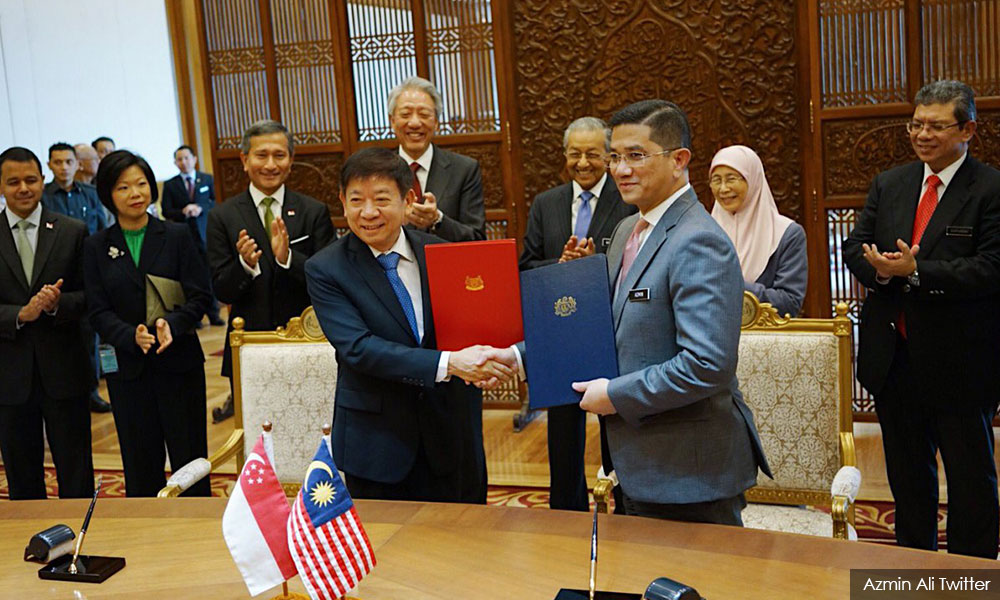
In a ceremony held at the Prime Minister's Office in Putrajaya today, the side-letter was signed by Malaysia’s Economic Affairs Minister Azmin Ali and Singapore’s Transport Minister Khaw Boon Wan...
.
Malaysia and Singapore have inked a deal marking their agreement to defer the KL-Singapore High-Speed Rail (HSR) project until May 31, 2020.
In a ceremony held at the Prime Minister's Office in Putrajaya today, the side-letter was signed by Economic Affairs Minister Azmin Ali and Singapore’s Transport Minister Khaw Boon Wan.
This was witnessed by Prime Minister Dr Mahathir Mohamad and Singapore's Deputy Prime Minister Teo Chee Hean.
Also present were Deputy Prime Minister Wan Azizah Wan Ismail and Transport Minister Anthony Loke.
The signing followed a series of discussions between Putrajaya and Singapore to review the project, which was deemed too costly by the new Malaysian government.
At a joint press conference later, Khaw said the agreement was made in bilateral spirit between the two neighbouring countries.
RM45mil for 'abortive costs'
Khaw also said that Malaysia will bear the deferment costs, which Azmin revealed to be around S$15 million (RM45.1 million).
The Singapore minister explained that when a project is suspended or canceled, abortive costs have to be paid as some contractors have a built-in breakage of terms.
He added that the suspension would also incur costs as works to divert utilities had been carried out, and these works could not just be left incomplete.
Azmin told reporters that both countries have agreed the abortive costs payment must be paid by the end of January 2019, and thanked Khaw for "letting us have this opportunity to prepare and make payment".
Khaw, who is also Singapore’s coordinating minister for infrastructure, added that Malaysia would have to bear the costs incurred by the republic for the project should Malaysia decide to cancel it after the two-year deferment period.
To a question on the amount that Malaysia would have to pay in the event the project is cancelled, Azmin said he did not want to jump to conclusions as both governments had expressed their commitment to resuming the project after the postponement.
Singapore understands
In saying that Kuala Lumpur was a "sweet spot" for HSR project and that many Singaporeans were looking forward to its realisation, Khaw said that the republic however understood why Malaysia wanted to suspend it temporarily.
"So, even though HSR bilateral agreement has no provision for such a suspension, but in the spirit of bilateral cooperation, Singapore has given Malaysia fair consideration.
"After several rounds of discussion, we have reached a fair agreement going forward, and today we exchanged documents to finalise our agreement of suspension," Khaw said.
He also expressed appreciation to companies which had actively participated in the project so far, and hoped to work with them again when HSR construction is resumed.
'M'sia spared from forking out RM120b'
On the sidelines of the press conference, Azmin's aide Yin Shao Loong said the deal to defer HSR meant the end of economic burden brought by the project for the next two years.
"It's a wrap on the HSR. So far, only two men have had the calibre to free Malaysia from economically burdensome deals struck by Najib (Abdul Razak) - Mahathir with the ECRL and Azmin with the HSR.
"With today's joint signing of a bilateral side letter with Singapore, Azmin has spared Malaysia from the burden of a financial commitment of RM120 billion over the next two years," said Yin.
Reintroduced by the previous BN-led administration under the leadership of Najib in 2010, HSR was part of a plan to cut travel time between the two cities and also aimed at spurring economic growth along its route.
It was estimated then that the project would cost RM72 billion.
The Pakatan Harapan administration had been trying to scrap the project since it came into power in May, after estimating that the total cost for HSR was closer to RM120 billion with interest factored in.
It was learnt that the RM120 billion cost include a roughly RM55 billion capital expenditure for the core project, RM65 billion in government guarantees for train procurement, maintenance and train systems maintenance over 30 years.


