


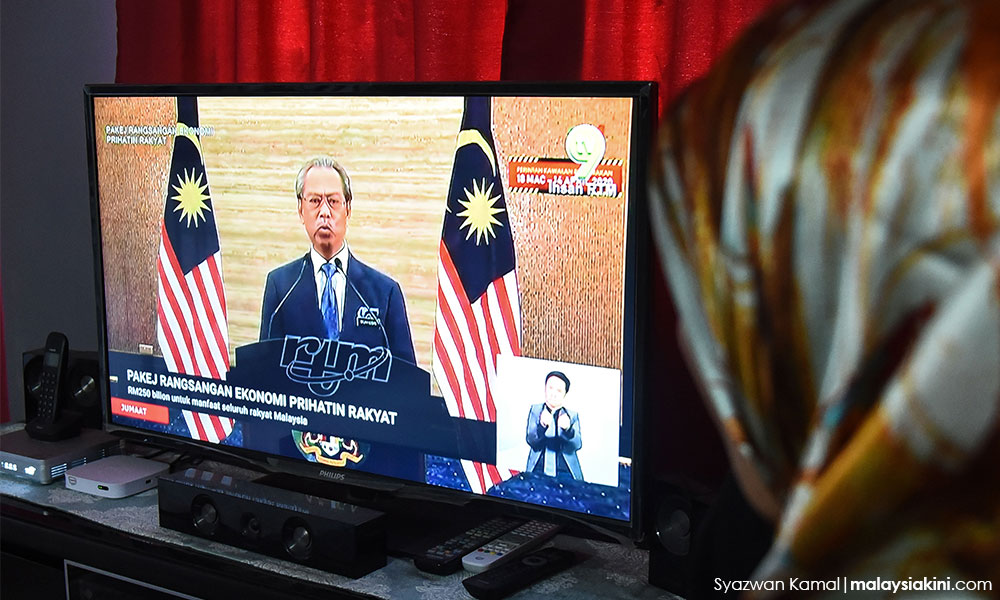

Focus on maintaining employment in stimulus package, gov't urged
CORONAVIRUS | The Malaysian government has been urged to emulate Singapore, the UK and Australia in focusing more on employment sustainability in the economic stimulus package meant to alleviate the effects of the Covid-19 pandemic.
Research for Social Advancement (Refsa), a think thank, has unveiled a working paper comparing the stimulus measures across Malaysia, Singapore and the UK and noted the main difference lies in the focus of Malaysia’s package compared with Singapore and the UK.
CORONAVIRUS | The Malaysian government has been urged to emulate Singapore, the UK and Australia in focusing more on employment sustainability in the economic stimulus package meant to alleviate the effects of the Covid-19 pandemic.
Research for Social Advancement (Refsa), a think thank, has unveiled a working paper comparing the stimulus measures across Malaysia, Singapore and the UK and noted the main difference lies in the focus of Malaysia’s package compared with Singapore and the UK.
As the economic consequences of the Covid-19 pandemic are becoming clearer, nations around the world are quickly introducing stimulus packages for their countries, said Refsa.
From the research process, the think tank said most countries appear to have abandoned the idea of fiscal prudence for now as policy measures from countries including Singapore, the UK and Australia have been generous on job support.
“We recommend that the government immediately set up a wage support scheme, designed to protect the income of workers in the private sector, that offsets part of the cost to the employer through cash grants.
“The percentage offset by the government can vary according to the sector, as well as duration, but we recommend a duration long enough to see businesses through the worst of the crisis and enable them to build up a sound financial position again.
“Given the stricter measures in Malaysia, the size of this measure should be significantly bigger than in Singapore. Instead, the aid to the economy, especially small businesses, is the least among the nations,” said Refsa executive director Tan E Hun in a statement today.
Malaysia is currently in its third week of the movement control order (MCO) and it is uncertain whether it will be extended again past April 14.
Refsa said it has been reported that a majority of SMEs, which makes up 98.5 percent of Malaysian businesses, foresee zero cash inflow for at least the coming three months, while other think tanks have estimated some 2.4 million jobs could be lost, of which 67 percent are unskilled workers.
“The key objective for a stimulus package in today’s context should be to make up for the lost income of workers and revenue of businesses and to safeguard future production capacity.
“The most straightforward way to achieve this is to maintain employment. Maintaining employment and levels of income during the MCO and beyond would allow the economy to quickly return to baseline production once the Covid-19 pandemic subsides,” said Tan.
In the report’s qualitative comparison, Refsa found that the movement restrictions enacted in Malaysia are the strictest compared to Singapore and the UK and is likely to have the biggest impact on the national economy.
They also found that the Singapore and the UK packages focus mainly on companies and preservation of employment, while the Malaysian package focuses on maintaining household incomes.
Singapore has improved its co-funding of wages from the beforehand introduced eight percent to 25 percent for each Singaporean employee in employment, as much as a month-to-month wage cap of S$4,600.
The earlier month-to-month wage cap was S$3,600.
The UK has a grant to cover 80 per cent of a furloughed employee’s salary for three months up to £2,500.
Malaysia only provides a RM600 wage subsidy for each worker earning less than RM4,000 for three months, provided the business reports at least 50 percent loss in revenue, Refsa also noted.
Malaysia announced its MCO on March 18 and it is expected to end on April 14. However, Federal Territories Minister Annuar Musa has hinted that it may be extended beyond April 14.
Keep up with the latest information on the outbreak in the country with Malaysiakini's free Covid-19 tracker.
Malaysiakini is providing free access to the most important updates on the coronavirus pandemic. You can find them here.
Help keep independent media alive - subscribe to Malaysiakini.


Report this comment
Are you sure you want to delete this comment?
This action cannot be undone.