




Covid-19 infectivity dips back below sustained outbreak level
CORONAVIRUS | Covid-19 infectivity in Malaysia has dipped back below levels needed to sustain an outbreak, following the emergence of several large clusters over the past month.
According to Health Ministry director-general Dr Noor Hisham Abdullah, the daily estimate for the disease’s effective reproduction number (Rt) has dropped below the crucial threshold of 1.00 since Aug 1...
CORONAVIRUS | Covid-19 infectivity in Malaysia has dipped back below levels needed to sustain an outbreak, following the emergence of several large clusters over the past month.
According to Health Ministry director-general Dr Noor Hisham Abdullah, the daily estimate for the disease’s effective reproduction number (Rt) has dropped below the crucial threshold of 1.00 since Aug 1.
“Current update on the number of active cases and daily R0-, or more precise we call it Rt-, as of today we managed to bring down the R0/Rt from 1.36 to less than 1.0 from Aug 1, and yesterday was 0.78,” he said in a Facebook post today.
The reproduction number (R) is an estimate on the average number of people who would catch a disease from each existing infected person.
A figure of 0.78 would mean that, on average, each infected person is passing on the disease to 0.78 people. The figure can be influenced by the contagiousness of the disease itself, as well as environmental factors such as whether social distancing is practised.
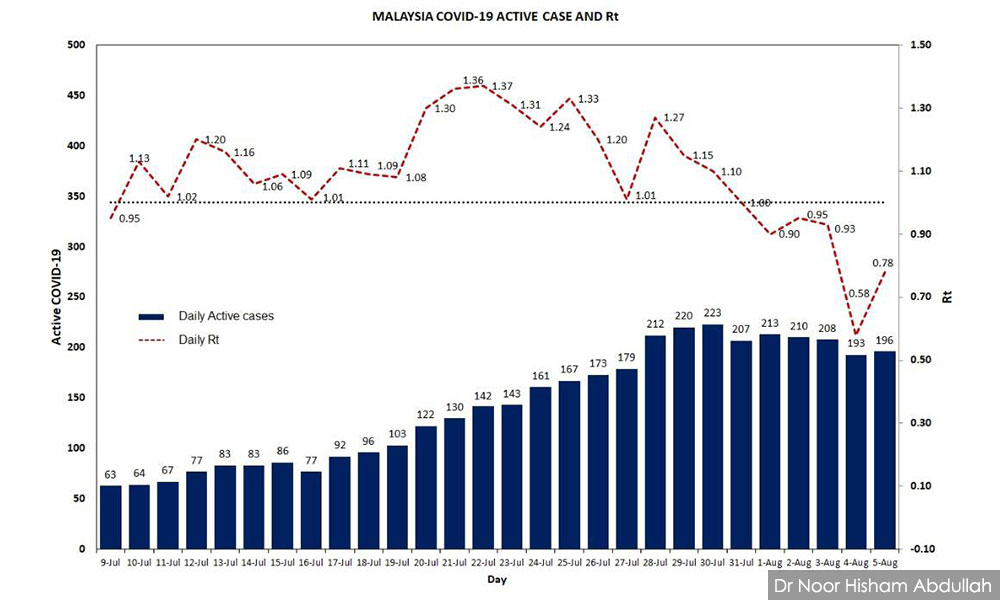
A figure below 1.00 is regarded to be insufficient to sustain an outbreak, and the disease would eventually be eliminated from the population if it remains below the threshold for a prolonged period of time.
The R0 for Covid-19 in Malaysia was 3.55 prior to the implementation of the movement control order in March, meaning that the disease was spreading exponentially through the population.
The figure fell to just 1.00 by early-April, and down to just 0.3 by mid-May.
On July 23, however, Noor Hisham sounded the alarm that the R0 has crept back up to 1.36 following outbreaks in Sarawak and other places, and warned that Malaysia could see a surge in Covid-19 cases if the figure hits 1.6.
The government has since reintroduced mandatory institutionalised quarantine for overseas returnees and made the wearing of face masks mandatory in crowded public places.

For the record, R0 and Rt are terms used by epidemiologists to describe the infectivity of a disease, but the basic reproductive number (R-nought, or R0) assumes a population that is completely susceptible to a disease.
This would be the case for emerging diseases for which there is no existing natural immunity or vaccine.
In contrast, Rt accounts for people who become unsusceptible to the disease such as through a previous infection or vaccination.
The latter is closer to real-world conditions and is generally lower than R0.





Report this comment
Are you sure you want to delete this comment?
This action cannot be undone.