



Right-wing groups pan MACC’s Chinese-language site
The MACC’s newly-launched Chinese-language website has drawn criticism from Bersatu Youth, Parti Bumiputera Perkasa Malaysia (Putra), and Ikatan Muslimin Malaysia (Isma), which claimed that the move sidelines Bahasa Malaysia’s constitutional position as the national language.
Bersatu Youth information chief Mohd Ashraf Mustaqim Badrul Munir said of the MACC's Mandarin website that as a government agency, Bahasa Malaysia should...
The MACC’s newly-launched Chinese-language website has drawn criticism from Bersatu Youth, Parti Bumiputera Perkasa Malaysia (Putra), and Ikatan Muslimin Malaysia (Isma), which claimed that the move sidelines Bahasa Malaysia’s constitutional position as the national language.
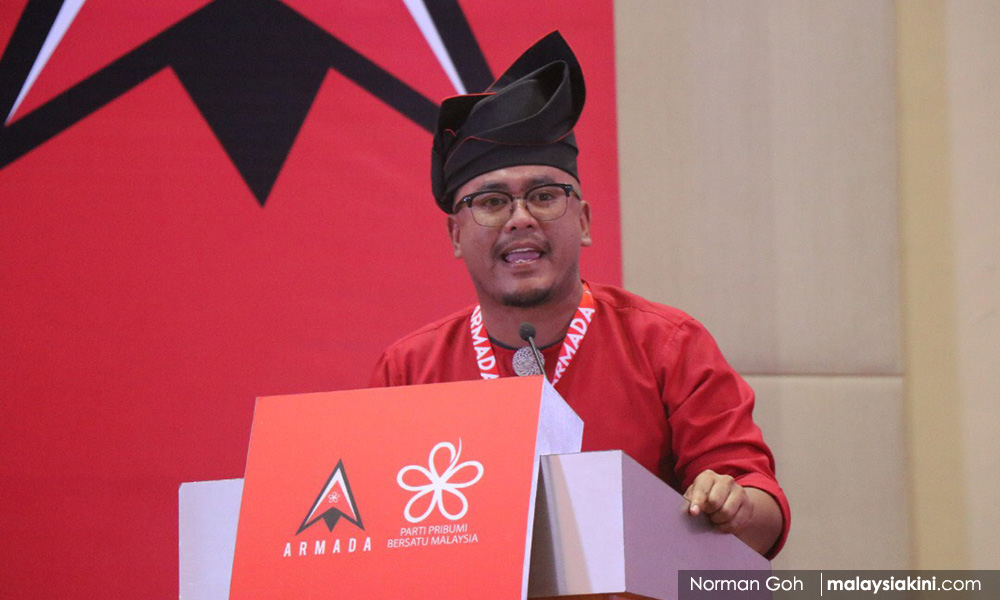
Bersatu Youth information chief Mohd Ashraf Mustaqim Badrul Munir (above) said of the MACC's Mandarin website that as a government agency, Bahasa Malaysia should be prioritised in all its dealings, including public communication.
“Although Section 3 of the National Language Act 1963/69 enacted 57 years ago allows documents and official statements to be translated, it is saddening that a government institution like the MACC is forced to use Mandarin in its communications 63 years after independence.
“Is it that 63 years after Merdeka, comprehension of the Malay language amongst citizens is still so poor that a government portal has to be translated into Mandarin?” he said in a statement today.
Ashraf said the MACC should double down on its use of Bahasa Malaysia instead and work with Dewan Bahasa dan Pustaka to do so.
This is unless the new portal is aimed at netizens from China he said, but even then, English is a better option because it is more widely understood. For the record, the MACC already has an English-language portal.
“Bersatu Youth calls on the MACC to review the Mandarin portal so that it is in line with the national moral responsibility to strengthen Bahasa Melayu as a unifying tool,” he said.
Meanwhile, The Star reported that Putra vice-president Mohd Khairul Azam Abdul Aziz claimed it is unconstitutional for a government agency to undermine the national language, and demanded that the new website be taken down.
"MACC is a government agency. It is mandatory for government agencies to apply the national language in official communications, as enshrined in Article 152 of the Federal Constitution, read together with Section 2 of the National Language Act 1963/67," he said.
He claimed that this might give rise to a demand for similar portals in “Tamil, Telegu, Jawa, Iban, Kadazan, and Orang Sungai and others”.
"What happened to the policy of using the national language as the language of unity among multi-ethnic Malaysians?" he said.
For the record, Article 152(1) of the Federal Constitution stipulates that the Malay language is the national language, but no one shall be prohibited or prevented from teaching or learning any other language.
It further states that this clause shall not prejudice the right of the federal or any state government to “preserve and sustain the use and study of the language of any other community in the Federation”.

Meanwhile, Isma president Aminuddin Yahaya (photo) asked whether the launch of the website meant that many Chinese Malaysians could understand neither Malay nor English languages.
“It this is true, we should think back where we have gone wrong in trying to shape a Malaysian community based on a national identity?” he said.
“Not only they don’t understand, the government had to fork out money to provide amenities to understand something in their mother tongue,” he said in a Facebook post.
In that vein, Aminuddin reiterated his support for single-stream schooling, claiming that vernacular schools cause large segments of society to become “trapped” in their own ethnic bubbles.
He said ethnic bubbles can be seen when Chinese-language posters are put up in the Chinese-majority areas of Sabah for the ongoing state election.
The MACC’s Chinese-language site was launched earlier today by its Deputy Chief Commissioner (Prevention) Shamshun Baharin Mohd Jamil.
“With this latest facility, it is hoped that it will further increase the confidence and knowledge of the Chinese community towards the MACC and the anti-corruption agenda, as well as disseminate the message of anti-corruption education," MACC said in a statement.






Are you sure you want to delete this comment?
This action cannot be undone.