



Some Covid-19 patients infectious far longer than others, researchers warn
COVID-19 | A group of researchers has warned that certain Covid-19 patients may remain infectious for months longer than typical patients.
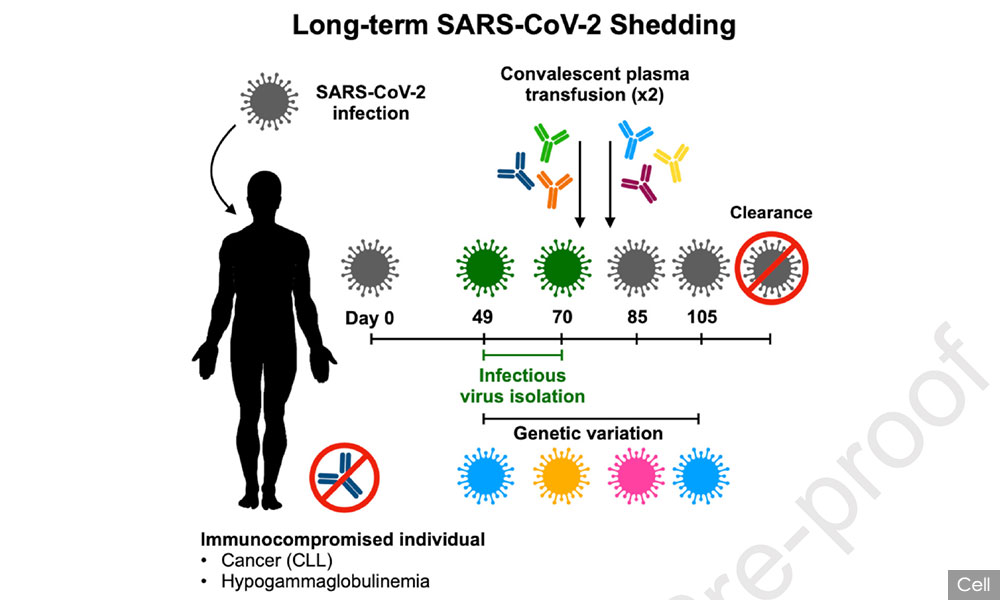
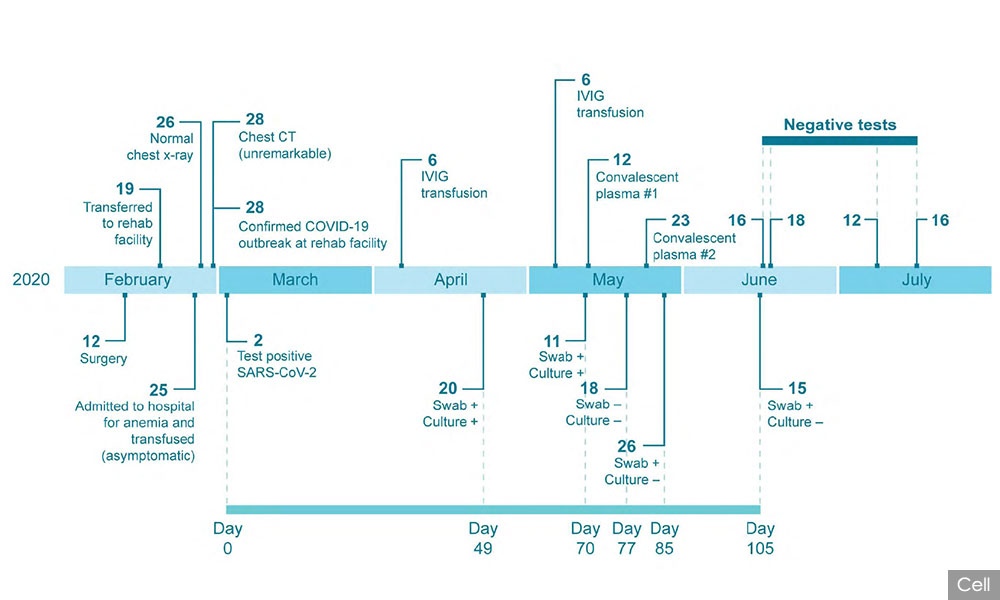
They reported a case study where a patient in Washington state in the US who tested positive for the disease on March 2 and was found to still be shedding infectious viral particles for up to 70 days (May 11)...
COVID-19 | A group of researchers has warned that certain Covid-19 patients may remain infectious for months longer than typical patients.
They reported a case study where a patient in Washington state in the US who tested positive for the disease on March 2 and was found to still be shedding infectious viral particles for up to 70 days (May 11).
She also continued to test positive on reverse transcription-polymerase chain reaction (RT-PCR) tests up to June 15 (Day 105), although she did not appear to be infectious by then. She did not show Covid-19 symptoms throughout the course of her infection.
The 71-year-old woman has a 10-year history of chronic lymphocytic leukaemia (a type of cancer), which has crippled her immune system.
“Although it is difficult to extrapolate from a single patient, our data suggest that long-term shedding of infectious virus may be a concern in certain immunocompromised patients.
“Given that immunocompromised patients could have prolonged shedding and may not have typical symptoms of Covid-19, symptom-based strategies for testing patents and discontinuing transmission-based precautions, as recommended by the (US Centers for Disease Control), may fail to detect whether certain patients are shedding infectious virus,” the researchers wrote.
The study has been accepted for publication on the journal Cell. A pre-publication draft has been made available online on Nov 4.
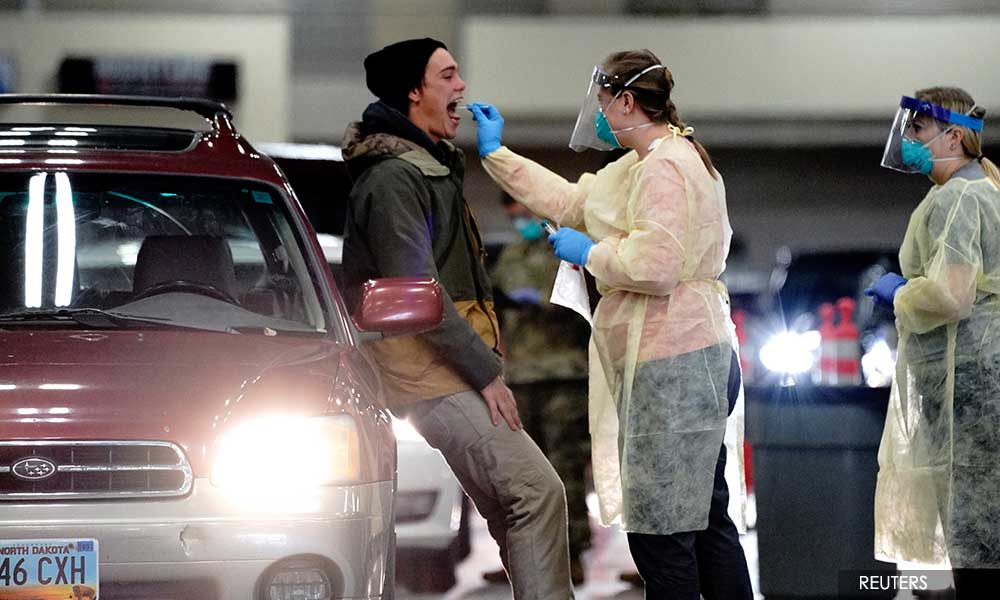
For the record, RT-PCR tests are considered the gold standard for diagnosing Covid-19 patients, but the test cannot distinguish between ‘live’ infectious viral particles and genomic fragments of the virus that are no longer infectious.
To determine whether the sample taken from the patient was still infectious, researchers have deliberately exposed animal cells grown on a petri dish to the sample and waited to see if an infection takes hold.
The process is laborious and required the use of laboratories with more stringent safety protocols and facilities than those used for diagnostic testing.
For further confirmation, the authors of the paper also used scanning and transmission electron microscopy on the viral particles isolated from the petri dish, which was found to be consistent with the novel coronavirus.
Previous studies had found that Covid-19 patients usually become infectious two to three days before symptoms appear, and the infectivity declines within seven days after the onset of symptoms. This is despite patients continuing to test positive long after they have recovered.
The data on immunocompromised Covid-19 patients are more limited but are thought to be infectious for no more than 20 days after the onset of symptoms.
In light of this, many health authorities have amended treatment guidelines to allow patients to be discharged after about two weeks after testing positive or after the onset of symptoms.
In Malaysia, for example, the latest edition of its clinical guidelines stipulates that patients who have Covid-19 symptoms may be discharged after at least 10 days have passed since the onset of symptoms, provided that the symptoms have resolved.
Those who never experience symptoms over the course of their infection will be discharged 10 days after they first test positive.
The discharge criteria for both types of patients are in line with World Health Organization recommendations, which were published on May 27.
For immunocompromised Covid-19 patients, however, Malaysia’s Health Ministry protocols stipulate the discharge of such patients should be evaluated on a case-by-case basis.
The authors of the new paper urged hospitals to take a “more nuanced” approach to test immunocompromised individuals for Covid-19 and said more research needs to be done to identify additional cases of persistent Covid-19 infection.
As for the patient mentioned in the study, the authors also reported she was treated with plasma donated by recovered Covid-19 patients, on Day 71 and Day 82 of her infection.
“Despite two transfusions of convalescent plasma, nasopharyngeal swabs at Day 85 and 105 remained positive for both genomic-RNA and subgenomic-RNA, suggesting that the convalescent plasma therapy was not successful in rapidly clearing the infection from the upper respiratory tract in this patient.
“Although the presence of subgenomic-RNA at these timepoints suggests active viral replication, infectious SARS-CoV-2 could not be cultured after Day 70,” they wrote.
The researchers also reported that the virus population within the patient was continuously changing and evolving, in contrast to typical infections where there is a limited genetic variation of the virus within an individual’s body.
This was despite the patient being kept alone in an isolation ward since testing positive for Covid-19, thus have no further contact with the virus apart from those already in her body.
“Potential factors contributing to the observed within-host evolution is the prolonged infection and the compromised immune status of the host, possibly resulting in a different set of selective pressures compared to an immune-competent host.
“These differential selective pressures may have allowed a larger genetic diversity with a continuous turnover of dominant viral species throughout the course of the infection,” they said.
Despite these changes, the researchers reported that the virus’ behaviour did not change significantly compared to the Covid-19 strain involved in the outbreak in Washington state early this year.
The patient, meanwhile, did not fully clear her infection until June 16, which was the 105th day after she tested positive. She tested negative for four consecutive times from that date until July 16.




Are you sure you want to delete this comment?
This action cannot be undone.