



New CMCO rules: Dine-in limit lifted, new restrictions for sports, meetings
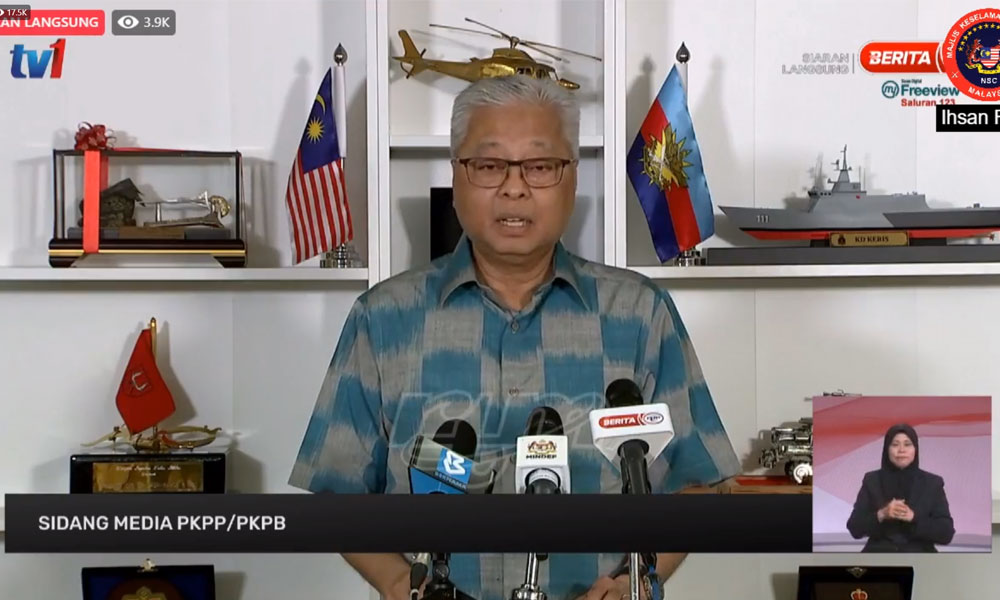
The National Security Council has issued a set of new rules for areas under conditional movement control order (MCO) that would see table seating capacity limits lifted for dining in restaurants.
However, new restrictions are being imposed on meetings and non-contact sports.
According to the conditional MCO rules, restaurants and eateries may...
The National Security Council has issued a set of new rules for areas under conditional movement control order (MCO) that would see table seating capacity limits lifted for dining in restaurants.
However, new restrictions are being imposed on meetings and non-contact sports.
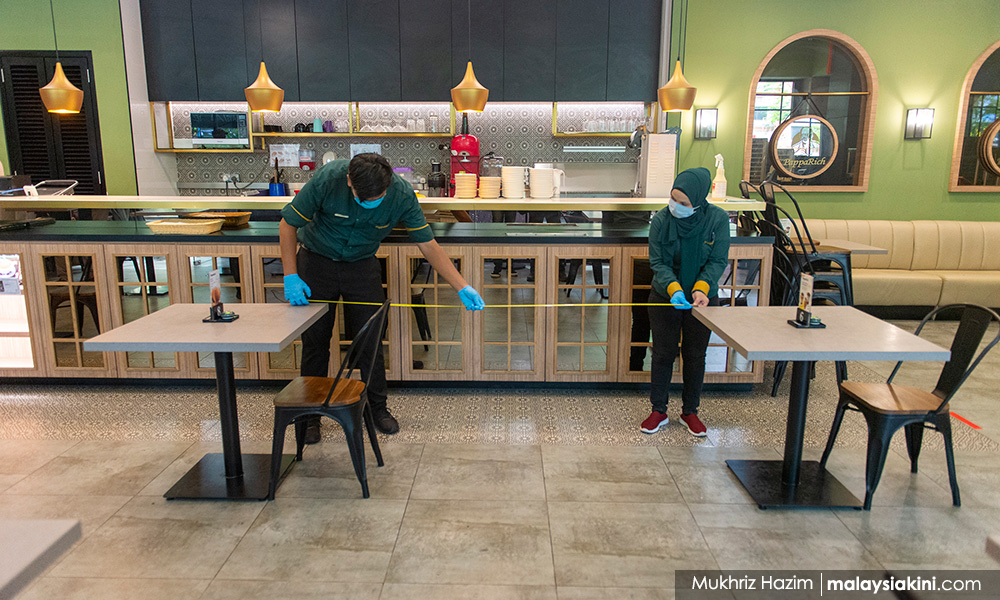
Under previous conditional MCO rules, restaurants may cater to dine-in customers, but must limit each table to two to four patrons and maintain social distancing of at least one metre.
With the new rules, the restaurants must still ensure patrons maintain social distancing, but there is no longer a limit on how many can be seated around each table.
The rule is unchanged for places under the recovery MCO, which already allow restaurant tables to seat as many customers as the one-metre rule can accommodate.
The change comes as the government lifted the ban on inter-district and inter-state travel nationwide, except for areas under enhanced MCO, beginning today.
The government has also ended the conditional MCO in most places beginning today, saying that it costs the economy RM300 million per day to maintain the MCO.
Study warns of restaurants' Covid-19 risk
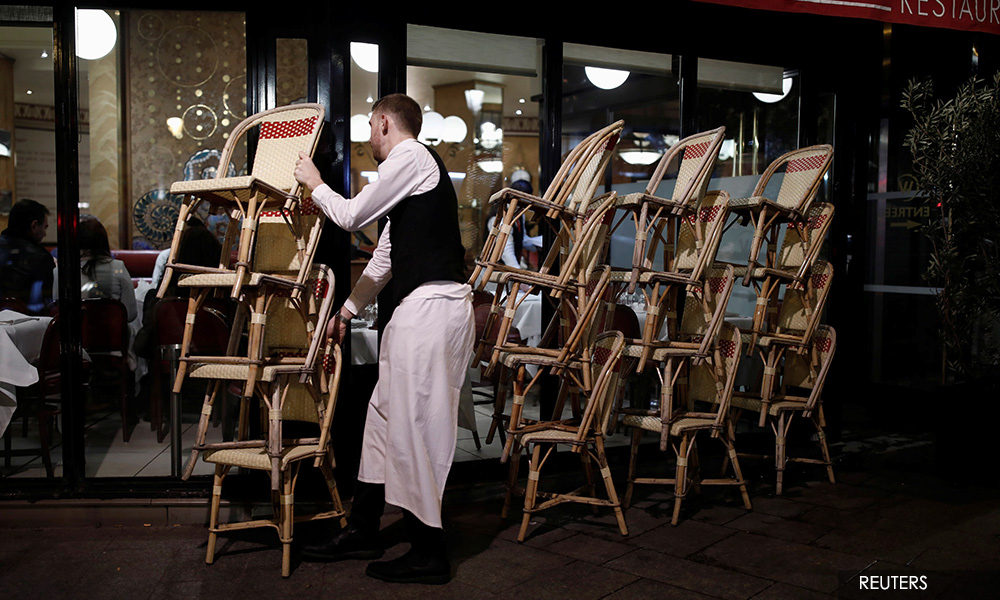
The changes to dine-in rules come despite a study warning the risk of Covid-19 transmission associated with full-service restaurants.
The study in the US cities found that such restaurants are of particularly high risk due to “high visit densities and long dwell times” at such venues.
This is estimated to triple the number of infections linked to full-service restaurants compared to the next the riskiest category – fitness centres.
The paper published in the journal Nature also advocated limiting maximum occupancy in venues as a cost-effective means of limiting the spread of the disease.
“Reducing the maximum occupancy substantially reduced the risk without sharply reducing overall mobility: capping at 20 percent of the maximum occupancy in the Chicago metro area reduced the predicted number of new infections by more than 80 percent but only lost 42 percent of overall visits, and we observed similar trends across other metro areas.
“This result highlights the nonlinearity of the predicted number of infections as a function of the number of visits: one can achieve a disproportionately large reduction in infections with a small reduction in visits,” the authors wrote.
Meeting rooms capped at half capacity
Meanwhile, the new conditional MCO rules also changed the rules for conducting meetings.
Previously, all meetings involving outsiders were to be held via video conferencing with some exceptions.
The new rules now stipulate that all meetings at offices, hotels and other institutions are allowed with the following conditions:
- Social distancing is observed;
- Wearing of face masks is mandatory;
- Meeting room occupants are limited to 50 percent of its maximum capacity.
The new standard operating procedures also introduce social distancing rules for sports and recreational activities.
The limit is one to three metres for static activities and three to five metres for dynamic activities.
This applies to non-contact individual sports such as jogging, cycling, aerobics, hiking, and fishing.
The previous rules only limited the number of people present to no more than 10. The limit is still in place in the new rules.
As for public sporting facilities, the previous rules stipulated a maximum capacity of 10 people at a time.
Now, the new rules allow the facility to accommodate up to 50 percent of its maximum occupancy.
The ban on contact sports remains in place.


Report this comment
Are you sure you want to delete this comment?
This action cannot be undone.