


'Only locals' rule leads to manpower concerns at KL wholesale market
Wholesalers at the Kuala Lumpur wholesale market are concerned about manpower shortage after being told that only local workers can be hired from next year.
According to the Kuala Lumpur City Hall's (DBKL) notice on the matter dated Oct 23, those who violated the rule could lose their licence.
Kuala Lumpur Vegetable Wholesalers' Association president Wong Keng Fatt told Malaysiakini that although DBKL barred undocumented workers and refugees from the wholesale market, migrant workers with valid documentation were still able to work.
However, he said effective Jan 1 next year...
Wholesalers at the Kuala Lumpur wholesale market are concerned about manpower shortage after being told that only local workers can be hired beginning next year.
According to the Kuala Lumpur City Hall’s (DBKL) notice on the matter dated Oct 23, those who violated the rule could lose their licence.
Kuala Lumpur Vegetable Wholesalers’ Association president Wong Keng Fatt told Malaysiakini that although DBKL barred undocumented workers and refugees from the wholesale market, migrant workers with valid documentation were still able to work.
However, he said effective Jan 1 next year, wholesalers would not be able to hire foreign workers with valid documents or those with red identity cards.
Describing the move as unreasonable, Wong said: “Not allowing undocumented workers is the right move, but our workers have permits.”
“They are not allowed to work even if they have permits and they can't go back right now. How are they supposed to earn a living?” he added.
Wong said while the government encourages employers to “recalibrate” their undocumented workers through amnesty exercises, migrant workers with documents, however, are rendered jobless.
“Illegal (workers) can become legal, but you don’t allow legal (workers) to work. Is this reasonable?” he asked.
He also said the permits of many of their migrant workers are far from expiration and forcing them to quit now will increase the cost for wholesalers.
On the same note, he said the turnover rate among local workers was high, and a batch of them had left after the movement control order (MCO) was lifted.
Not a sustainable policy
Meanwhile, Kuala Lumpur Hoi Seong Fish Wholesaler Association president Sing Kian Hock said he agreed priority should be given to locals but opined that it was not a sustainable policy.

He predicted that most local workers would leave once the public health crisis is resolved.
According to Sing, fish wholesalers would face at least a 70 percent turnover rate among their local workers.
He said the locals come from various industries, with some of them previously being Grab drivers, technicians, and sales personnel.
He conceded that the workers are not provided with benefits that would convince them to continue after the pandemic has stabilised.
On a personal note, Sing said he had to change seven workers at his stall just last month.
“We work at midnight, it is dirty and smells bad. You can often get injured by fish scales. It is difficult to find workers.
“If the pandemic is under control, will these local workers continue to work in the market?”
“We have to look at it long-term, not just for the next few months… when the situation improves and all the economic sectors reopen, they will go back to their jobs,” he added.
Permanent residents not allowed to work?
Kuala Lumpur Fruit Wholesaler Association president Chin Nyuk Moy told Malaysiakini that fruit wholesalers have many workers with “red” identity cards.
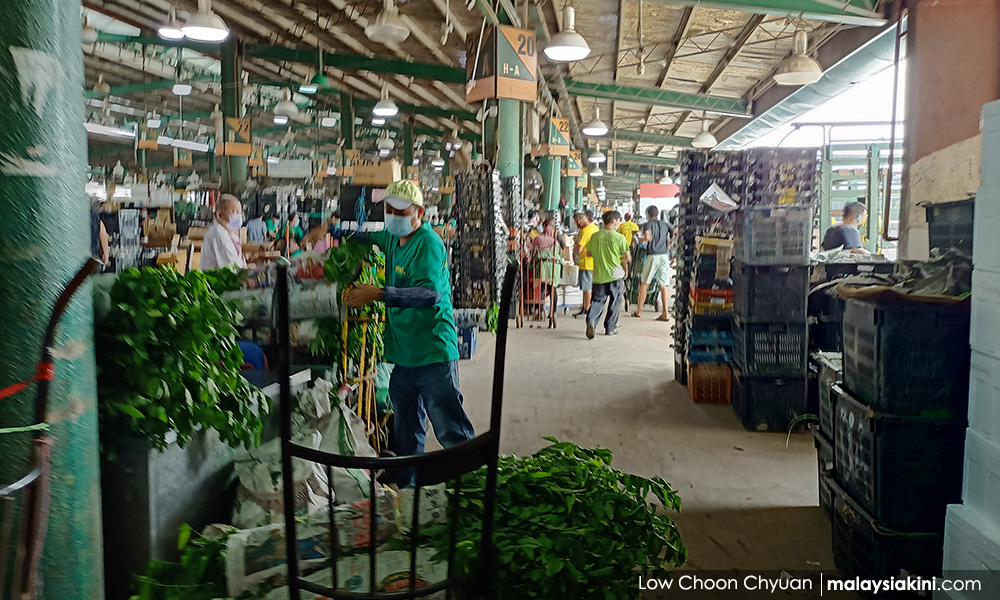
She pointed out that they have been working for the same employers for more than 20 years and are highly skilled.
“Holding red identity cards means they have permanent residency... I don’t understand why permanent residents are not allowed to work,” she added.
According to Chin, wholesalers would face a conundrum if they lose their skilled workers as training their local replacements would be time-consuming.
Therefore, she said the association urged authorities to allow wholesalers to continue employing those with red identity cards and documented workers until the expiration of the latter’s permits.
Malaysiakini has contacted Kuala Lumpur mayor Mahadi Che Ngah for his response.
Further reading: Migrant workers policy amid Covid-19 a pipe dream nightmare




This is the only wholesaler's market in the world in developing country which is heavily manual based! Why not automate it and charge the wholesaler's a huge sum?
Report this comment
Are you sure you want to delete this comment?
This action cannot be undone.