



Merge PKR-Amanah to counter anti-DAP propaganda - analyst
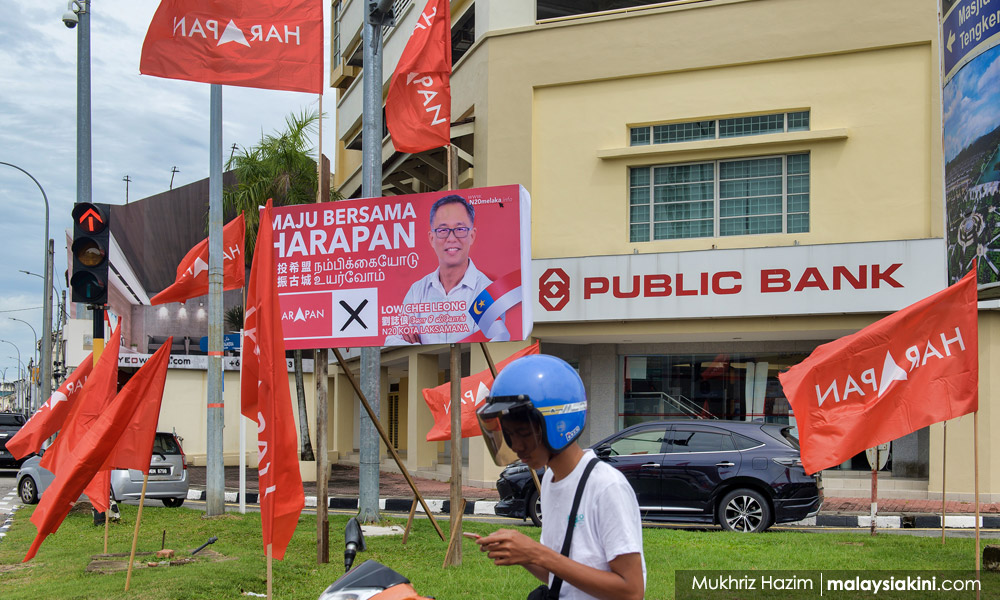
The end of the Malacca state polls, which saw Pakatan Harapan component PKR being wiped out and Amanah only winning one seat, has brought about an idea to merge the two political parties into one.
Political analyst Wong Chin Huat, who mooted the merger idea, said the move was "necessary" as part of lessons to be taken from Harapan's failure in the Malacca polls.
He said both PKR and Amanah must...
The end of the Malacca state polls, which saw Pakatan Harapan component PKR being wiped out and Amanah only winning one seat, has brought about an idea to merge the two political parties into one.
Political analyst Wong Chin Huat, who mooted the merger idea, said the move was "necessary" as part of lessons to be taken from Harapan's failure in the Malacca polls.
He said both PKR and Amanah must strengthen their parties with a clearer vision in preparation for the 15th general election.
This is in contrast to the old narrative of "returning the people's mandate from GE14" or trying to compete with PAS by challenging the party's stance on alcohol and gambling, he said.
"If Amanah tries to be more PAS than PAS, PAS voters will still vote PAS, while non-Malay voters and the liberals will abandon them.
"In the end, they will not get what they are chasing after, and also lose what they already have in hand," Wong told Malaysiakini.
Wong had first raised his proposal for the PKR-Amanah merger as a panellist in a television programme.
'Crucial in marginal areas'
Commenting further, Wong said without the merger it would be difficult for Harapan to compete with BN or PN when the two coalitions are also talking about reforms and stability.
Therefore he said Harapan - particularly PKR and Amanah - should focus on issues on the economy and the disparity of income.
"There are many common Malays who are disappointed and upset looking at the elites living a high life while the majority are in financial woes.
"Harapan must emphasise on daily life issues like inflation, not just fanning the dissatisfaction but offer solutions, including using powers it has in three states under its administration," he said.
"While many Malays are confused and feeling deflated with the emergence of many new parties and factions, PKR and Amanah - both with similar directions - could consider a merger to achieve synergy, particularly in marginal areas," he said.
Looking back, Wong said PKR was a product of reforms while Amanah's founders also comprise supporters of PKR president Anwar Ibrahim, some going back to 1998.
"If the two parties can be merged, then the new party will replace DAP as the biggest bloc in Parliament with 46 seats.
"This will work to dispel propaganda from parties that claim Harapan is dominated by the DAP," he said.
At the same time, Wong noted the merger process could take a long time and go beyond GE15.
He said the process could however start with the formation of a coordinating body featuring a joint leadership from the central level all the way to the grassroots.
"What is important, Harapan cannot hope their loss in Malacca will not happen again unless they start making changes," he stressed.
PN is now BN’s main rival
He said the proposal should be given serious consideration after Harapan is only left with five seats in Malacca - four from DAP and one from Amanah - while PKR lost in all seats it contested in.
Looking at the numbers, Wong said Harapan also trailed in third place behind BN and PN in 13 seats, while placing second in 10 others.
"So in other words, PN has replaced Harapan as BN's main rival, and this is more evident in Malay-majority areas.
"In 12 seats with more than 70 percent Malay voters, Harapan only placed second in Kuala Linggi and Merlimau (both contested by Amanah)
"In 11 seats with more than 60 percent Malay voters, Harapan only won in Bukit Katil, also contested by Amanah," he said.
Explaining the matter, Wong said PN's success at replacing Harapan as the alternative to Umno in Malay areas effectively meant that votes for Bersatu and support for PAS - at an average of 9 percent in GE14 - had been successfully combined.
He said Malay voters who rejected Umno on issues of corruption and kleptocracy did not move to Harapan due to its uncertain direction, particularly after the decision to field former Umno representatives Idris Haron and Nor Azman.
Wong said the move saw Harapan losing its "moral capital" to label Bersatu as a traitor.
"For sure PN and BN's propaganda that Harapan is dominated by the DAP is effective among Malay voters but the solution is not to ask the DAP to be less dominant.
"If the DAP is not dominant, PKR and Amanah will also lose out when non-Malay voters are less inclined to go out and vote," he said.





Are you sure you want to delete this comment?
This action cannot be undone.