




PSB may overtake PKR in S'wak if Baru Bian takes helm - analysts
Political analysts felt that Parti Sarawak Bersatu (PSB), which contested for the first time but garnered second highest votes in the recently concluded Sarawak state election, may replace PKR's role in the Dayak constituencies in the Borneo state.
This is possible if former state finance minister II Wong Soon Koh relinquishes his position as PSB president and allows presidential council member Baru Bian to take over the party leadership, according to Ngu.
"If Wong relinquishes his position...
Political analysts have expressed their views that Parti Sarawak Bersatu (PSB), which contested for the first time but garnered the second-highest vote share in the recently concluded Sarawak election, may replace PKR's role in Dayak constituencies in the state.
This is possible if former state finance minister Wong Soon Koh relinquishes his position as PSB president and allows presidential council member Baru Bian to take over the party leadership, according to Universiti Malaya senior lecturer Ngu Ik Tien.
"If Wong relinquishes his position and allows Baru to recruit PKR supporters into the party, I think PSB may replace PKR's role in Sarawak," she told a virtual forum titled "Malacca and Sarawak State Poll: Benchmark for Next General Election?" on Wednesday.
"Baru and See Chee How won in the recent polls. They stayed with the opposition for several terms and did not join the ruling coalition. These lawmakers were widely supported by local voters.
"This shows that the voters not only look for a winnable candidate, but they value the candidates’ effort," added Ngu, who was born in Sibu and has observed politics in her home town for a long time.
She said most constituents who voted for PSB in the polls were fence-sitters whose voting trend depended on the candidates' ability, popularity, resources and issues surrounding the election instead of loyalty towards any party.
Ngu added that PSB is a flexible party and that it may recruit more Dayak leaders in the next election because one of its promises is to nominate a Dayak chief minister.
While it is uncertain how long the PSB brand and platform may be able to sustain itself, Ngu said it is possible that these lawmakers could become an effective force in future elections.

The virtual forum was jointly held by the Kuala Lumpur And Selangor Chinese Assembly Hall (KLSCAH) and Pocket Times, a video portal linked to Sin Chew Daily.
PSB could fill PKR's gap
Concurring, political scientist Wong Chin Huat said PSB is able to fill the gap left by PKR and attract more leaders to join the party.
However, he said that PSB needs to work with national parties if it plans to expand its base beyond that of a local opposition party.
"There is so much to gain as government lawmakers. They have an annual allocation of RM8 million. So, why will your lawmakers and voters stay with you? What do you have to attract others with?
"If you can't win in the state election, can you be part of the federal political bloc? It is not necessarily advantageous to insist on going solo," he added.
Wong said that Warisan expanded to the peninsula because it risks having more of its lawmakers defect if it fails to convince them that the party stands a chance at the federal level in the next general election.
Merdeka Center research manager Tan Seng Keat agreed with Wong, saying local parties in Sarawak need to work with national parties to bring bigger benefits to their parties.
This is because Sarawak voters regularly vote for the ruling coalition in local polls but support the opposition during the general election instead.
"In the 2016 Sarawak polls, BN garnered 62 percent of total votes, but this dropped to 52.5 percent in the 2018 general election.
"Both elections saw a voter turnout rate between 68 and 70 percent. Back in 2018, 1MDB was among the factors that affected the election
"Just like in Sabah, the cooperation between Warisan and Pakatan Harapan may pose a challenge (to the local ruling coalition)," Tan said.

PSB won four state seats out of the 70 it contested and garnered 18.8 percent of votes. Harapan only gained 10.5 percent of the total vote share.
Formerly known as United People's Party (UPP), PSB was formed by Wong, who resigned as state minister in 2019.
Meanwhile, Ngu said some Chinese voters in Sarawak voted for Parti Bumi Kenyalang (PBK) not because they want Sarawak to be independent but as a protest against the federal government, Islamisation in the peninsula, Malay hegemony and unequal distribution of resources.
PBK managed to keep its deposit in four seats out of the 73 it contested.
Out of these four seats, two were Chinese-majority seats in Sibu, namely Bukit Assek and Palawan.
The other two seats were Tasik Biru in Kuching, a Dayak-majority seat, and Tanjung Batu in Bintulu.
Chinese support not a given
Tan said based on a survey, the urban Chinese in Sarawak want Sarawak to be independent as they felt the Borneo state has worsened after becoming part of Malaysia.
However, the polls also showed that the Dayak community believes Sarawak had improved after joining Malaysia, he added.
Ngu explained that while she acknowledged PBK performed well in Sibu and Bintulu, that did not mean the urban Chinese now support the party.
She noted that PBK lost its deposit in places like Kuching, which comprises several Chinese-majority seats.
"We are trying to figure out why (they performed well in parts of the constituencies)," she said.
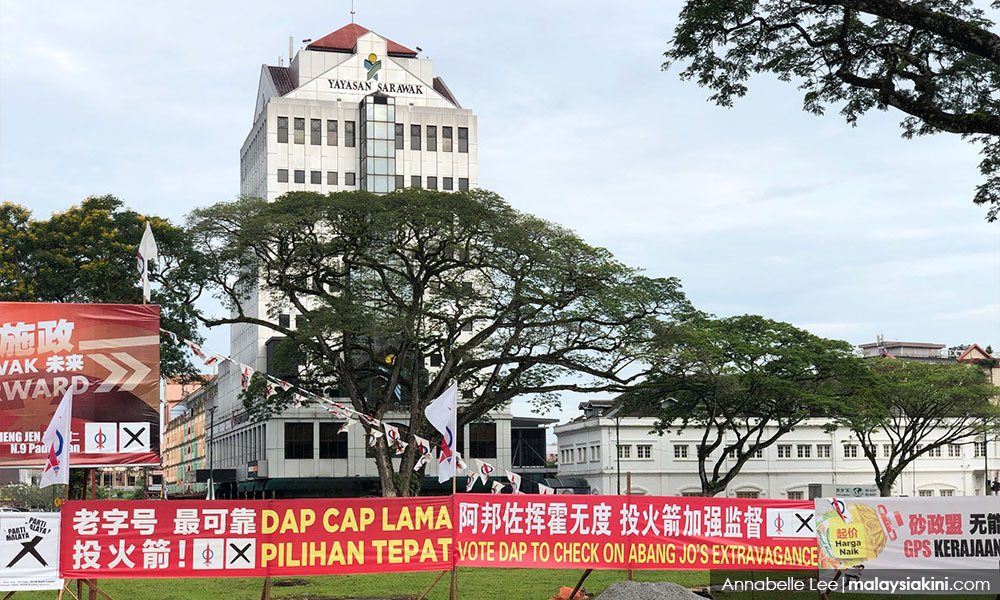
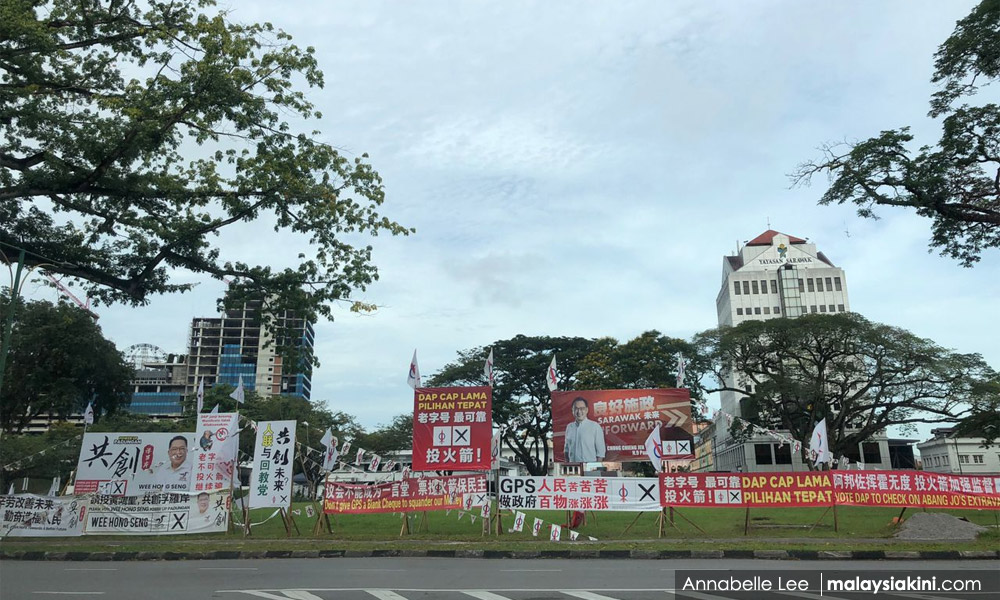
Ngu pointed out that the support garnered by PBK could have effectively divided the votes for DAP.
Drawing from her own experience, she said eight out of 10 of her friends from Sibu may have voted for PBK, and six of them had supported DAP in the past.
"They said directly that they could split the votes of DAP. And the result shows this is indeed the case," she said.
DAP lost all seats it contested in the central Sarawak region, which includes the third-biggest district in the state, Sibu. It lost Bukit Assek and Palawan with a slim majority of 800 and 100 votes respectively.
Meanwhile, Wong said, compared to their opponents, Sarawak Harapan could neither come out with a bold secession slogan like PBK nor offer cash handouts and other benefits to the voters like GPS.
This placed Harapan at a disadvantage, he added.
"If you just said we will fight for our rights step by step, this sounds very useless."
Therefore, Wong suggested that DAP explore decentralisation instead of just harping on the sentiments of Sabah and Sarawak.
Only then, he said Harapan will give new hope to voters and get rid of its “original sin” of being part of the West Malaysia party.





Report this comment
Are you sure you want to delete this comment?
This action cannot be undone.