


/file/publisher-c1a3f893382d2b2f8a9aa22a654d9c97/2022/11/e0e5e2b0ebab488368e43f9b4fb5f034.jpg)

GE15 predictions - winners and losers
Some predictions are based on the total number of 222 parliamentary seats, while some are based on the 165 seats in Peninsular Malaysia.
In light of Padang Serai candidate M Karupaiya's death, and the Election Commission (EC)’s announcement that polling for the seat is postponed to Dec 7, the total number of parliamentary seats in GE15 is now down to 221.
Malaysiakini dove into six research pieces - four local and two foreign - to...
GE15 | With the race to the 15th general election (GE15) now reaching its last leg, various predictions by research houses have been released, hoping to shed light on the possible winner.
Some predictions are based on the total number of 222 parliamentary seats, while some are based on the 165 seats in Peninsular Malaysia.
In light of Padang Serai candidate M Karupaiya's death, and the Election Commission (EC)’s announcement that polling for the seat is postponed to Dec 7, the total number of parliamentary seats in GE15 is now down to 221.
Malaysiakini dove into six research pieces - four local and two foreign - to summarise what could be the country's political scenario after polling day on Saturday. Three handed victory to Pakatan Harapan while three others sided with BN.
Despite the differing outlooks, all the surveys had one thing in common - no coalition would command a simple majority (previously 112 seats, but now 111, after excluding Padang Serai) to form a government on its own. Here are the research findings:
Ilham Centre - Harapan leads the race
According to the survey done by this independent research centre, Harapan is leading the race, with BN and Perikatan Nasional (PN) tussling for Malay-majority seats.
The survey, conducted face-to-face among 1,211 respondents nationwide between Oct 30 and Nov 17, also found that GE15 will serve as a catalyst for the formation of a "Borneo Bloc".
According to Ilham Centre, Harapan will capture 86 parliamentary seats out of the 221 being contested.
BN is projected to capture 51 seats, while PN is predicted to win 25. A total of 26 seats are expected to be a close 50-50 contest.
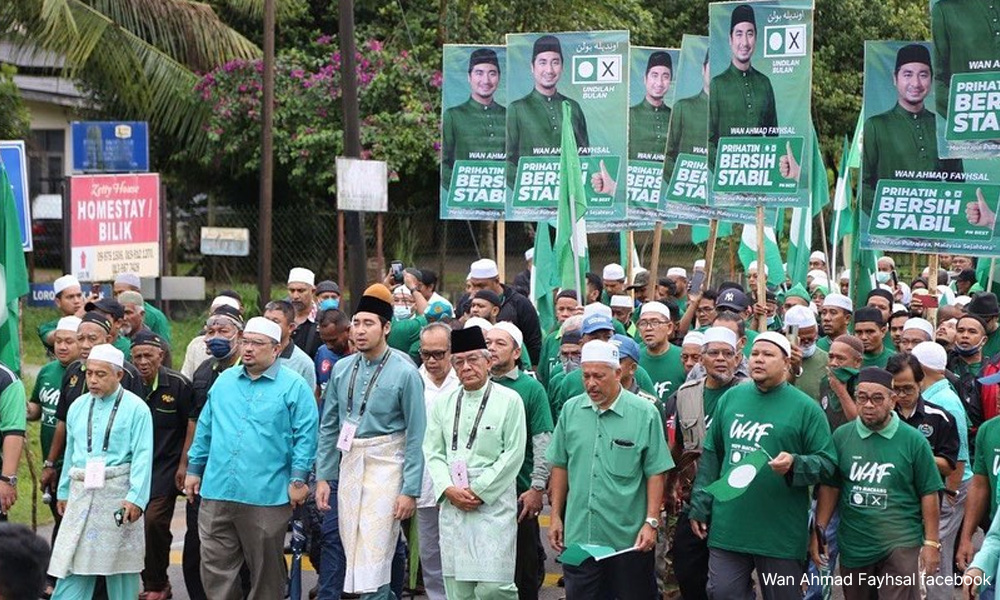
Elaborating, the research said BN's tactic of fielding 80 percent new faces would "backfire" on the coalition, while Harapan chairperson Anwar Ibrahim as the coalition's prime ministerial candidate is its biggest "selling point" that could grant it victory at the polls.
Emir Research - Harapan clear winner with 94 seats
According to the projection by Emir Research, Harapan would garner 94 parliamentary seats in Peninsular Malaysia, while BN will gain less than half of that, with 46. PN, meanwhile, is predicted to get 24 while former premier Dr Mahathir Mohamad's Gerakan Tanah Air (GTA) may gain only one seat.
Emir Research president and CEO Rais Hussin said the projections are based on a turnout rate of 77 percent.
Of the predicted results, there are 41 seats categorised under "close calls", or seats with a majority of approximately 1,000 votes.
State-wise, Rais predicted that Johor, Perak, and Malacca will fall to Harapan, while states like Terengganu and Kelantan will remain with PN. Pahang, meanwhile, is expected to be retained under BN, after a close contest with Harapan.
Invoke - Harapan winner
According to Invoke’s survey, Harapan will win 91 seats, while BN and PN trail behind with 50 and 41 seats, respectively. The remaining seats are expected to go to GPS (Gabungan Parti Sarawak - 30), Warisan (six), and GRS (Gabungan Rakyat Sabah - four).
The research predicted Perak to fall to Harapan with a total of 15 seats, while BN and PN garner seven and two seats, respectively. Johor will also predictively fall to Harapan with a combined 13 seats, while BN and PN take 10 and one seat, respectively.
Malaysian Institute of National Development (Mind) - BN winner
According to this research house, BN will be the winner of GE15 due to the splitting of votes.
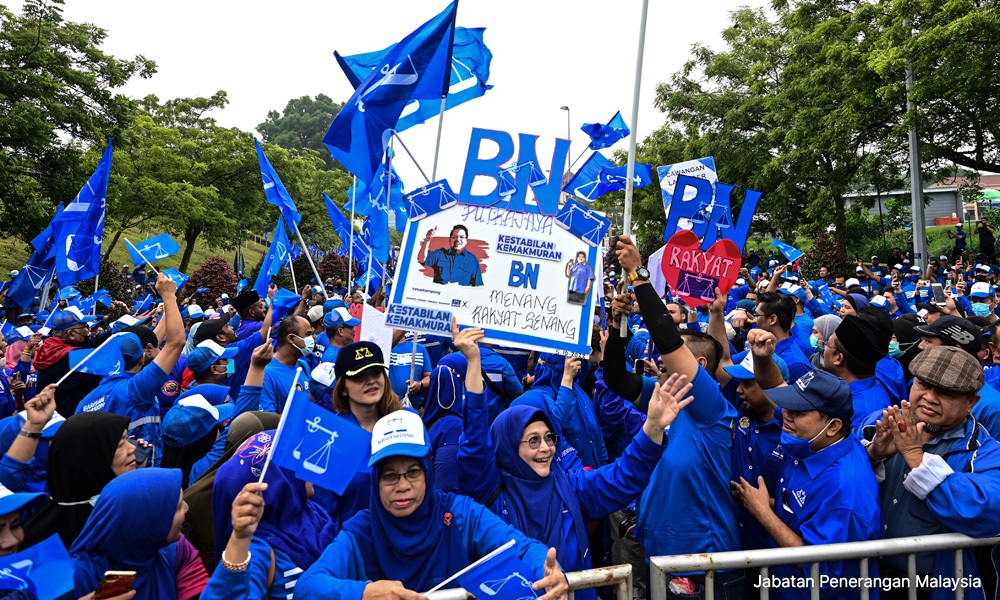
The researchers randomly surveyed 1,000 voters through phone calls, in 166 parliamentary seats in Peninsular Malaysia.
According to lead researcher Helmy Ishak, the predictions were based on two scenarios - the first being the number of voters being equal in number, or lower than voters in the Johor and Malacca state elections.
The second scenario, meanwhile, accounted for overseas voters who return to cast their ballots, according to the pattern of ballots cast by outside voters in the two state elections.
Based on the first scenario, Mind predicted that BN will win 75 seats, while Harapan and PN will gain 54 and 36 seats, respectively. Pejuang is expected to win a single seat.
The second scenario, meanwhile, predicts that BN will win 65 seats, followed by Harapan, PN, and Pejuang with 56 seats, 44 seats, and one seat, respectively.
Although no one coalition can gain a simple majority to form the government, BN could have an edge over the other coalitions, after joining hands with Sabah and Sarawakian parties, the survey concluded.
Fitch Solutions Country Risk and Industry Research - BN wins, forms government
This survey by the research arm of US credit rating agency Fitch Solutions found that BN will win GE15, although there remains a risk of a hung Parliament.
If BN's victories at the Malacca and Johor state elections are an indication, BN is likely to have regained political momentum among the electorate, the research stated.
The fact that BN is the country's longest-ruling coalition will also benefit it as voters would see it as having the biggest "governing experience", the firm was reported saying by Free Malaysia Today.
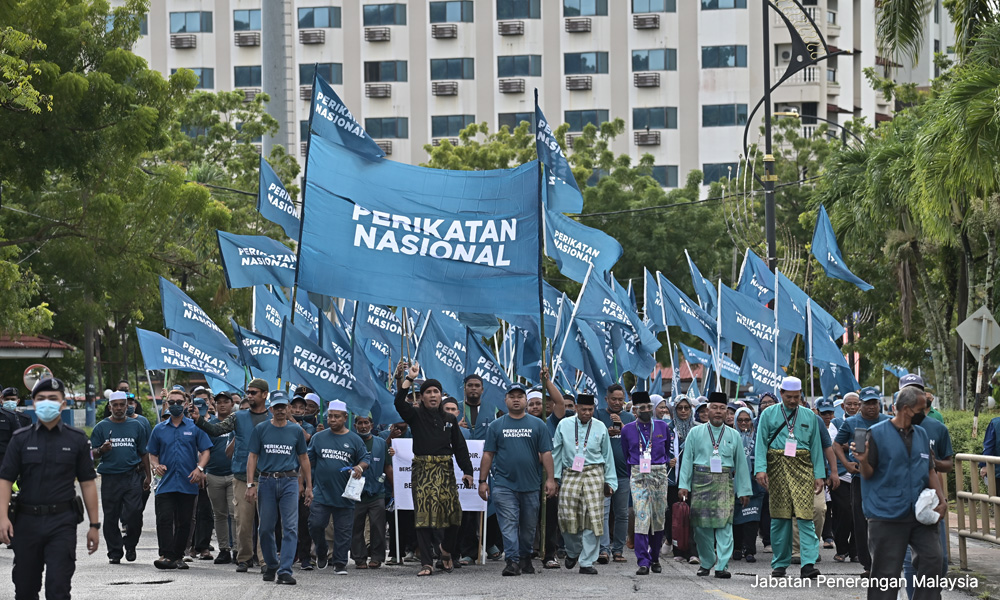
The survey further noted that Harapan's popularity has waned since the 2018 general election, and the probability of the coalition, as well as PN winning GE15, is below 25 percent in probability.
Among others, Fitch predicted that once BN wins Putrajaya, it would reintroduce the Goods and Services Tax (GST).
Economist Intelligence Unit (EIU) - BN wins, Ismail Sabri to be reappointed PM
According to this study by the research and analysis division of the Economist Group in the United Kingdom, BN will win GE15 and caretaker prime minister Ismail Sabri Yaakob is expected to be reappointed as prime minister.
In a statement, EIU's principal economist Fung Siu said that while BN is likely to form the government, the coalition would not get enough seats to get a two-thirds majority.
According to him, the lowering of the voting age from 21 to 18 under the Undi18 initiative is unlikely to have any impact on the electorate's voting patterns, as voters would revert to race-based preferences.
For the record, the Undi18 initiative, along with automatic voter registration, has led to an estimated 6.23 million newly registered voters for GE15.
/file/publisher-c1a3f893382d2b2f8a9aa22a654d9c97/2022/11/19201859756908be51ccc55e34d6a27a.jpg)
/file/publisher-c1a3f893382d2b2f8a9aa22a654d9c97/2022/11/fba8ad6d436ef209c7d54ee9b27e45ec.jpg)
/file/publisher-c1a3f893382d2b2f8a9aa22a654d9c97/2022/11/1b9b44b24c5496fcadfb5b418de5bfc5.jpg)
/file/publisher-c1a3f893382d2b2f8a9aa22a654d9c97/2022/11/a6c8ba97978af7c3d9af33b7d2986781.jpg)


Are you sure you want to delete this comment?
This action cannot be undone.