




Machap: DAP staring at defeat
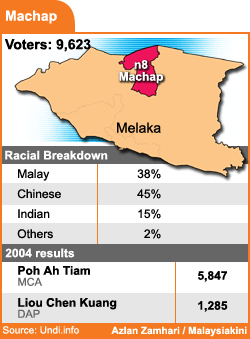
Without a doubt, DAP's traditional rival MCA will win the April 12 Machap by-election in Malacca. The simple reason for this is that all the resources of the ruling Barisan Nasional can be concentrated and focused on one constituency at one point of time.
Without a doubt, DAP's traditional rival MCA will win the April 12 Machap by-election in Malacca. The simple reason for this is that all the resources of the ruling Barisan Nasional can be concentrated and focused on one constituency at one point of time.
Like all other opposition parties, DAP is certainly poorer in resources, especially the power of official patronage. On the other hand, MCA can distribute 'goodies' like funds to renovate Chinese schools, clear up clogged drains and repair damaged roads in the name of 'development' during the campaign period.
 Of course, the acts of distribution of public funds or resources could be decried as abuses of power and institutionalised bribery, the fact seems to be that there are still people who accept it as a 'traditional' and 'normal' culture of politics in Malaysia which cannot be changed overnight.
Although it can be pointed out that from a historical perspective, DAP had won by-elections under similar circumstances in the past such as Kepayang in 1982. However, the current reality is different despite some quarters saying that the 'opposition wind' is strong now, especially in the Chinese community.
DAP's vulnerabilities in the Machap by-election seem to be its own subjective conditions which, more likely than not, serve to negate or vitiate the objective circumstances that are thought favourable to it and other opposition parties.
The vulnerabilities certainly include the just concluded and widely publicised row on the question of opposition candidacy between DAP and Parti Keadilan Rakyat (PKR).
The row is certainly not new. Similar public disputes have occurred in the past, like the Lunas by-election in Kedah in 2000.
Yet, it is precisely because it has developed into a pattern that it serves to demoralise opposition supporters without partisan affiliations as well as swinging voters who are potentially inclined to give the opposition an opportunity to check and balance the ruling coalition.
Propaganda theme
Of course, it also opens up a propaganda theme for the ruling coalition, especially MCA, to paint the picture that its opponent is not as 'idealistic' as claimed and DAP is in fact no different from MCA as far as the practice of 'realism' is concerned.
 However, even without the public row with PKR, DAP already suffered two serious blows to its image in the eyes of opposition supporters and swinging voters.
The first was the recent defection of serving Bahau state assemblyperson Lim Hui Ming in Negeri Sembilan back to MCA. Lim had left MCA for DAP some 20 years ago.
Certainly, the political ethics of the defection can be questioned and even described as a blatant betrayal of public trust because Lim was elected under a DAP ticket, with the support given of DAP supporters.
This issue and the many questions pertaining to DAP's internal politics will certainly be used as propaganda material by MCA against the opposition party.
Of course, DAP can argue that its internal politicking has nothing to do with the larger and higher issue of the nation's democratisation and good governance, but MCA can certainly retort by questioning the ability or capability of DAP's top leadership to manage even its own family affairs.
MCA's will be along this line: If DAP cannot even manage its family business, how can the people entrust it to manage public affairs?
It may sound simple but this will be a powerful line on the ground in a societal culture that, rightly or wrongly, sees no difference between a family and country.
MCA also has the case of the midnight coup against former DAP Selangor chief Ong Chee Keng by his own comrades to back up its allegation that the opposition party cannot manage its own affairs.
The prevailing public image of DAP is that it is a party incapable of managing relations in its own organisation as well as with its supposed allies and friends.
So, while it is almost impossible for DAP to win the Machap by-election, the critical question is whether it can maintain a reasonable quantum of votes to preserve hope for any future contests.


Report this comment
Are you sure you want to delete this comment?
This action cannot be undone.