




ISA still relevant and useful
The government will not scrap the controversial Internal Security Act as it is still relevant and useful.
The government will not scrap the controversial Internal Security Act as it is still relevant and useful.
 "At the moment, the government feels that ISA is significant because we use it to maintain peace and to ensure the security of the general public," Prime Minister Abdullah Ahmad Badawi said in a parliamentary written reply today.
"Many countries like Singapore, Brunei, Israel, South Africa and the US also use a concept that is similar to our ISA," said Abdullah, who is also the Internal Security Minister.
However, he added, the Act will be upgraded with suggestions stated in the Royal Police Commission Report.
"Matters pertaining to rights of the detainees will be given due consideration and assessment," said Abdullah.
Abdullah was replying a query from Yap Pian Hon (BN-Serdang) who asked the Internal Security Minister to state whether the government will review some of the rules in the Internal Security Act.
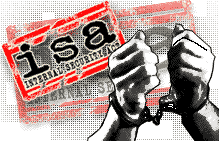 Explaining that ISA was put in use to ensure the stability and security of the nation, Abdullah said: "We have conducted inspection on the law in 1972 to broaden the scope related to subversive attack, organized terrorism and disturbance to delivery system and economic."
"This prevention law is needed to curb the possibilities of threats to the nation's security and economics," he said, adding that threats must not be allowed to take a physical form.
"The worrying aspect is that the threats are disseminated in forms of indoctrination, which are often well planned and systematic. This make them difficult to be traced."
The Act has for long been cited by opposition parties and civil society groups as being draconian and used arbitrarily by the government to oppress dissent.
Many breaches of human rights have also been blamed on the Act which provides for detention without trial.
Toll agreements secret
On another matter, the government has also decided that it was not necessary to reveal highway privatization agreements to the public.
 "Concession agreements are the government's official secret document under the Official Secrets Act 1972," said Works Minister S Samy Vellu in a parliamentary written reply.
These documents are also confidential, where permission from the concessionaires was needed before making the documents public, he added.
"If the government decides to reveal the documents without the concessionaires' permission, they could take legal actions against the government for not following the terms stated in the agreement."
Samy Vellu (BN-Sungai Siput) was responding to a query from Lim Kit Siang (DAP-Ipoh Timur) who asked the Works Minister to state why the government has failed to reveal highway privatization agreements as promised in February 2007.
Lim also said that such failure has affected the public's confidence in the government.


Are you sure you want to delete this comment?
This action cannot be undone.