


/file/publisher-c1a3f893382d2b2f8a9aa22a654d9c97/2024/04/8779633c533556bf2963b2ebc533f86d.jpg)

KK Mart, political opportunism, and Malaysia's 'dark time'
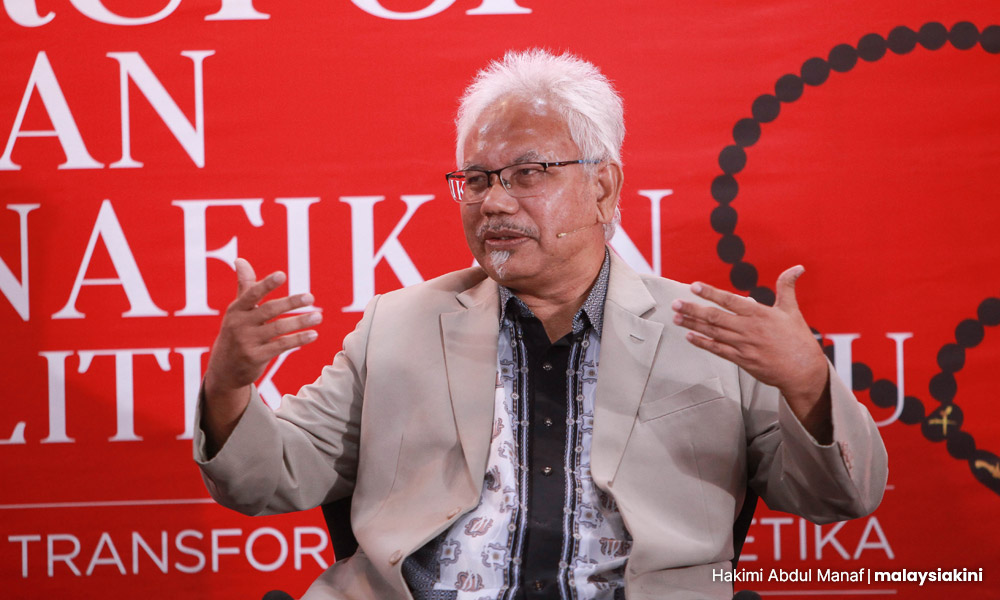
In a no-holds-barred conversation with actor and comedian Harith Iskander titled “Is this the darkest Malaysia”, academic Tajuddin Rasdi explores, among others, the controversial KK Mart socks issue.
Harith observed that in the current mood enveloping the nation, non-Muslims are perceived as enemies of Islam.
In a no-holds-barred conversation with actor and comedian Harith Iskander titled “Is this the darkest Malaysia”, academic Tajuddin Rasdi explores, among others, the controversial KK Mart socks issue.
Harith observed that in the current mood enveloping the nation, non-Muslims are perceived as enemies of Islam.
According to Tajuddin, there are two main reasons for this - the basic education of Islam and politics.
Elaborating on the latter, the professor from UCSI University’s School of Architecture and Built Design, said that politics considers religion as something which can be weaponised.
“Because people are ignorant of their religion. They love their religion, they want to go to heaven. But they don’t know that they don’t know (all there is to know about religion),” he explained.
On the KK Mart issue, Tajuddin noted the absence of calls for boycotts from politicians in subsequent cases such as the logo on Vern’s shoes and the mats - which later turned out to be prayer mats - with the image of the kaabah.
“Why is that? Because the man who was calling for the boycott (of KK Mart) had met the Yang di-Pertuan Agong just like when pupils met the headmaster.
“So, I don’t trace anything from him now about boycotting other products and ruining other businesses. So that is where we see the incompatibility of his claim that he is fighting for Islam.
“You say that you are fighting for Islam but you don’t know how the prophet (Muhammad) did it… If you had understood the akhlak (character), even the politics and diplomacy of the prophet, then you can say you are fighting for Islam.
“But here, it is very clear that you are fighting for yourself and your party,” he added.
As for the reason there were no calls to boycott other products from this politician, Tajuddin said it is because the former had achieved his objective - to become popular.
“Umno (too) has become popular again after their fall in GE15. This is where it is unfortunate, when we want to get popularity at the expense of our own people,” he added.
Although both Harith and Tajuddin did not mention the name of the politician, it was obvious that the pair was referring to Umno Youth chief Dr Muhamad Akmal Saleh.
Politician’s action unlike prophet’s
On the repercussions of this action, Tajuddin said while he was glad that lives were not lost, it had however affected the livelihood of honest and hardworking people.
The self-confessed former PAS supporter said this is the reason he did not support the boycott of certain outlets due to the conflict in the Middle East as well.
“Because I was concerned about the workers (in these outlets)... who have nothing to do (with the conflict)... That is what I call destroying the dignity of a person,” he added.
To Harith’s question on there being no forgiveness or compassion even after KK Mart founder Chai Kee Kan had apologised, Tajuddin cited an incident of how the prophet responded to a man who urinated in a mosque.
He said when some of those present rebuked the Bedouin, the prophet told them to wait until he finished urinating, after which, the place was washed.
“The prophet then said, ‘This is a house of worship, it would not be nice for you to do this’... Now compare it to what this guy (Akmal) said, I wouldn’t even mention his name, who said, ‘No. This is the sanctity of Islam. We are not satisfied that he apologised. We want him to be charged… We want to go on with the boycott’…”

Tajuddin said when he pointed out that Akmal was bullying, the latter denied it and cited that those involved were business tycoons.
“I am sorry, you belong to a political party with a million members and it is also part of the government. You don’t consider yourself bigger? Even Robert Kuok (Malaysia’s richest person) cannot fight Umno with its million members and its being part of the government. So who is the bully then?
“So this is the problem - political opportunism. This is a very dangerous path for us to take,” he added.
‘It is a very dark time’
Quizzed on the future of Malaysia and his advice to youths to seize opportunities abroad, Tajuddin painted a bleak picture of what lay ahead.
He pointed out that there are two issues - the conservatism in Islam and non-Muslims not knowing how to respond appropriately.
“So we have a mess of things. Somebody weaponising (religion), more Muslims becoming conservative and the non-Muslims reacting un-strategically. So that is a whole cauldron of mess.
“So, that is why I said in the meantime, for the next 10 years, if you have the opportunity to challenge yourself in another country, do so.
“Because it is going to be a mess. But this is how society grows. This is how we grow. You know what they say, (it is) darkest before dawn... This is our dark time, and it is very dark. I thought the Reformasi time was dark. This is darker.
“Even though you don’t have burnings and killings… Some people ask me what is the level of extremism in Malaysia, they are surprised when I say 9.7…
“There is a way to cut short this situation… Both parties, the non-Muslims and the Muslims themselves. You cannot clap with one hand… I have talked about it, unfortunately, nobody is listening,” he added.
Tajuddin said when Amanah’s Mujahid Yusof Rawa was the religious minister, he had suggested to him to train 50 to 100 Malaysian ustaz in countries where there are no Muslims to make them understand how it felt to be a minority.
“This is the only way they can change the Malay society. Because I can’t change the Malay society, you can’t change the Malay society. I don’t think the sultan can change the Malay society. Only the ustaz or religious people (can change them),” he added.
Tajuddin also said while those in Sabah and Sarawak are proud of their multiculturalism, he had told them that a similar situation would happen in East Malaysia in the next decade.
“You can stop (Muslim preacher) Zakir Naik from coming here (Sabah and Sarawak) but you cannot stop videos (from reaching the people),” he added.
Tajuddin then recalled how a Universiti Malaysia Sabah (UMS) student did the Nazi salute during his convocation in 2019 and posted on his Facebook that he supported the struggle of the Palestinians and therefore is grateful to Adolf Hitler for the Holocaust.
During the hour-long podcast, the professor also tackled questions on the siege mentality of Malay Muslims, which he attributed to not reading, the usage of the term kafir, and the lack of like-minded individuals and academics speaking up.
‘Tempurung mindset’
Tajuddin said one of the reasons Malays do not read more about religion is because many ustaz argue that faith should be understood through teachers and not books.
“Those days, you did not have books… photocopiers. In order to copy (a text), you would have to transcribe, write it. So that is why to learn, you need to go to the teacher.
“But now in the age of printing and with YouTube and all that, the sources of learning are different. So, we need to have a different way of learning about religion,” he added.
Tajuddin also lamented that Malay Muslims do not associate with other cultures and even those who go abroad, stick to their own circle.
“I have been invited to churches to give talks. I have been invited to tea in churches. I have also given talks in temples. As an architect, I have done measured drawings of Chinese temples. So you move in different cultures.
“I have also read about other religions, Buddhism, Christianity, I have read the bible, I have read the book on Taoism by Lao Tzu. So this is the wide understanding of things. Therefore, you don’t look at things in a simple, wrapped-up box.
“When you study religion within a short, narrow construct, you become frightened by your own shadow because you do not have a wide thinking. Of course, the ustaz will say a wide thinking will lead to sesat (one going astray),” he added.
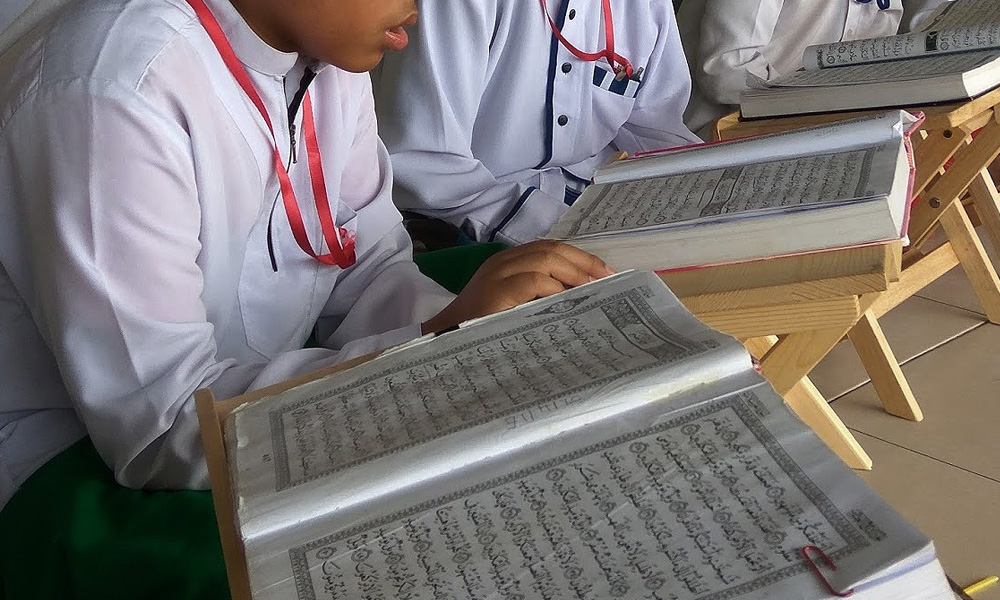
Tajuddin said this resulted in the “tempurung mindset”, where a person limits himself or herself to the teachings of the ustaz.
“You take a tempurung (coconut shell) or basin (to use as a shield) and put several cockroaches inside. What happens to the cockroaches? They are safe from predators… But what happens to them eventually? They die. Where are they going to get food? They can’t get any food because they sit in the tempurung.
“So this is where the idea of faith, there are two. Number one, faith is about you confronting what is outside and what is in life, increasing your strength because of all the challenges.
“The other is to stay safe somewhere. So that you just go for prayers, mix with your own kind; even charity, giving only to your faith (and not other causes).
“So you feel you are safe but that is where growth does not occur and enmity does. Where you make enemies of others and it is easy for others to make you believe that there are enemies all around you. That is the tragedy of the education of religion,” he surmised.
Please join the Malaysiakini WhatsApp Channel to get the latest news and views that matter.
/file/publisher-c1a3f893382d2b2f8a9aa22a654d9c97/2020/07/c3b95903a1e00ae897262cf06d8dff71.jpg)
/file/publisher-c1a3f893382d2b2f8a9aa22a654d9c97/2023/10/8057db374f3eba8d6ee4cc3e845490a8.jpg)
/file/1135/cb7c9f4f88060e1ca36771d4095bc1ad.jpeg)
/file/publisher-c1a3f893382d2b2f8a9aa22a654d9c97/2022/06/8b2aa5721a28902adf7f665cb26b3c1d.jpg)
/file/publisher-c1a3f893382d2b2f8a9aa22a654d9c97/2024/04/f7d15dfc2ea2bd4d66c5953d286bab5c.jpg)
/file/publisher-c1a3f893382d2b2f8a9aa22a654d9c97/2021/11/bc9c15a60075650c14ee2a2c6648d625.jpg)


Report this comment
Are you sure you want to delete this comment?
This action cannot be undone.