




Indigenous people: The forgotten minority
Universiti Kebangsaan Malaysia's Institute for Environment and Development (Lestari) organised a national level celebration of the International Indigenous People's Day today.
Universiti Kebangsaan Malaysia's Institute for Environment and Development (Lestari) organised a national level celebration of the International Indigenous People's Day today.
Some 100 people from various organisations participated in the celebration, co-organised by the United Nations Development Programme (UNDP) and the Education Ministry. It was officiated by MP for Cameron Highlands SK Devamany.
Organisers focused on the hardships faced by the Orang Asli and bumiputera in Peninsular Malaysia, and in Sabah and Sarawak respectively.
In his opening speech, Devamany stressed that the Orang Asli Affairs Department (JHEOA) has to transform itself with more Orang Asli in its framework.
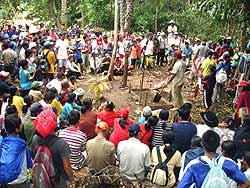 "Forget about qualification and look for people with passion and understanding of these people's problems. They will bring about more changes," he said
He added that the Orang Asli community must not only be provided with amenities, but also with a lot of support.
He also urged the government to look into capacity building and school drop out programmes, as well as comprehensive economic development plans to assist the Orang Asli community.
Forgotten minority
Meanwhile, Adrian Lasimbang of Partners of Community Organisations (Patos) from Sabah highlighted the Aboriginal People's Act (Act 134).
Lasimbang said Act 134, which was drafted to protect the indigenous people during the Emergency, must be amended.
"From one that protects the community, it must be amended to be an Act that provides socio-economic development to the indigenous people," he said.
Urging policy makers to be more sensitive to the needs of indigenous people, he said: "A lot of policy makers look down on indigenous people. They often label indigenous people as an under developed community."
"We have the NEP to assist the bumiputera community, but there are also the minority bumiputera community who are more often than not forgotten by the government," he said, adding that the minority community especially in Sarawak and Sabah must not be marginalised.
He also claimed that the authorities have been lackadaisical when it comes to issuing identity cards (IC) to indigenous people in Sabah.
"Many bumiputeras in Sabah do not have IC. On the other hand, foreign workers receive PR status not long after they enter the state," he said, adding that issuing PR to foreign workers puts the rights of indigenous people under threat.
On that note, Raymond Abin from Borneo Resources Institute Malaysia (Brimas) Sarawak said that indigenous people's native customary rights (NCR) are often violated by the government and authorities.
"Government alienate the customary land of Dayaks to private companies without prior consent from the community, resulting in them becoming squatters on land that they have been staying on for generations," he said.
This, he added, creates large-scale commercial plantations and makes way for the influx of illegal immigrants into the state.


Are you sure you want to delete this comment?
This action cannot be undone.