




A tale of two villages
During the 2004 general election, several boats belonging to various government agencies arrived from 'civilisation' to the interior villages of Orang Asli in Royal Belum forest reserve in Hulu Perak.
The Orang Asli voters were then taken on a long ride back to the mainland for them to vote. The shortest ride from one such village to the nearest polling booth was about two hours and 30 minutes.
Days before the elections, several state leaders too had descended on some of the villages.
During the 2004 general election, several boats belonging to various government agencies arrived from 'civilisation' to the interior villages of Orang Asli in Royal Belum forest reserve in Hulu Perak.
The Orang Asli voters were then taken on a long ride back to the mainland for them to vote. The shortest ride from one such village to the nearest polling booth was about two hours and 30 minutes.
Days before the elections, several state leaders too had descended on some of the villages.
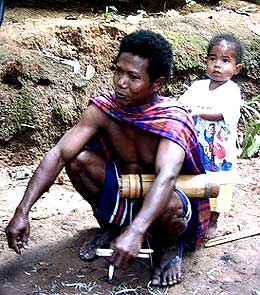 One such village is the Kampung Sungai Kejar, home to some 10 families of the Jahai tribe. The Orang Asli here is led by Radi, who at 38 is touted as one of the youngest Orang Asli headman (
right
).
One such village is the Kampung Sungai Kejar, home to some 10 families of the Jahai tribe. The Orang Asli here is led by Radi, who at 38 is touted as one of the youngest Orang Asli headman (
right
).
"They promised us a lot during the elections," said Radi when malaysiakini visited his village recently, which sits at the edge of the Temenggor lake in Hulu Perak.
Radi's village is just a 10-minute boat ride away from another slightly bigger Jahai village, Kampung Bunga Hilir.
The second village is however less developed compared to Radi's, the reason being Radi's village was fortunate enough to be visited by the Perak Menteri Besar Tajol Rosli and several other state assembly representatives.
As a result, there is a relatively large multipurpose hall built to commemorate the politicians' visit in June 2004.
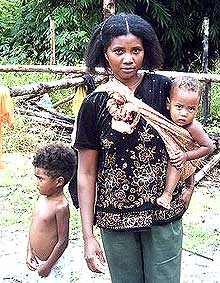 The houses in this village were sponsored by the state government, thus they look more like kampung houses with zinc roof and not shacks as those found in Kampung Bunga Hilir.
Even before the post-general election visit, several politicians had come visiting, asking the Jahais to continue to vote for BN. Some of these villagers were also made Umno members.
For Radi, it was his task to ensure that his people went in the long boat ride to vote for their BN benefactors, hoping that in return his village would get all the development they desperately wanted.
Broken promises
It has been more than three years now since the last visit by the BN politicians to his village and Radi is still waiting for the promised development.
"Where is the electricity, clean water or school?" he asked.
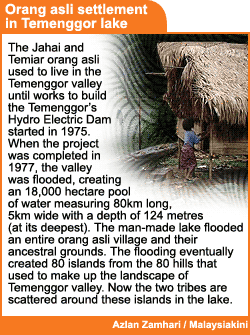 He said that he and his villagers have repeatedly reminded the Orang Asli Department of their needs but nothing has been forthcoming.
"How many times do we have to ask them? We got nothing," said the father of two young children.
When asked if they would fall for similar promises made by politicians in the next general election, Radi emphatically said: "I'm not voting anymore."
"We are not getting anything from the government. Why should we vote?" he said, adding that he would rather go look for jungle roots and rattan on polling day as he could earn some money by selling them.
When asked to comment on the 50th Merdeka celebrations this year, Radi looked puzzled and asked, " Yakah? Sudah merdeka?" (Is it? Already independent?)
"We (the Jahai) have not gained our independence. We are still left behind. The celebrations don't apply to us," he said.
Merdeka concert
And like he said there were also no signs of any preparations for a Merdeka bash in the village, unlike in Kampung Bunga Hilir where works were in progress to build a platform to act as a stage for a concert.
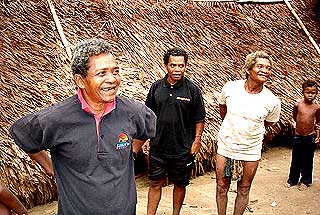 "This is the second time we are holding a Merdeka concert in our village," said Kampung Bunga Hilir chief Dubog (
far left
). The concert was sponsored by the Orang Asli Department.
"This is the second time we are holding a Merdeka concert in our village," said Kampung Bunga Hilir chief Dubog (
far left
). The concert was sponsored by the Orang Asli Department.
Interestingly when malaysiakini visited Dubog's village , almost everyone there had no idea what they were celebrating. Nor did they know how long has it been since Malaysia gained its independence.
Dubog's village has about 100 families, or kelamin as they call it, all living in squalid conditions in raised bamboo huts which leak every time it rains. Their major water source is a small stream across the lake.
However in Radi's village, the villagers have managed to incorporate a pipe system where they collect water from a stream uphill and then distribute it to the houses in the village.
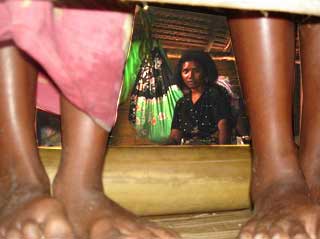 Children in both these villages are missing school simply because the nearest school is too far away (in Banding in the mainland), and they don't have sufficient boats to take them there.
This is also the case for all children from the other villages located further in the interior.
Both villagers survive largely on catching fish, trapping animals and picking roots in the jungle. They also sell their catch to middlemen in Banding, earning a paltry sum for the hard work.
When malaysiakini visited Radi's village, the village headman and his men had just returned from the jungle after looking for roots, rattan and animals.
"We were in the jungle for two days but we have nothing to show. There aren't enough animals for hunt or roots for our own use, let alone for us to sell in Banding," he said.
"All that we wasted were our poisonous darts ( buluh sumpit )," added Radi, who was in the midst of preparing more darts for future hunting trips into the jungle.
We will survive
Radi lamented that it was becoming increasingly difficult to feed all the mouths in his village.
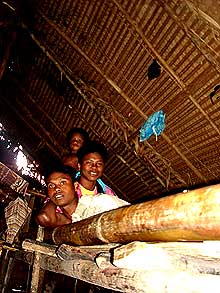 When asked if he would move out of the interior into the town area so that he could find employment easily, Radi immediately rejected that notion, saying that his people would prefer to stay where they are.
"Our forefathers are here to protect us. We love our land. We don't want to leave," he said.
"We just hope the our village is developed so that we too could enjoy the benefits," he added.
Dubog from the other village too rejected the idea of moving into civilisation.
"Never. We want the government to give us better houses and some basic amenities. And a school if possible, that's all. We will survive," he said with a toothless grin.
Photos by M Sivapriah
Related report: The forgotten Malaysians
Click below to watch 3-minute video clip


Report this comment
Are you sure you want to delete this comment?
This action cannot be undone.