


/file/publisher-c1a3f893382d2b2f8a9aa22a654d9c97/2024/08/4852517293e0f3de4fa77729869870db.jpg)

PKR MP: Govt's funding MOU an attempt to curtail opposition
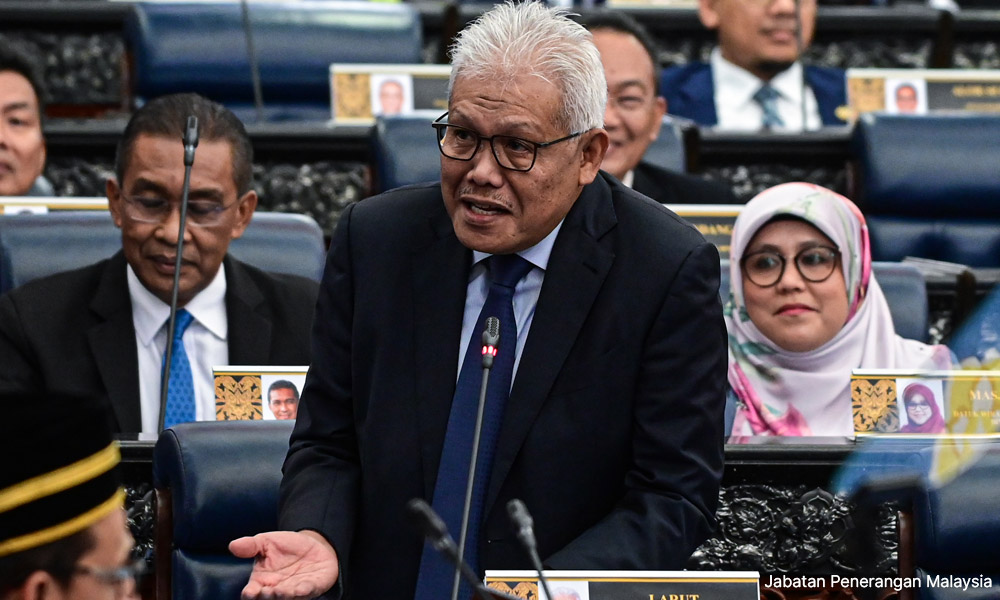
Pasir Gudang MP Hassan Abdul Karim has described the government’s memorandum of understanding (MOU) on opposition allocations as an attempt to paralyse and undermine the opposition's role in Parliament.
Calling it executive overreach, the PKR rep argued that the MOU would result in the opposition losing its ability to serve as an effective check and balance against the government.
Pasir Gudang MP Hassan Abdul Karim has described the government’s memorandum of understanding (MOU) on opposition allocations as an attempt to paralyse and undermine the opposition’s role in Parliament.
Calling it executive overreach, the PKR rep argued that the MOU would result in the opposition losing its ability to serve as an effective check and balance against the government.
“The proposal to impose the condition of signing the MOU can also be viewed as the executive, specifically the federal government, attempting to violate the principle of separation of powers by deliberately weakening the opposition bloc in Parliament,” he said in a statement today.
Hassan further explained that the Federal Constitution enshrined the principle of separation of powers, which aims to maintain the independence of the three main branches of the state - Parliament (legislative), the government (executive), and the judiciary - each of which is free to perform its roles and responsibilities as outlined in the Constitution.
On Sept 15, opposition leader Hamzah Zainudin announced that Perikatan Nasional had collectively rejected the government’s MOU, citing four main concerns.
They include fears that the agreement might compromise the rights and privileges of Malays and bumiputera as guaranteed by the Federal Constitution.
Following the rejection, Deputy Prime Minister II Fadillah Yusof revealed the contents of the MOU and dismissed Hamzah’s concerns as baseless.
Lawmakers’ oath would suffice
Hassan also claimed that the MOU conflicted with the principles of parliamentary democracy, asserting that there is no need for MPs, whether from the government, opposition, or independent parties, to sign another document after having already taken their oath before the Speaker.
He warned that signing the MOU could silence the opposition on important issues concerning the people and the nation.
“Why? Because they will have signed an agreement with the government, which is the executive.
“The introduction of this MOU is an example of executive overreach by the ruling government, undermining the freedom of opposition MPs, a fundamental part of Parliament.”
As an alternative, Hassan proposed that parliamentary reform should focus on the government introducing a Constituency Allocation Bill.
“This would ensure that every parliamentary constituency in the country is automatically and unconditionally allocated funds without needing any agreements or an MOU.
“Each MP, whether from the government, opposition, or independent blocs, should be guaranteed by law to receive the same amount of constituency funds fairly and equitably,” he said.
Yesterday, electoral watchdog Bersih also made five recommendations regarding the MOU, including a call for the government to legalise constituency development funds, ensuring equitable distribution to both government and opposition MPs, thereby safeguarding equal rights for all.
/file/publisher-c1a3f893382d2b2f8a9aa22a654d9c97/2024/04/2a7b717f87f4b215ccedd0baa84b05fe.jpg)
/file/publisher-c1a3f893382d2b2f8a9aa22a654d9c97/2022/11/d7a681912d90d25ac1fb14dfdfe1b9b4.jpg)
/file/publisher-c1a3f893382d2b2f8a9aa22a654d9c97/2023/09/ef6ae7a6c782cc6eb4cc7e74dfd7b67a.jpg)
/file/publisher-c1a3f893382d2b2f8a9aa22a654d9c97/2022/03/6a29c66bac37ad1d5f45139f10c0dd81.png)
/file/publisher-c1a3f893382d2b2f8a9aa22a654d9c97/2021/08/6943bf19c02990484599c62aeba2ad75.jpg)
/file/publisher-c1a3f893382d2b2f8a9aa22a654d9c97/2024/02/539a0711cdcfb1dd68e248390481fba8.jpg)


Are you sure you want to delete this comment?
This action cannot be undone.