


Expert: M'sians deeply involved in online scams, human trafficking
Despite many Malaysians falling victim to human trafficking and online scams, a report on transnational crime in Southeast Asia reveals a more complex reality - Malaysians are also deeply involved in running these illegal operations.
The report, “Transnational crime in Southeast Asia: A growing threat to global peace and security”, details how criminal networks built scam compounds in Myanmar, Cambodia, and Laos, and involved Malaysians in managing their operations and fraudulent proceeds.
“The senior study group involved in preparing the report looked closely at dozens of...
Editor’s Note: The article was amended to more accurately reflect the cited Usip report and statements by the study group’s chairperson.
Despite many Malaysians falling victim to human trafficking and online scams, a report on transnational crime in Southeast Asia reveals a more complex reality - Malaysians are also deeply involved in running these illegal operations.
The report, “Transnational crime in Southeast Asia: A growing threat to global peace and security”, details how criminal networks built scam compounds in Myanmar, Cambodia, and Laos, and involved Malaysians in managing their operations and fraudulent proceeds.
“The senior study group involved in preparing the report looked closely at dozens of compounds hosting forced labour scam operations across the region.
“They found that the criminal networks behind the compounds built a web of contacts across the region, including in Malaysia.
“The study group identifies the involvement of Malaysian nationals in the operation of at least two of the so-called casino cities in Myanmar,” said United States Institute of Peace (Usip)’s Burma programme country director Jason Tower, who co-chaired the study group.
“One of these casino cities, on the Thai-Myanmar border, was even launched in Kuala Lumpur by a prominent figure in Chinese transnational criminal syndicates.
“The management team in another casino city was composed of Malaysians as well as Chinese nationals.
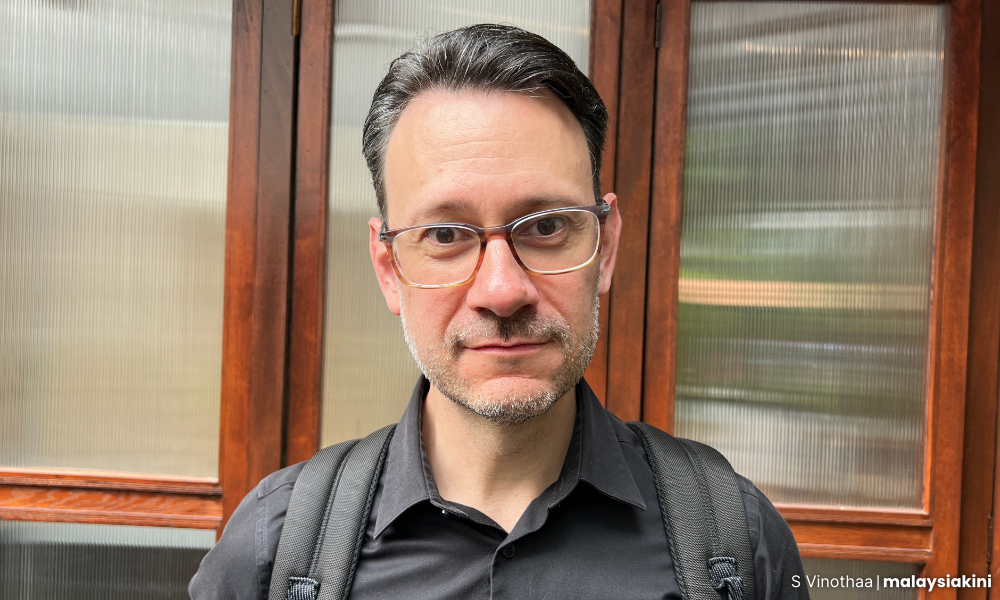
“This means Malaysians have been involved both as operators of these illegal operations and as victims, particularly in human trafficking and online scams,” added Tower (above).
The areas where these casino cities are located have been reported to be a base for cyber scam operations, involving human trafficking victims.
This mirrors the broader regional criminal landscape, where weak governance enables these operations.
Expanding criminal networks
In the course of completing the research on casino cities in Myanmar, it was discovered that Chinese crime groups operating there were deeply entangled in illegal activities across seven countries: Cambodia, Laos, Thailand, Vietnam, the Philippines, Malaysia, and Singapore.
This led Usip to expand its focus toward the broader Southeast Asian region, where it uncovered a complex, expanding network of criminal operations.
The study group was formed to explore techniques and evolving technologies these criminal networks use to extend their global influence.
The report identified key elements that undercut the ability of law enforcement to tackle the real perpetrators, including corruption of officials from top to bottom, and criminal organisations’ ties to government institutions, such as the police, customs, and other departments, which help to protect these operations.
The report stated that criminal networks enjoy political cover, secured through Malaysia’s patronage system, making it difficult to target the true orchestrators, while the lower-tier scammers are scapegoated.
The Usip 2024 report published in May is a comprehensive investigative analysis of geopolitical and criminal activities, aimed at providing policymakers with critical insights to develop more effective solutions.
Out of China
Tower pointed out that many of the scam centres were set up during China’s expansion through the Belt and Road Initiative (BRI), with implicit permission to operate in Southeast Asia.
However, during Covid-19, the operations shifted to target a global population, as China’s Covid protocols cut off access to the Chinese labour market, and the Chinese lockdown also made it harder to scam Chinese targets.
Tower said that while certain towns in China were once disproportionately affected by scams, the problem escalated as Chinese citizens became both perpetrators and victims abroad, leading the government to treat them primarily as criminals rather than acknowledging their victimisation.
READ MORE: 'Govt claiming 90pct scam victims are criminals an oversimplification'
The report also revealed how Chinese transnational crime groups exploit China’s BRI to gain legitimacy and access countries like Malaysia.
Criminal networks align with Chinese officials eager to show international support for the BRI, using the initiative as a front for their activities.
Special economic zones, created to attract foreign investment, become havens for these illicit enterprises, especially in authoritarian countries.
In Malaysia, the study found, Chinese triads use ethnic Chinese communities as entry points to build connections with political and economic elites, embedding themselves in the region’s power structures.
The Usip report highlighted the Malaysia government’s identification of 72 criminal groups, with a significant number being Chinese triads.
Two major China-linked triads operate in Malaysia, both tracing their origins to the Qing dynasty.
They are the “Green Gang”, connected to the Wah Kee secret society, and the “Red Gate,” linked to the infamous Hongmen or 14K Triad.
Broken Tooth Koi
Hongmen is led by 69-year-old Macau native Wan Kuok-koi, also known as Broken Tooth Koi.
The businessperson is a former leader of the Macau branch of the 14K Triad and was released in 2012 after more than 14 years in prison for illegal gambling, loan-sharking, criminal association, and the attempted murder of police chief Antonio Marques Baptista with a car bomb.
He became chairperson of a Malaysian public-listed firm Inix Technologies Bhd in August 2020 - a move the Securities Commission said is perfectly legal as the law only bars office bearers who had a criminal conviction in the past five years of appointment. He resigned in December of that year.
US officials have identified his other aliases which include Yin Guoju and Bung Nga Kuii.
His World Hongmen and Culture Association based in Cambodia has operated in Malaysia since at least 2018, the report noted.

Usip said he and his allies have also set up legally registered companies for their criminal activities and adapted to stronger laws and enforcement in their home base by extending operations abroad.
“A signing ceremony for several criminal investors in Wan’s Dongmei Zone in Myanmar was held in Kuala Lumpur in March of 2020, and the management team for this project was subsequently drawn from Malaysia,” the report read.
The Dongmei Zone is an area which houses online scam operations and was built between February 2020 and February 2022 in an area along the Thai-Myanmar border, where human trafficking victims were taken.
During its groundbreaking event in 2020, the Dongmei Zone was called Saixigang.
Belt and Road Initiative
“Couching themselves as part of a re-energised role for China in Southeast Asia, the criminal networks have piggybacked on the expansion of China’s investment in the region, notably, China’s Belt and Road Initiative (BRI),” read the report.
READ MORE: Scams take over drugs as top money makers in organised crime
Tower said many illicit networks, like the triads and Hongmen, surprisingly became strong supporters of BRI and began awarding contracts to Chinese state-owned enterprises (SOEs).
For example, on the Thai-Myanmar border, China Metallurgical Group Corporation (MCC), a large Chinese SOE, received a US$350 million contract from Yatai International Holding Group (Yatai IHG).
Yatai IHG is involved in developing these special economic zones, which have also been reported to be the bases of cyber scam operations.
However, in a statement to Bangkok Post in May 2023, Yatai IHG rejected claims that it runs scam operations and said the alleged scam operations are outside of the area it is developing.
The Usip report also described how, over the past two decades, China-origin syndicates have shifted from affiliates to direct operators in Malaysia, establishing legal fronts, including companies and social organisations, to mask their illicit activities.
They leverage China’s growing role in Southeast Asia, particularly through BRI investments, to engage in fraud, money laundering, and online gambling.

This transition highlights how online scams are driven by powerful criminal networks, while the real bosses remain insulated from legal consequences due to systemic corruption.
In essence, Malaysia was said to have played a notable role in facilitating and being victimised by these transnational criminal activities, particularly those tied to illegal gambling operations and online scams in Southeast Asia.



Report this comment
Are you sure you want to delete this comment?
This action cannot be undone.