


/file/publisher-c1a3f893382d2b2f8a9aa22a654d9c97/2024/11/09bcb06f6f7362e90e98175c7ec713e7.jpg)

PM hit by Blackrock deal reminder when briefing MPs about Gaza
PARLIAMENT | Prime Minister Anwar Ibrahim briefed the Dewan Rakyat today about recent developments in Gaza and what Malaysia plans to say at the Organisation of Islamic Countries (OIC) emergency meeting next week.
However, the briefing inadvertently became a platform for the opposition to grill the government once again about the sale of Malaysia Airport Holdings Berhad (MAHB) shares to the subsidiary of a company linked to the Israeli military, Blackrock.
UPDATED 12.38PM | Included comments from Kota Bharu MP Takiyuddin Hassan.
PARLIAMENT | Prime Minister Anwar Ibrahim briefed the Dewan Rakyat today about recent developments in Gaza and what Malaysia plans to say at the Organisation of Islamic Countries (OIC) emergency meeting next week.
However, the briefing inadvertently became a platform for the opposition to grill the government once again about the sale of Malaysia Airport Holdings Berhad (MAHB) shares to the subsidiary of a company linked to the Israeli military, Blackrock.
In his speech today, Anwar said he will reiterate the government’s demand for action against atrocities committed by Israel’s Zionist regime, as well as support for proposals to be adopted by the international community.
“It is important for Malaysia and the international community to condemn the genocide in Gaza, placing pressure on Israel to implement an immediate ceasefire and allow for the passage of humanitarian assistance,” he said.
Anwar said Malaysia will propose for the United Nations to summon Israel before the Special Committee against Apartheid; as well as pledge support for the efforts of the UN Relief and Works Agency (UNRWA) for Palestine Refugees in the Near East.
“Malaysia intends to use this (OIC) summit to gain the support of Arab and Muslim countries towards the initiatives, as well as prevent the Israel parliament from enforcing a decision to stop operations of UNRWA in the occupied territories.
“One possible approach is for the OIC to support mediation efforts by the United States, Egypt, and Qatar towards a ceasefire,” he said.
Being consistent
While supporting Malaysia’s stand on the international stage, Ahmad Tarmizi Sulaiman (PN-Sik) reminded Anwar that the government should be consistent in its domestic policies, including on the Blackrock issue.
“We state that we do not recognise Israel directly or indirectly. But the government must make its stand clear when many pro-Palestine activists called for a review of the sale of Malaysian Airports Holdings Berhad shares to Global Infrastructure Partners (GIP), linked to Blackrock,” he said.
“The UN Human Rights Council has declared that companies and states must immediately end arms transfers (to Israel) or risk committing a human rights violation.
“The MAHB faces this risk if it proceeds with the shares sale. So we hope that the prime minister will take a firm stand,” said the PAS lawmaker.
Last month, Blackrock Inc announced the completion of its acquisition of GIP, the entity that is set to hold a 25 percent stake in MAHB as part of a privatisation deal.
Blackrock also owns a 7.4 percent stake in Lockheed Martin - a US-based defence contractor with multibillion-dollar investments in the Israeli arms and aerospace industry.
In response, Anwar reiterated that Malaysia’s decision to not allow any Israel-based companies from operating here, as well as to prevent the entry of Israeli cargo ships, has gone beyond measures taken by many governments around the world.
More Blackrock investments incoming?
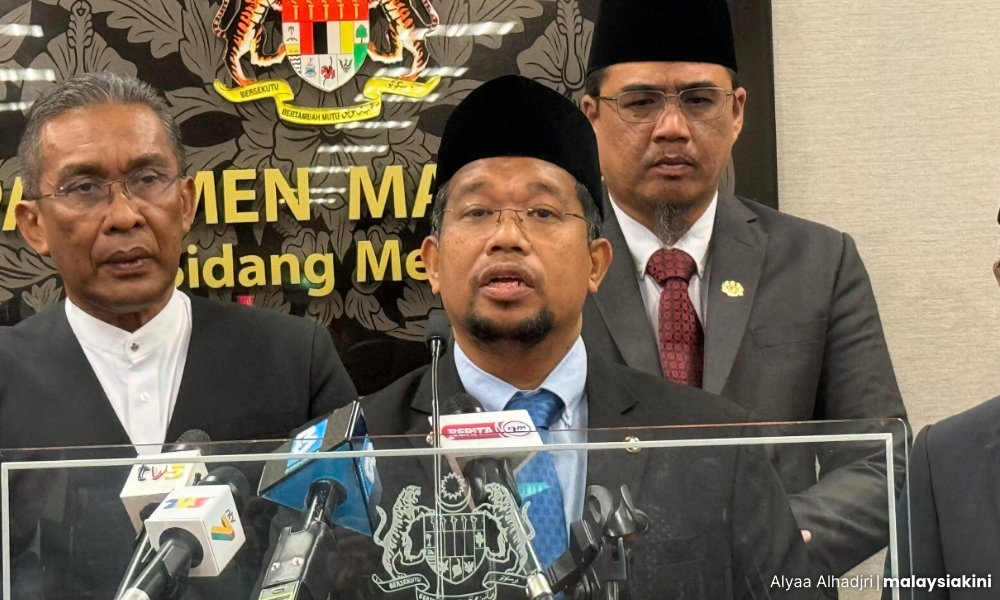
In a separate press conference, Takiyuddin Hassan (PAS-Kota Bharu) expressed concerns over Blackrock’s involvement with MAHB, citing the strategic importance of the aviation company.
He noted that while Blackrock may hold shares in various Malaysian companies, its investment in MAHB is particularly noteworthy.

“Recently, we raised this issue in Parliament, where the second finance minister mentioned that, despite Blackrock acquiring only a 30 percent stake worth around RM4 billion, the company plans to inject an additional RM10 billion in investments,” he explained.
“This injection would dilute the remaining 70 percent of shares held by Khazanah and the Employees Provident Fund, which is precisely where our concerns lie. Smaller issues can be addressed, but this has larger implications.”
Takiyuddin urged the government not to overlook the matter or misinterpret the opposition’s stance on MAHB.
“As the English proverb goes, ‘two wrongs don’t make a right.’ If both parties are at fault, it doesn’t justify either.
“So if there are similar situations elsewhere, we still shouldn’t accept it, regardless of location,” he remarked.
/file/publisher-c1a3f893382d2b2f8a9aa22a654d9c97/2024/08/07c47c0f1373f2e5f5415ae6576ab7a8.jpg)
/file/publisher-c1a3f893382d2b2f8a9aa22a654d9c97/2023/10/5829f21f83286a1ee3e4cc47e525ed96.jpg)
/file/publisher-c1a3f893382d2b2f8a9aa22a654d9c97/2024/07/fa27533822b7e8a33c220f3b5d80b304.jpg)
/file/publisher-c1a3f893382d2b2f8a9aa22a654d9c97/2024/06/b4ae282fc183902fb70c049eea4d3bb1.jpg)
/file/publisher-c1a3f893382d2b2f8a9aa22a654d9c97/2024/07/cdee960ab3abe6f744cd1cf2049ed89c.jpg)


Are you sure you want to delete this comment?
This action cannot be undone.