




Federal Court: Subashini case full hearing tomorrow
The Federal Court will hear full submissions tomorrow on the issue of jurisdiction after hearing skeletal arguments from counsel for both parties in the R Subashini case today.
The Federal Court will hear full submissions tomorrow on the issue of jurisdiction after hearing skeletal arguments from counsel for both parties in the R Subashini case today.
Subashini's lawyer Malik Imtiaz Sarwar and the respondent's lawyer Mohamed Haniff Khatri Abdullah were instructed to brief the three-man bench led by Justice Nik Hashim Nik Ab Rahman before the court was adjourned at noon.
The other two judges on the panel were Abdul Aziz Mohamad and Azmel Ma'amor.
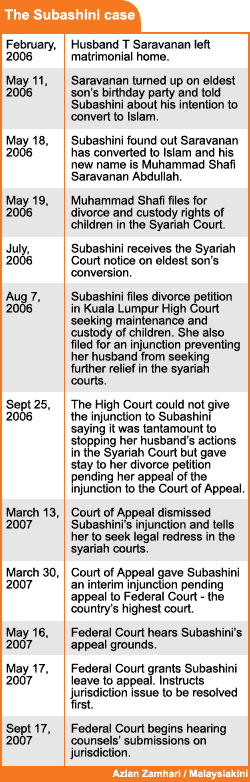 On May 17, Subashini was
granted leave
to appeal to the Federal Court to reverse the decision made in the Court of Appeal.
On May 17, Subashini was
granted leave
to appeal to the Federal Court to reverse the decision made in the Court of Appeal.
However, both parties in the case were directed to answer a paramount question concerning jurisdiction before arguing the case further.
The issue of jurisdiction - whether the civil or syariah court is more authoritative on the issue of divorce when one spouse converts to Islam - has been a long-standing moot point in the trial.
Subashini, 28, a Hindu, is trying to stop her 31-year-old husband, who has converted to Islam and assumed the name Muhammad Shafi Saravanan Abdullah, from taking the divorce proceedings to the Syariah Court.
Her battle began when her husband converted in May 2006, along with their eldest son, four-year-old Dharvin Joshua.
The husband then launched proceedings in the Syariah Court for divorce and custody of their second son, two-year-old Sharvin.
"The husband should be restrained from using the judicial system in order to get orders from the sharia court which will adversely affect the rights of the wife even though she cannot appear in that court," her lawyers said in a submission.
Subashini has twice failed in the lower civil courts. She now faces her final chance in the Federal Court.
On March 13, the Court of Appeal dismissed her attempts. Justices Suriyadi Halim Omar and Hassan Lah who made the majority 2-1 decision told her to take her case before the Syariah Court instead while Justice Gopal Sri Ram dissented.
It was also held in the landmark ruling that a Muslim could apply to the Islamic court to convert underage children without permission from the non-Muslim spouse.
However, on March 30, Subashini was granted an interim injunction by the Court of Appeal restraining Saravanan from pursuing his claims in the Islamic court.
Where they disagree
Malik told the bench that the jurisdiction should be at the civil court because Saravanan's right to embrace Islam should not extend to evading his obligation under civil law to his wife and children.
He also argued that the country's highest court had recently ruled unanimously in case of Latifah Mat Zin, that jurisdiction over a non-Muslim will fall under the civil court because the Syariah Court is only for individuals professing Islam.
"It is submitted that the correct approach must be first to examine if the Syariah Court does indeed have jurisdiction (over Subashini).
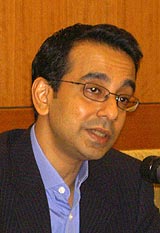 "The Syariah Court has no jurisdiction since the wife petitioner is not a person professing Islam," Malik (
left
) stated.
"The Syariah Court has no jurisdiction since the wife petitioner is not a person professing Islam," Malik (
left
) stated.
Haniff argued that there is a difference between the lack of jurisdiction over a subject matter and a lack of jurisdiction for a person.
He said this subject matter falls under Article 121(1A) of the Federal Constitution which grants jurisdiction for all Islamic law matters to the Syariah Court.
"The objection of the appellant to be made subject to the jurisdiction of the Syariah Court, on the ground that the Syariah Court has no jurisdiction over non-Muslim, is a non-starter," he said.
"The subject-matter approach to vest the Syariah Court with jurisdiction... has beyond doubt also relegated 'all persons Muslim' or 'both parties Muslim' tests as irrelevant."
The question on jurisdiction must first be settled before the court can proceed to decide on the nine questions pertaining to issues pertaining to abuse of process in the conversion of a child and the decree of divorce.


Are you sure you want to delete this comment?
This action cannot be undone.