




Poor feel the pinch of price hikes
An elderly woman in Shah Alam offers cleaning services in her neighbourhood to earn extra income to support herself and her son, who does not make enough money for both to survive in these hard times.
An elderly woman in Shah Alam offers cleaning services in her neighbourhood to earn extra income to support herself and her son, who does not make enough money for both to survive in these hard times.
At the same time, she plants greens and gets some money from her produce if the grocery shop she gives them to is able to sell them.
She has had to struggle even harder to make ends meet after the price of most essential products increased over recent months.
Since the pay hike for civil servants came into effect in July, there have been many media reports on the increased prices of essential items.
 Last week, the
New Straits Times
highlighted Deputy Prime Minister Najib Abdul Razak's statement that the people "must make adjustment to their spending" to cushion the cost of living.
Last week, the
New Straits Times
highlighted Deputy Prime Minister Najib Abdul Razak's statement that the people "must make adjustment to their spending" to cushion the cost of living.
Malaysiakini interviewed three retailers from Selangor, Penang and Johor, and all were of the same view those in the lower-income group are the worst hit by price hikes.
Cheah Cheng Swan, who has operated a sundry shop in Bukit Saga, Shah Alam, for about five years, said almost all her customers - who mainly fall into the lower income and middle income group - are affected.
"Those from the middle-income group tend to suffer because of poor financial planning, but those in the lower income are genuinely struggling to make ends meet," said Cheah, who often accepts home-based products for sale if customers bring these in to earn extra income.
Her customers, most of whom work in the Proton factory nearby, have switched from branded food-products to generic ones since the beginning of the year.
 Explaining that the shift is most evident for products like sardines, processed chicken and cooking oil, she said: "Those who were buying
Ayam
brand sardines are now buying cheaper brands, as the
Ayam
brand price has increased tremendously over the months.
Explaining that the shift is most evident for products like sardines, processed chicken and cooking oil, she said: "Those who were buying
Ayam
brand sardines are now buying cheaper brands, as the
Ayam
brand price has increased tremendously over the months.
"The same goes for cooking oil. Instead of buying branded cooking oil (at an average of RM12 to RM13 for a 5kg bottle), they are going for generic types which cost RM2.50 per packet - even this has gone up from RM2 previously."
Buying cheap comes at a cost, too, as she has seen with one brand of sardines. Poured out on a plastic plate, it left a layer of colour that could not be washed off.
Ways of coping
Shaji Kumaran, who runs a grocery store in Tangkak, Johor, shares the same view.
In an email interview, he said that customers - also from the middle and lower income groups - are opting for cheaper brands.
"For example, a packet of Nescafe which cost about RM6.40 a few months ago is now almost RM7. The price of a cheaper brand like Indocafe has increased as well, but people have started buying it now."
He said customers usually buy groceries to stock up for several weeks at the beginning of the month,when they get their pay.
"Their shopping bags mainly carry items with higher value, such as rice, milk powder, Milo and Nescafe ," he said.
"Perishable items like onions, potatoes and meat will be purchased in a lower volume. This is obviously due to the shorter lifespan of the products and would be better repurchased as the stock finishes later on in the month.
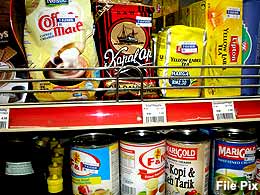 "Towards the third week, there is always a drop in sales. Our customers usually tighten their belt during this period, after settling other commitments, thus leaving only a small portion of money available to survive until their next pay packet."
Meanwhile, N Anitha who helps run her father's grocery store in Penang said many of her customers have started buying groceries in smaller volume to cope with the price increase.
However, she said, this is not the most appropriate way to shop as the consumers will end up paying more as they lose out on economies of scale.
Gradual increase
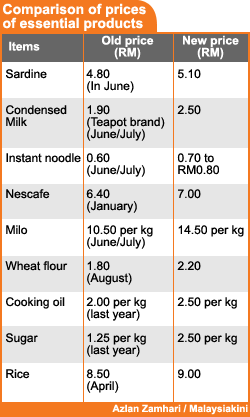 Looking at the bigger picture of price increases, Cheah explained that the price of
Maggie
noodles has gone up by 60-70 sen over a period of time, whereas the price of
Ayam
brand sardines has increased by 60 percent over the last five years.
Looking at the bigger picture of price increases, Cheah explained that the price of
Maggie
noodles has gone up by 60-70 sen over a period of time, whereas the price of
Ayam
brand sardines has increased by 60 percent over the last five years.
Shaji said the price of condensed milk has gone up by 10 percent over the last few months, but has recorded a steady rise of 30-40 percent over the years. Many of his customers have complained about this.
He also said the price of Milo has also increased by 5-10 percent in recent months.
Anitha pointed out that the price of sugar, a controlled item, and wheat flour have also shot up over the years.
"Last week, the price of wheat flour increased from RM1.80 to RM2.50. Although the government has capped the price at RM1.80, the middlemen are selling it at RM2.10," she said.
Sugar has gone up from RM1.25 a few years ago to RM2.50 at present.
Asked if the purchasing power of consumers has diminished over the years, Shaji and Anitha agreed that there has been an impact.
"Yes, the buying power has been brought down but it is still at an acceptable level. We cannot avoid inflation. However, it can be controlled by proper implementation of government policies," said Shaji.
 Cheah feels that consumers can adjust buying power through better planning of disposable income.
"The middle-income group is hit by the price increase because they tend to give priority to luxury items," she said, also noting that they are locked into mortgages and other forms of fixed monthly payments.
She also suggested that the government stops subsidising the price of essential commodities, while finding a way to boost disposable income through provisions in the national budget that "give back" money to taxpayers.
This, she added, would be more effective than picking up the cost of essential items and then throwing more money into enforcement to ensure that traders are not manipulating prices.


