


/file/publisher-c1a3f893382d2b2f8a9aa22a654d9c97/2025/04/636d6b8ecd5e6c66786a0f9751196c3b.jpg)

Trump puts 'reciprocal tariffs' on hold, 10pct baseline stays
US President Donald Trump has announced a 90-day pause on the so-called “reciprocal tariffs” imposed on imports from about 60 countries and territories just as it came into effect.
This includes the 24 percent tariff imposed on Malaysian imports into the country, though the 10 percent baseline tariff for nearly all countries will remain in place.
In the announcement made through the microblogging site Truth Social, Trump said...
Summary
Trump announces a 90-day pause on new “reciprocal tariffs”, including the 24 percent imposed on Malaysian imports, reducing it to 10 percent temporarily.
The move follows negative market reactions and requests from over 75 countries for negotiations, though China still faces a 125 percent tariff.
US President Donald Trump has announced a 90-day pause on the so-called “reciprocal tariffs” imposed on imports from about 60 countries and territories just as it came into effect.
This includes the 24 percent tariff imposed on Malaysian imports into the country, though the 10 percent baseline tariff for nearly all countries will remain in place.
In the announcement made through the microblogging site Truth Social, Trump said the decision was made based on the fact that more than 75 countries have contacted the US for the negotiations and have not retaliated against the US new tariffs.
As such, he said, “I have authorised a 90-day pause, and a substantially lowered reciprocal tariff during this period, of 10 percent, also effective immediately.”
The New York Times quoted Trump saying the decision was made following the negative market reaction towards the new tariffs.
“Well, I thought people were jumping a little bit out of line. They were getting yippy. They were getting a little bit afraid,” he said.
The pause marks a reversal of his stance that there would be no delays, and despite trumpeting on Truth Social last Friday that “My policies will never change.”
Instead, he reportedly told reporters at the White House today that, “This is something, certainly, we’ve been talking about for a period of time.
“We don’t want to hurt countries that don’t need to be hurt,” he said, according to The New York Times.
US v China
In the same announcement, however, Trump continued the tit-for-tat tariff escalation between the US and China by announcing a 125 percent tariff on Chinese imports.
“At some point, hopefully in the near future, China will realise that the days of ripping off the USA, and other countries, is no longer sustainable or acceptable,” he said.
The announcement also came just after the EU announced 25 percent retaliatory tariffs on most US imports, though these would only come into effect on April 15.
Asked about this, Trump reportedly said it was “bad timing for them” but added that he is glad the EU had held back when informed that the measures would only be implemented later.
On April 2 (US time), which Trump dubbed “Liberation Day”, he unveiled a set of sweeping tariffs.
These comprise a 25 tariff on automobiles and parts and a 10 percent tariff baseline tariff that came into effect on April 5.
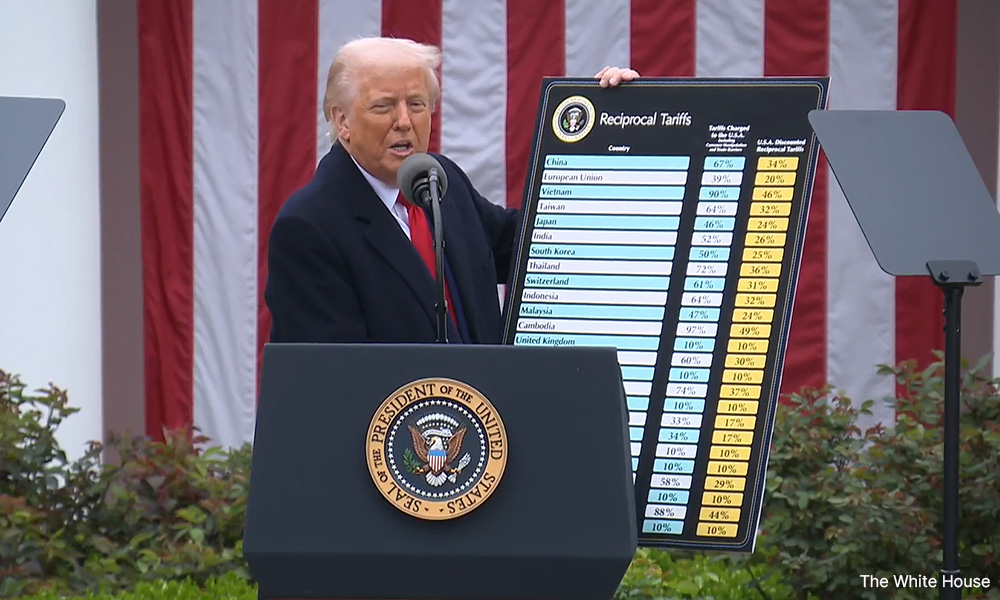
In addition, countries and territories accused of putting up trade barriers against the US were subject to higher tariffs, as high as 50 percent.
Seeking engagement
Malaysia, which it accused of setting up tariff and non-tariff barriers equivalent to a 47 percent tariff on US goods, was slapped with a 24 percent tariff in retaliation.
Various economic experts have highlighted flaws in how the US arrived at its conclusion, saying that the formula simply targets countries with which the US has a trade deficit rather than involving any in-depth analysis of trade barriers.
Prime Minister Anwar Ibrahim has described the calculation as “fundamentally flawed”, while Investment, Trade, and Industry Minister Tengku Zafrul Abdul Aziz said the actual tariff imposed on US goods imported into Malaysia is only 5.6 percent.
Malaysia has been seeking engagement with the US over the tariffs, with Zafrul slated to lead a Malaysian delegation to Washington by the end of the month.
As the Asean chairperson this year, the country is also seeking a coordinated regional response to the tariffs.
/file/publisher-c1a3f893382d2b2f8a9aa22a654d9c97/2020/12/05b5219ad3ec58bb4fdfcbfd0eab09c8.jpg)
/file/publisher-c1a3f893382d2b2f8a9aa22a654d9c97/2025/04/a7af76a7233cb9cd0490a4692276b07a.jpg)
/file/publisher-c1a3f893382d2b2f8a9aa22a654d9c97/2024/09/312d8940e4a71f4f59aab86584aeea6b.jpg)
/file/publisher-c1a3f893382d2b2f8a9aa22a654d9c97/2024/11/e8091cd3768a58209338e97d6b36543f.jpg)


Are you sure you want to delete this comment?
This action cannot be undone.