


/file/publisher-c1a3f893382d2b2f8a9aa22a654d9c97/2025/04/4f941282e25c54337ece1420d665c074.jpg)

From wreckage to gold: Sivasangari's transformative trek in pro-squash
MALAYSIANSKINI | When professional squash player Sivasangari Subramaniam smiles, she radiates. In moments of triumph on the court, the smile is there - raw and real - along with raised arms, clenched fists, a sweat-soaked victorious gesture.
It’s an expression that reveals the long, grueling journey behind the moment - from recovering after a career-threatening car accident to rebuilding her strength with quiet resilience and relentless dedication, leading her back to the world stage.
The 26-year-old's unshaken calm under pressure has drawn admiration from elite commentators and fans alike, marking her not just as a fierce competitor but as a player in full command of her mental game.
It’s this quiet intensity that likely inspired the Professional Squash Association (PSA) to dub her the “Malaysian Tiger” about two years ago.
The PSA oversees the...
Summary
After a serious car crash, Sivasangari Subramaniam thought she would never play squash again, but her determination to rise against challenges brought her back with a golden bang.
The ‘Malaysian Tiger’ won her maiden gold last year in the London Classic, and now she has her eyes set on an Olympic gold.
As she puts it, "hard work beats talent," and the key to success, whether in sports or life, is consistent effort and genuine passion.
MALAYSIANSKINI | When professional squash player Sivasangari Subramaniam smiles, she radiates. In moments of triumph on the court, the smile is there - raw and real - along with raised arms, clenched fists, a sweat-soaked victorious gesture.
It’s an expression that reveals the long, grueling journey behind the moment - from recovering after a career-threatening car accident to rebuilding her strength with quiet resilience and relentless dedication, leading her back to the world stage.
The 26-year-old's unshaken calm under pressure has drawn admiration from elite commentators and fans alike, marking her not just as a fierce competitor but as a player in full command of her mental game.
It’s this quiet intensity that likely inspired the Professional Squash Association (PSA) to dub her the “Malaysian Tiger” about two years ago.
The PSA oversees the international squash tour, which runs annually, where players compete to earn world ranking points - beginning with major events like the CIB Egyptian Open in late August and culminating in the PSA World Tour Finals in June.
Sivasangari joined the PSA Tour in 2014 at 15 and reached the quarterfinals in most of her first tournaments. From 2016, she dominated the Malaysian Tour, winning her first six events and continued her success in 2017, breaking into the world’s top 50.
Not every player on the PSA Tour gets a nickname, as they’re typically reserved for those who’ve made a lasting impression.
“I don’t know why they chose to call me that but maybe it’s just the way I am. I don’t think I'm fierce.
“Not all players get one… so yeah, it’s good to have a nickname on tour. It means you’re recognised,” said Sivasangari.

With squash now included as a medal event in the Olympics, Sivasangari has her eyes set on bringing home Malaysia's first gold medal.
As a podium programme athlete, she hopes to be enrolled in the National Sports Council's Road to Gold programme once it begins to reach this goal.
Podium programmes are training systems designed to support top athletes with medal potential at major events.
However, her eligibility will depend on her performance in the international circuit, with rankings playing a key role in the selection criteria. Her next competition will be in the Grasshopper Cup in Zurich, Switzerland.
Sivasangari’s ultimate goal is to reach the world number one ranking, solidifying her place among the sport’s upper echelon.
The amazing ‘giant killer’
Born in Sungai Petani and raised in Alor Setar, the Kedahan was already dabbling in badminton, swimming, taekwondo, and classical Indian dance purely for fun when she enrolled in a talent identification programme held at her primary school, Sekolah Kebangsaan Taman Rakyat.
Alongside her brother, Puvendren, 28, she was selected to train under a state-run squash development programme.
“Attendance was strict and my parents got very involved with sending us for training, but I was still just having fun playing squash,” she recalled.
It wasn’t until she began competing and seeing results that something shifted.
“That’s when I decided to put more effort into my game,” she said.
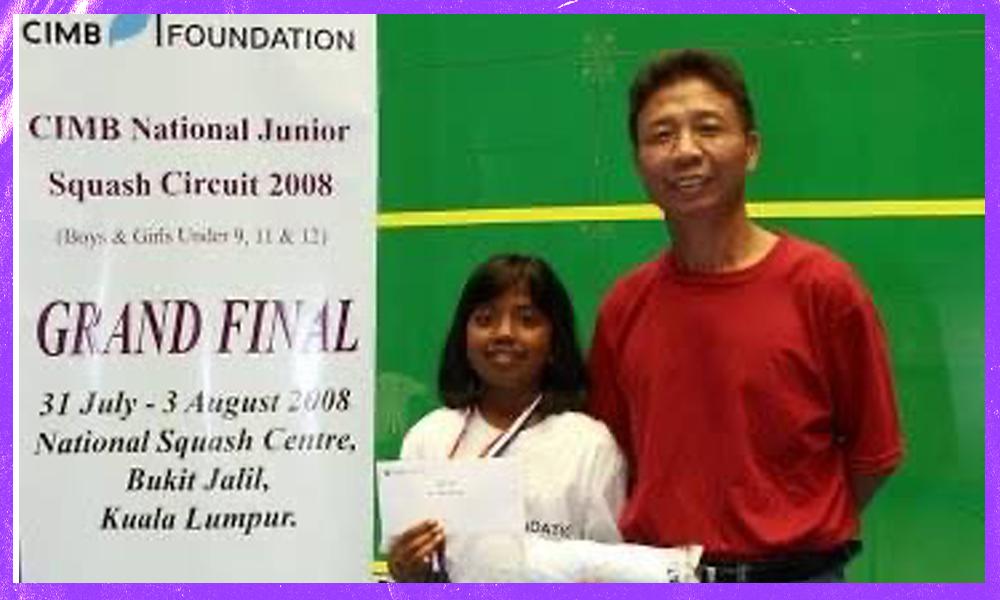
The girl who first picked up a squash racket at seven and began competing at nine was driven by a growing hunger to win and she soon found herself competing at the British Junior Open every year. It was that determination that shaped her into the player she is today.
Sivasangari plays an aggressive, fast-paced game that pressures opponents with quick rallies and precise, strategic shots.
What sets her apart is her ability to mix up angles and placements, using smart, deceptive shots to stay in control.
Despite her relatively small stature, standing at 160cm and weighing approximately 53kg, she leverages her agility and precision to dominate rallies.
Her style has been described as fluid and precise, contrasting with more physically imposing opponents.
After recovering from serious injuries sustained in a 2022 car accident, at the 2024 GillenMarkets London Squash Classic, Sivasangari’s dominance was on full display, which was encapsulated by the commentator’s remarks after she took the final point:
"She’s done it! The amazing ‘giant killer.’ She’s taken down the world number one, the world number four, and now the world number two, all in the same tournament."
As Sivasangari knelt on the court, head bowed in either disbelief or gratitude for her maiden gold in the London Classic, the commentator continued:
"She has been by far the best player in this tournament all week. Ruthless, aggressive. She really took the game to the world number one."
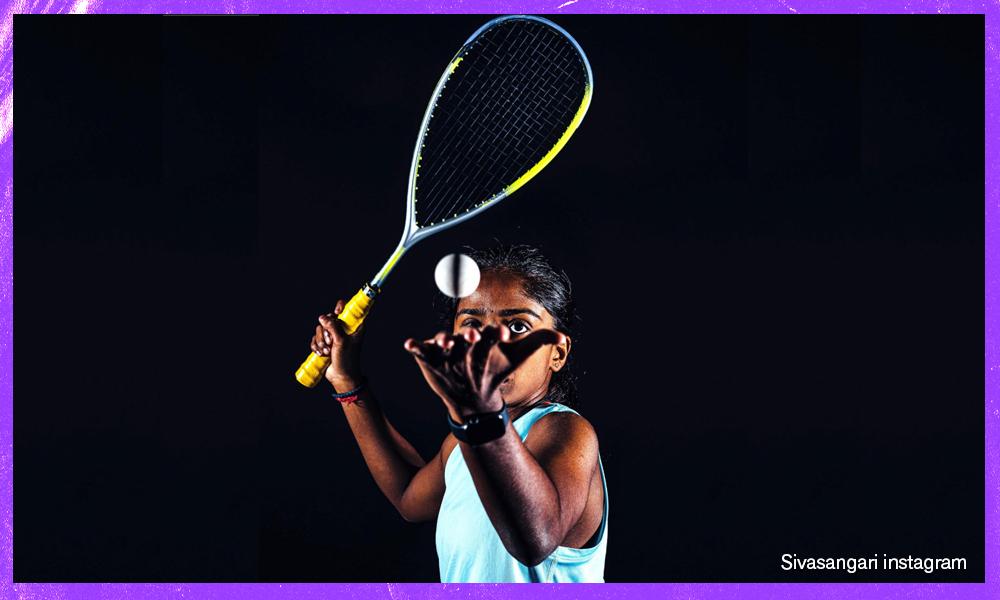
Sivasangari’s victory wasn't just a statement of skill, it was a testament to her persistent drive and mental strength - a combination that has made her one of the most exciting players to watch on the circuit.
She entered the London Squash Classic as the 16th seed, climbed to 13th by the time she reached the finals, and finished the tournament ranked 10th.
Not just a physical sport
With the ball speed reaching up to 290kph, professional squash is not just about physical strength.
Sivasangari likens it to a game of chess on a court - every move is calculated, and strategy can be the deciding factor between winning and losing.
“Tactics are really important. You’re playing against different players with different game plans and styles, so you have to adapt and get it right,” she said, adding that it is even more so at the top level.
Intuition also plays a significant role, she said.
“You have to be smart out there, but sometimes you have to follow your instincts. You can’t change your playing style too much.”
She also revealed that the game plan is all about making the opponent work for every point and utilising the court’s full length to your advantage to keep the pressure on.
It’s also important to have a Plan B, in the event the game plan fails, she added.
Competing with legends
With her rising popularity among squash fans, Sivasangari recalled one of the sweetest gestures from a young girl who, after watching her play at the Malaysian Open, handed her a card and a bouquet.
"It was really cute, especially because she was so young. I’m guessing she was seven and played squash too,” Sivasangari shared.
On icons who inspired her, Sivasangari spoke fondly of squash queen Nicol David and Egypt's Raneem El Weleily - both of whom have since retired from the sport.
"Nicol was huge in our country. I looked up to her a lot, especially when I was around nine or 10 years old. She was a true legend of the game," she said.

Nicol held the world number one squash ranking for a record 109 consecutive months - an extraordinary feat in a sport where rankings constantly shift with every match.
Sivasangari also admires the playing style of Raneem.
"She's super smooth on the court. Calm, but aggressive and smart. It's a pleasure to watch her play."
Having played against both of her idols, Sivasangari describes it as a learning experience.
"Just getting on court with Nicol was huge for me. I’ve looked up to her since I started my journey. My goal was to stay on court as long as I could and make the match as competitive as possible,” she recalled.
Against Raneem, the match was equally valuable.
"It wasn’t just about beating her, but more about taking points from her game and analysing how she plays," Sivasangari explained.
For the rising squash star, playing these legends not only served as an opportunity to learn but also a reminder of how far she has come.
Mark of destiny
In mid-2022, Sivasangari was asleep in a car her friend was driving when they were involved in a terrible accident which left her with facial fractures, a broken jaw, and a fracture to her C1 vertebra, just millimetres from her spinal cord.
Doctors warned of the risks as her life and squash career hung in the balance.
The media attention only added pressure, especially for her parents, who had to field questions while grappling with the uncertainty.
“The main injury (that threatened my) squash (career) was my neck. It was very close to my spine, and it prevented me from turning my head fully. I was lucky,” she shared.

She spent two weeks in hospital, then months in recovery, first wearing a hard neck brace, then a soft one. Her face bore scars, and titanium had to be inserted near her cheek to fix the broken jaw.
“There was a big cut on my forehead. That was my first surgery,” she said.
Eventually, she chose rest over risky neck surgery, to let it heal naturally and preserve mobility.
“I didn’t want steel in my neck. I needed that rotation for squash,” she said.
Though she missed the 2022 Commonwealth Games, where she was slated to be Malaysia’s flag bearer, Sivasangari focused on healing, which was slow and demanding. At first, she could only manage light cycling and bodyweight exercises.
“I had to trust the journey. If I rushed it, I could’ve made things worse,” she said.
Sivasangari made her competitive return in January 2023, representing Cornell University, where she later graduated with high honours with a Bachelor of Science in Communications in May of that same year.
At that point, she estimated she was only 50 percent healed. It wasn’t until the summer, about a year after the accident, that she felt close to fully cured.
“Getting back took about five to six months. Even then, I couldn’t fully turn my neck.
“Mentally, it was as tough as the physical part. I had to rebuild both strength and belief,” she said.
By September 2023, she was back with a bang when she competed at the Asian Games in Hangzhou, China, clinching two gold medals in women’s singles and team events, a full-circle moment for someone who once thought squash might be over for her.
“Squash has been my life since I was young. After the accident, I told myself, if I couldn’t play, it’s okay, I’ll find something else. But I still wanted to try. And I’m glad I did,” she said.
Today, the scar across her forehead is a quiet reminder, not of the pain, but of the power she discovered in herself.
“Sometimes, it reminds me how strong I am. Rather than thinking about the bad, I try to see how far I’ve come,” she added.
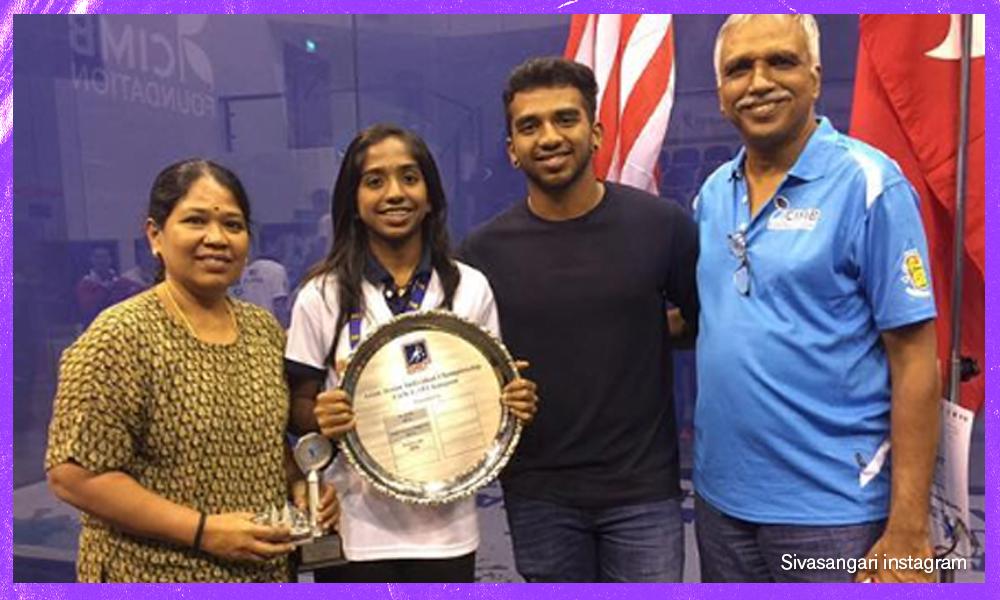
Strong support by her side
Apart from her parents, Subramaniam Kaniappan, 65, a retired Aimst University COO, and Valli Nagappan, 60, an English teacher, Sivasangari also leaned on two pivotal figures - national head coach Ajaz Azmat, and Cornell University head coach David Palmer.
“I think that was my lowest point,” she said quietly. “In life and in my squash career.”
Sivasangari wasn’t just trying to heal, she was trying to become whole again, to reclaim a game that once came effortlessly.
But she wasn’t alone. Even with an ocean between them, Ajaz, who is from Pakistan, stayed close.
“Ajaz was always checking up on me. Being there for me, virtually, but always present.”
At Cornell, it was her college coach, a former world number one, who anchored her.
“Palmer was there all the time, pushing me. It was tough because I had high expectations for myself, and I wasn’t reaching them. I wasn’t 100 percent recovered. Mentally, it was really hard.
“I felt like I couldn’t get back to where I was, but I had to try. The love I have for this sport is so big,” she said.
Before the accident, Sivasangari had broken into the world’s top 20. After graduation, she dreamed of going pro and letting go of that dream felt impossible.
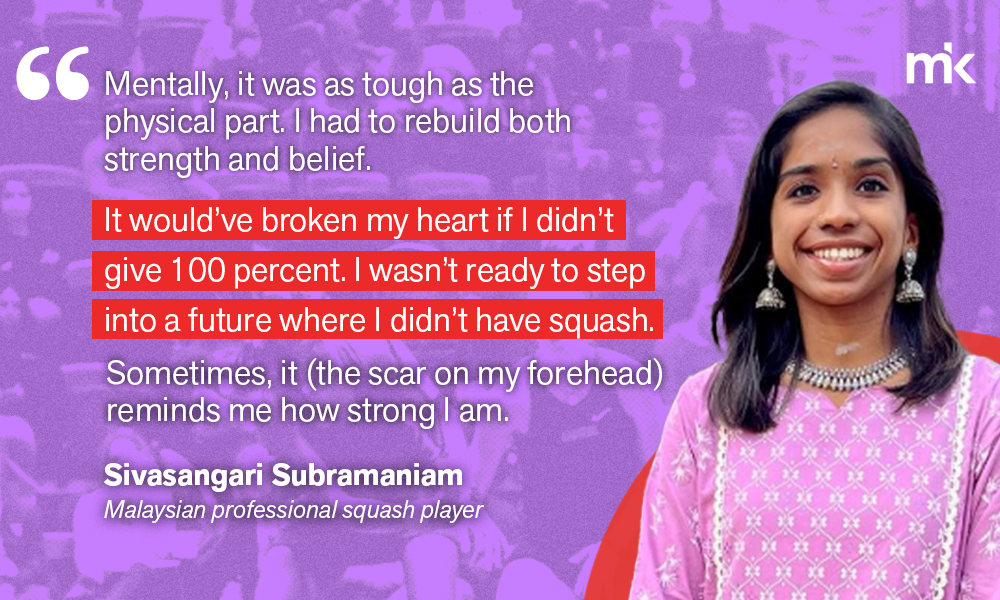
“It would’ve broken my heart if I didn’t give 100 percent. I wasn’t ready to step into a future where I didn’t have squash,” she said.
So she kept going.
In the summer of 2023, after graduating, she dedicated herself to training.
“That summer changed everything. I came back much stronger,” she said.
Placing Cornell on squash map
The 2023 season became a turning point in her recovery, with Sivasangari once again earning All-American honours, being named First-Team All-Ivy, and claiming the Ivy League Player of the Year title.
In 2021, she stormed through the national championship, going undefeated with 19 consecutive victories, a feat that made her the first Cornell squash player to capture a national individual title.
Her accomplishments that year made history, cementing her place in the record books as a trailblazer for the programme.
Yet, the 2023 finals were a reminder that progress doesn’t always follow a linear path. In a hard-fought battle, Sivasangari fell short of defending her title, losing in four tight sets to Columbia’s Simmi Chan.
However, the outcome didn’t overshadow what she had already achieved.
It was her comeback story, the way she rose from the depths of uncertainty, that truly defined her season.
Even when the odds seemed stacked against her, Sivasangari’s belief in herself never wavered.
"I needed to try my best to get back to where I was," she said, a testament to the mental toughness she had developed during those six months in recovery.
But her journey wasn’t only personal. Through her success, she helped elevate Cornell’s squash programme, bringing attention to a university that had never seen a national champion before.
By becoming a trailblazer, Sivasangari not only raised the level of play at Cornell but also changed the course of its squash future.
Hard work over talent
The path to success isn’t just about raw talent, Sivasangari believes in putting in the elbow grease.
“I think hard work beats talent. You have to put in a lot of work if you want to get better at anything, whether it's sports or anything else.
“If you want to see a good result, you have to put the work in,” she advised.
It was this mindset that carried her through her toughest career challenges, but more than that, it was her love for the sport that kept her going.
“You have to enjoy what you're doing. If you don’t enjoy it, it just becomes a daily routine, and you feel forced into that position.
“Even when it’s tough, when there’s pressure, you have to find some enjoyment in it,” she said.
MALAYSIANSKINI is a series on Malaysians you should know. For March, we are featuring notable Malaysian women as part of the Women In Front series for International Women’s Day.
Women In Front 2025:
From make-believe spaceships to trailblazing M'sia's space trajectory
PAC chair with the most probes, aiming for accountable politics
Sarawakian musician on mission to revive fading ethnic sounds
/file/publisher-c1a3f893382d2b2f8a9aa22a654d9c97/2024/08/46e10db5b79a72acb48f2b21cd86a465.jpg)
/file/publisher-c1a3f893382d2b2f8a9aa22a654d9c97/2024/04/196fe8e7eaabe153d4d969bc54aa375a.jpg)
/file/publisher-c1a3f893382d2b2f8a9aa22a654d9c97/2024/04/c0eb2563a5af9122f952a968a071e41b.jpg)
/file/publisher-c1a3f893382d2b2f8a9aa22a654d9c97/2023/12/5a0071bb80814eb218af979d90dd9bc6.jpg)


Report this comment
Are you sure you want to delete this comment?
This action cannot be undone.