


/file/publisher-c1a3f893382d2b2f8a9aa22a654d9c97/2024/05/ef41283591a817e463e8ec43f3069e49.jpg)

Police: Beng Hock probe nears end, family uncooperative
However, according to Bukit Aman CID director Shuhaily Mohd Zain, the family has not been cooperative during the process.
“The investigation is limited in terms of...
Summary
Cops say the probe into Teoh Beng Hock’s 2009 death is in its final stages, but hampered by uncooperative witnesses, including his family.
Beng Hock’s family accused police of harassment and ignoring key issues, urging them to investigate implicated MACC officers.
Bukit Aman CID director Shuhaily Mohd Zain adds that a 3D rendering of the crime scene yielded little progress due to insufficient witness input.
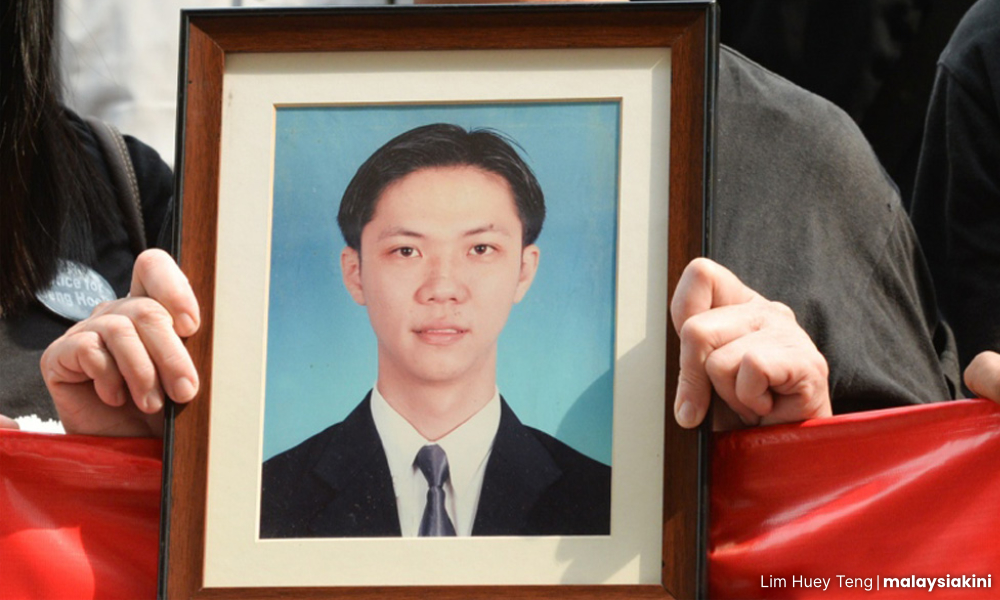
The reinvestigation into the death of former political aide Teoh Beng Hock, who died 15 years ago, is now in its final stages.
However, according to Bukit Aman CID director Shuhaily Mohd Zain, the family has not been cooperative during the process.
“The investigation is limited in terms of resources, as it was 15 years ago. We are unable to reinterview some witnesses, while others refuse to come forward.
“We also called up (Beng Hock’s) family members, but they did not give good cooperation,” he was reported as saying.
In February, Beng Hock’s family told the police to steer their investigation in the right direction and highlighted 10 unresolved issues.
The family criticised the police for repeatedly questioning them instead of investigating the MACC officers implicated in Beng Hock’s death.
“We are deeply perplexed and outraged. Why do the police summon us for questioning every time they reopen the investigation? Is this an attempt to torture and harass us into giving up? Or is it to try to shift blame onto the victim to find evidence to support the suicide theory, which the Court of Appeal has already ruled out?
“We firmly reject any further police summons for statements. Every possible statement from the Teoh family has already been recorded. We urge the police to respect the law and the court ruling, immediately arrest the individuals named in the Court of Appeal’s judgment and ensure that all offenders - including MACC officers - are held accountable.
“We call on the police to thoroughly study the Court of Appeal’s ruling and to investigate the case based on the findings of Justices Hamid Sultan and Mah Weng Kwai,” said the deceased’s sister Lee Lan.
Crime scene investigation
Elaborating, Shuhaily (above) said the 3D rendering of the crime scene also failed to shed light on the case.
“The reason being that the rendering could not give us a picture of what occurred due to a lack of input from witnesses.
“The only thing that assisted us is the physical aspect of the investigation, such as the angle of the drop,” he said.
It was previously reported that a firefighter was roped in to simulate various possible scenarios surrounding his death, including the possibility of Beng Hock falling on his own or being forced to jump.
“We wanted to assess whether such scenarios were feasible from that window. The test was to confirm if it could happen in different situations,” Shuhaily had said.
Beng Hock, an aide to then-Seri Kembangan assemblyperson Ean Yong Hian Wah, was found dead after overnight questioning at Selangor MACC, which was then headquartered at Plaza Masalam in Shah Alam.
A 2011 Royal Commission of Inquiry ruled he was driven to suicide due to aggressive interrogation. However, in 2014, the Court of Appeal ruled his death was caused or accelerated by unlawful acts, including those of MACC officers.
On Nov 21 last year, the Kuala Lumpur High Court ordered the police to complete the investigation into his death within six months after appeals court judge Wan Ahmad Farid Wan Salleh allowed a judicial review application by Beng Hock’s parents.
/file/publisher-c1a3f893382d2b2f8a9aa22a654d9c97/2024/07/49d5cd32246ab07a0f5dac92edee11c6.jpg)
/file/publisher-c1a3f893382d2b2f8a9aa22a654d9c97/2024/08/79505f9c58d1b5bd5663730adc1b8907.jpg)
/file/publisher-c1a3f893382d2b2f8a9aa22a654d9c97/2025/02/56af8e7fd77f2053c4e015aaf41ebaad.jpg)
/file/publisher-c1a3f893382d2b2f8a9aa22a654d9c97/2024/05/a4b443d6a0090cc7059370d948c83003.jpg)


Report this comment
Are you sure you want to delete this comment?
This action cannot be undone.