


/file/publisher-c1a3f893382d2b2f8a9aa22a654d9c97/2025/08/cf8b0c455edc965814182a38116bc092.jpg)

'Pen Drive man' offers to train M'sian academics to combat brain drain
Businessperson Pua Khein Seng, the Malaysian who invented the world’s first single-chip USB flash drive, has offered to train Malaysian academics at his headquarters in Taiwan to bolster his home country’s technology sector and stem brain drain.
While Malaysia is already a seasoned player when it comes to assembling semiconductor devices, Pua (above) said the country’s education system still needs more exposure to designing semiconductors and integrated circuits, a field he can help with.
“We have a lot to offer to...
Businessperson Pua Khein Seng, the Malaysian who invented the world’s first single-chip USB flash drive, has offered to train Malaysian academics at his headquarters in Taiwan to bolster his home country’s technology sector and stem brain drain.
While Malaysia is already a seasoned player when it comes to assembling semiconductor devices, Pua (above) said the country’s education system still needs more exposure to designing semiconductors and integrated circuits, a field he can help with.
“We have a lot to offer to cooperate with local universities. So if they want more support, they can send a few of their professors to my company in Taiwan, and work with my engineers for at least a year.
“If they can stay for one year, they know what’s there, then when they go back to campus, they can easily educate their students in engineering,” he said.
In August last year, Pua established MaiStorage Technology Sdn Bhd as a subsidiary of Phison, his Taiwanese company that invented the single-chip USB flash drive.
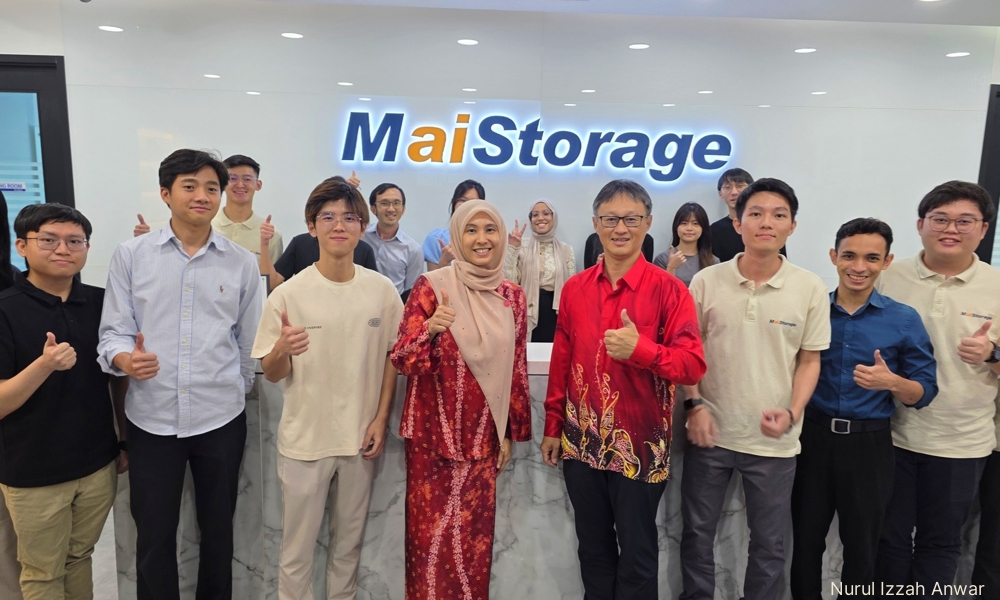
MaiStorage is an integrated circuit design and storage technology provider that caters to the data centre, artificial intelligence applications, and the automotive industries in the country.
The company was officially launched by Prime Minister Anwar Ibrahim in May and is managed by Selangor Information Technology and Digital Economy Corporation (Sidec), with co-investment from the Selangor government and the Economy Ministry.
‘Train the trainer’ approach
Similar to his previous strategy with Phison, Pua said that his long-term aim for MaiStorage is to recruit and train fresh graduates while offering them competitive salaries.
Last year, the company hired more than 50 entry-level engineers from Malaysian universities, with a starting salary of RM6,000. Pua said he plans to employ around 70 to 100 more graduates this year, and hopes to gradually increase the company’s workforce.
In this case, he explained, it becomes necessary to “train the trainer,” if Malaysia is serious about expanding expertise and opportunities within the field of integrated circuit and semiconductor design.

“You see, (if) now I have 50 engineers, I need to train (them) everything myself. Next, I need to hire the other 75, (also) I need to train myself.
“After 10 years, I still need to train myself. Why not (let the) university train for us? If you want to build Malaysia to be a good cluster in the design, then train the trainers first, train the professors first.
“(This is) the faster way. Train the trainer,” he said.
For the love of the country
Pua shared that he was willing to do this as he loves the country, noting that foreign companies would not be keen to impart much of their technology know-how.
He explained that he wants to invest in this industry because he believes in its potential, and hopes to expand the market for integrated circuit and semiconductor designs in Malaysia.
“We agree that Malaysia has a small market. But when you check how many electronic systems we import from overseas, then that number is very big.
“So the government needs to think about how we can use our home market to incubate local design companies.”
Pua said it is pertinent for Malaysia to have an ecosystem and market that can support the integrated circuit design industry.
Second wave
He said MaiStorage is planning a second wave where they want to hire more engineers, estimated to be between 100 and 200 every year.
However, for this to happen, Pua stressed that there has to be a business for the company in Malaysia.
“Without business, we can't do that much,” he added.
He also plans for the company to become publicly listed by 2028, and emphasised again that it could only be achieved through government support.

Last month, Malaysiakini reported that Nurul Izzah Anwar had previously met with Pua to discuss his long-term vision for MaiStorage and the future of Malaysia’s technology industry.
During the meeting, the businessperson expressed the desire to bring RM100 million in investments to Malaysia, as well as technology transfer valued at RM1 billion, which would allow Malaysia to spearhead the microchip design industry.
/file/publisher-c1a3f893382d2b2f8a9aa22a654d9c97/2025/07/ffab57983d0988babed73ea7e48cc84e.jpg)

/file/publisher-c1a3f893382d2b2f8a9aa22a654d9c97/2024/11/3560b8e25e2f57005e0b6ec36e39bb91.jpg)
/file/publisher-c1a3f893382d2b2f8a9aa22a654d9c97/2025/08/22ea6c20e5e9629407e0ac1b77f6751a.jpg)


Report this comment
Are you sure you want to delete this comment?
This action cannot be undone.