


/file/publisher-c1a3f893382d2b2f8a9aa22a654d9c97/2024/11/488a7d96ee328356d361d599a93c4477.jpg)

Govt MPs press for RCI, review of 'lopsided' US trade deal
Addressing a press conference in Parliament today, Subang MP Wong Chen read out a statement also endorsed by fellow government lawmakers Rafizi Ramli (Pandan) and Nik Nazmi Nik Ahmad (Setiawangsa).
The trio argued that while the agreement may have some positive impacts, particularly on digital trade, semiconductors, and pharmaceuticals, they remain concerned that the deal was not...
PKR backbenchers have outlined several recommendations to the government, following their assertion that the Malaysia-US trade agreement is “heavily lopsided” in favour of the foreign power.
Addressing a press conference in Parliament today, Subang MP Wong Chen read out a statement also endorsed by fellow government lawmakers Rafizi Ramli (Pandan) and Nik Nazmi Nik Ahmad (Setiawangsa).
The trio argued that while the agreement may have some positive impacts, particularly on digital trade, semiconductors, and pharmaceuticals, they remain concerned that the deal was not entered into according to due process.
“We are convinced, based on the official responses and lack of clarity of the text, that the signing of the agreement was done without a comprehensive cost-benefit analysis and adequate public consultations,” Wong said.
“We also note with deep concern that there are direct and indirect negative impacts of the agreement on Malaysia, including but not limited to the trade balance, fiscal implications, and investment outflow.
“We are also concerned that the agreement could impact existing Free Trade Agreements and existing commercial agreements with third-party countries,” he added.
Noting that Malaysia has two legal options to “defend its sovereign interest”, either by requesting to amend or terminate the deal, Wong said the government must “walk the talk” as part of its commitment to good governance, transparency, and accountability.
Reiterating calls for a Royal Commission of Inquiry (RCI) to probe the signing of the agreement, Wong said the commission must investigate Deputy Investment, Trade, and Industry Minister Liew Chin Tong’s recent assertion that Malaysia was “forced” into talks with the US.
On Nov 3, Liew reportedly said Putrajaya had no choice but to enter negotiations with the US over the reciprocal trade agreement as discussions were driven by Washington’s unilateral moves, with the two sides on unequal footing.
“If you ask me, of course, I don’t want to negotiate. None of us wants to negotiate with the US - not China, not Japan, not South Korea. But, when the US said, ‘You either follow my rules or I will impose hefty tariffs’, every nation had to decide to negotiate with the US,” he was quoted as saying by The Edge.
Liew was also said to have affirmed that while Malaysia had no desire to enter such talks with the US, it had to do so to protect its export markets.
Read more: MP SPEAKS | Countering MPs' claims on US trade deal
Proposal for experts, task force
Wong further urged the government to engage reputable external lawyers and experts on international trade for discussions, including on amending the “more onerous” sovereignty-related parts of the agreement.
Such professionals, he added, should also clarify and advise on all articles related to definitions, scope, obligations, and enforceability of the agreement, while conducting a “legal matrix study” on the potential market access impacts of the deal on other existing arrangements.
He also called on the government to establish a high-level advisory team on foreign policy to address the geopolitical impacts and consequences of the agreement on Malaysia’s foreign and international trade policies, with the team’s findings to be reported to Parliament.
The MPs also mooted the formation of a task force featuring international trade experts, including economists, to conduct a comprehensive cost-benefit analysis of the agreement.
The analysis should include studies and projections on the potential impacts on Malaysia’s gross domestic product, market access, trade balance, currency flight concerns, and flow of investments between the US and Malaysia.
They also proposed that the Investment, Trade, and Industry Ministry set up a special division to coordinate with other ministries to regularly update, answer, and engage investors and industry leaders.
Such talks could centre around topics such as market access, nuclear reactors, critical minerals, biosafety, medical devices, pharmaceuticals, labour, environment, and digital trade related to the agreement, they added.
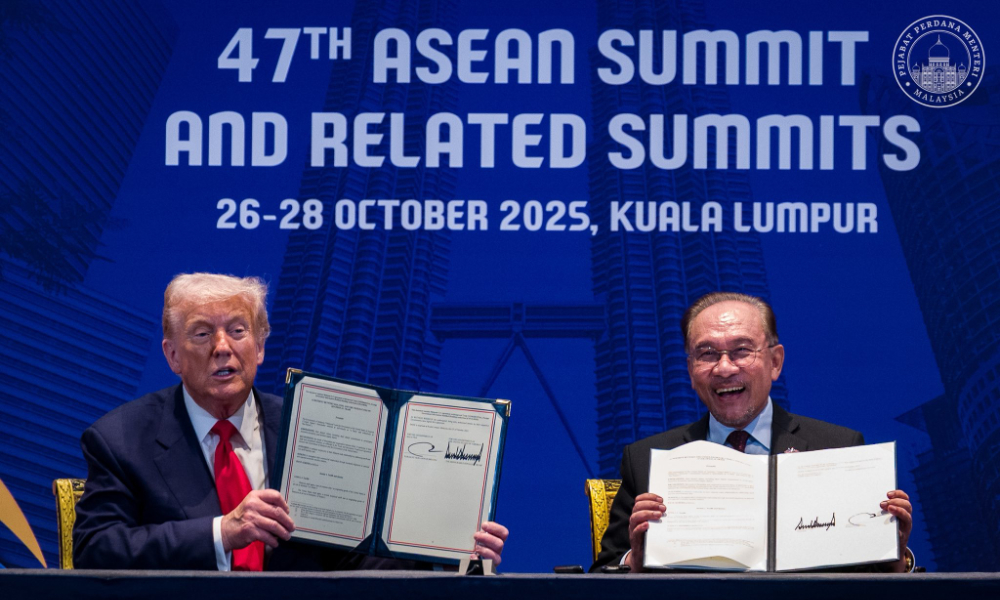
On Oct 26, Prime Minister Anwar Ibrahim and US President Donald Trump signed a comprehensive agreement on reciprocal trade.
Under the agreement, the reciprocal tariff rate for Malaysia remains at 19 percent. However, Malaysia has obtained an agreement that the list of goods exempted from reciprocal tariffs under Trump’s executive order last April will remain in effect.
This includes semiconductors and other electronic components, among Malaysia’s main exports to the US.
Another key point in the agreement is that Malaysia will not impose any quotas on exports of critical minerals and rare earth to the US.
Reporting by Qistina Nadia Dzulqarnain, Zarrah Morden, and Haspaizi Zain.
/file/publisher-c1a3f893382d2b2f8a9aa22a654d9c97/2025/04/cd07f3a02d1bacb46c9dc8585ea64fc8.jpg)
/file/publisher-c1a3f893382d2b2f8a9aa22a654d9c97/2025/10/41a30721a151a02ecdc173d07bc3e365.jpg)
/file/publisher-c1a3f893382d2b2f8a9aa22a654d9c97/2025/11/d12e1307f8a45a530faeb58c5e4999ed.jpg)
/file/publisher-c1a3f893382d2b2f8a9aa22a654d9c97/2024/11/efb85f6ca206227b53291f815c8f8fe2.jpg)


Are you sure you want to delete this comment?
This action cannot be undone.