
Summary

  • CIJ reports a 23.3 percent increase in the use of draconian and regulatory laws this year, with notable spikes in the CMA, Sedition Act, and Penal Code provisions.

  • It notes that developments this year reflect a mixed picture for freedom of expression while providing the government with recommendations for improvement.


The Madani government has increased weaponisation of draconian laws by 23.3 percent since last year, the Centre for Independent Journalism (CIJ) found.

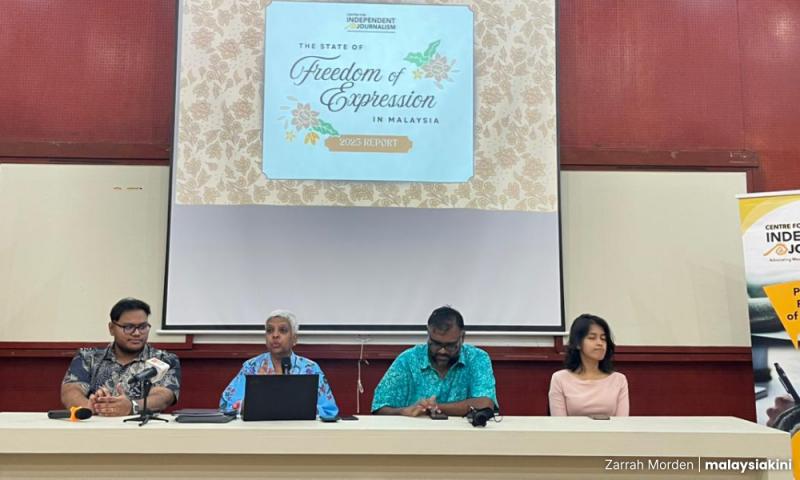
In its "Freedom of Expression in Malaysia 2025" report, it said Putrajaya has wielded regulatory laws 233 times this year compared to 189 times in 2024.

"There is a significant change in the pattern. It's not about what we saw during our former prime minister Najib Abdul Razak's administration. A lot of it (at that time) was political targeting.

"Here we are seeing two pictures: one, political targeting (and) political criticism are still going through censorship and restriction.

"But on the other hand, we are seeing the issue of morality being at the forefront.

“Public morality has become moral policing and we are seeing that cut across different sectors of our community and different sectors of our lives," CIJ executive director Wathshlah Naidu said during the launch of the report at the Kuala Lumpur and Selangor Chinese Assembly Hall (KLSCAH) this morning.

Usage breakdown

The report broke down the use of laws to restrict freedom of expression, noting an increase in the following:

  • Section 233 of the Communications and Multimedia Act 1998 was used 123 times this year but only 99 times last year,

  • The Sedition Act 1948 was used 36 times this year compared to 19 last year,

  • The Printing Presses and Publications Act 1984 (PPPA) saw use four times this year and only three times last year,

  • Section 505 of the Penal Code was used 30 times this year and 21 times last year, and

  • Section 500 of the Penal Code was used 14 times this year in comparison to last year's 11.

But the use of certain other laws did decrease:

  • Section 504 of the Penal Code was used only 12 times this year compared to 14 times last year,

  • Section 298 of the Penal Code saw use eight times this year but was used 14 times last year, and

  • The Peaceful Assembly Act (PAA) was used six times this year and 14 times last year.

The report noted that the state of freedom of expression in Malaysia this year was a mixed bag of progress and regressions.

Good moves by the government this year include the establishment of the Malaysia Media Council (MMC) and the formation of a pro-tem committee to draft the Freedom of Information Bill.

Pervasive culture of secrecy

However, the report found that Malaysia still has a pervasive culture of secrecy, pointing to the Selangor government’s purported rejection of residents’ applications for information related to the Selangor Smart Integrated Parking (SIP) project, allegedly on the grounds that the information was classified under the Official Secrets Act (OSA) 1972.

Other regressions include the use of the Sedition Act against Universiti Malaysia Sabah (UMS) student activists and restrictions on artistic freedoms, such as condemnation over the music video of local pop singer Mimifly’s Aidilfitri song “Serumpun” for being un-Islamic.

Malaysiakini was highlighted several times in the report, with the arrest of journalist B Nantha Kumar viewed as a form of judicial pressure on the press.

It said another point of state pressure on the media was when the MCMC and police seized a laptop belonging to Malaysiakini executive editor RK Anand for being a witness in an investigation against former minister Khairy Jamaluddin.

It also brought up the suspension of Malaysiakini and KiniTV's Facebook pages after the publication of an exposé involving the use of 263 accounts on the social media platform, which engaged in a coordinated campaign to artificially boost support for Prime Minister Anwar Ibrahim.

Upholding free speech

CIJ proposed several measures for the government to improve and uphold freedom of expression.

It urged the government to enact legislative and structural reform by repealing or amending laws that restrict freedom of expression.

It further called on the current administration to strengthen transparency and freedom of information by immediately enacting a federal Freedom of Information Act as well as repealing the OSA and Section 203A of the Penal Code.

CIJ said the government could safeguard digital rights and prevent overreach by establishing an independent multi-stakeholder body to regulate platform governance while pivoting focus away from content moderation.

It should likewise guarantee that AI policy frameworks follow a rights-based model and involve consultation with stakeholders, the report added.

It said the government must provide security for the MMC's resources and independence as a move towards protecting media freedom and ethical journalism.

Protect civic rights

Besides that, the report called on Putrajaya to protect civic participation and the right to peaceful assembly by ending the practice of investigating activists, students, and human rights defenders.

It urged the authorities to implement comprehensive protections against online gender-based violence and conclusively address abuse targeting women and the LGBTQ+ community, such as by halting all policing of expression based on gender norms.

The report also touched on protections for artistic and cultural expression, calling for a rights-based guideline for cultural content instead of "vague morality standards".

Artistic expression needs to be decriminalised, while the government must end the use of the PPPA and other tools for censoring artistic, gender, or identity-related content.

"The high-handed backlash over ambiguous 'morality' or religious-based laws may result in artists avoiding certain 'sensitive or controversial' themes altogether, thus stunting our learning, critical thinking, social reflection and cultural diversity in this global society," the report said.

"We are seeing a possibility where this can degrade the vibrancy and openness of Malaysia’s cultural sphere, making it harder for future generations of artists to produce meaningful, challenging, or transformative work," it added.

Finally, the report said the government must institutionalise inclusive stakeholder engagement for reforms related to freedom of expression.