


/file/publisher-c1a3f893382d2b2f8a9aa22a654d9c97/2025/12/82dd40f65f4555b6484925ff7aedd38e.jpg)

80 medals: Perseverance and passion of young robotics champs
What remained hidden was the reality behind those victories. The weekends sacrificed, lengthy journeys between states, mounting pressure of consecutive competitions, and parents who made it possible for their children to compete on the world stage.
The students, aged between 13 and 14, are...
Summary
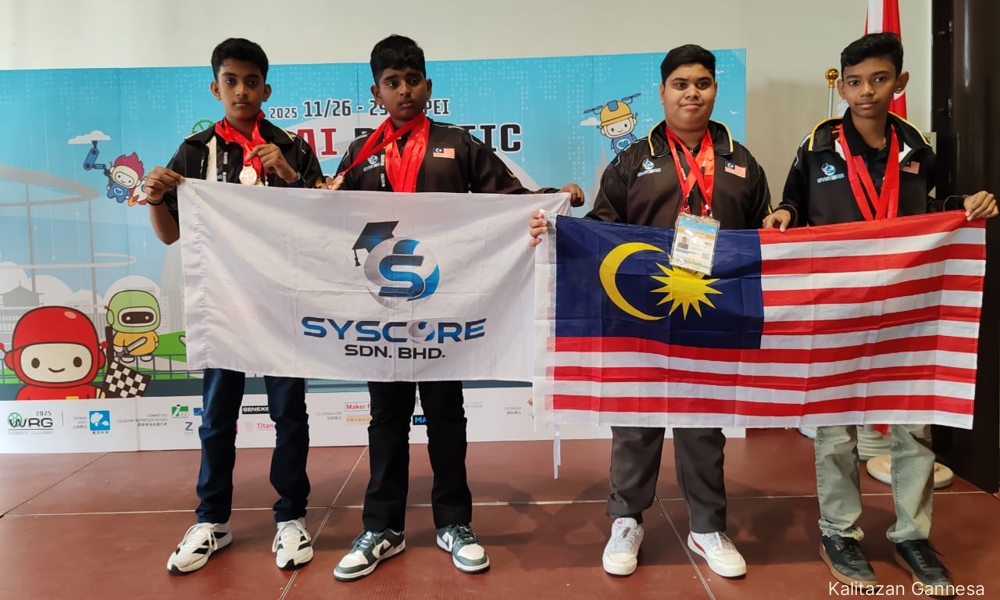
Malaysian students aged 13 to 14 delivered a standout performance at the World Robot Games 2025 in Taipei, winning more than 80 medals across multiple categories.
Categories include AI innovation, sumo fighting robotics, and drone football.
Behind the success is the demanding reality of 10 months of intensive preparation, constant travel, and heavy reliance on parental funding.
When 24 Malaysian students returned from the World Robot Games (WRG) 2025 in Taipei with more than 80 medals between them, the headline wrote itself: a remarkable international achievement by teens barely into their secondary school years.
What remained hidden was the reality behind those victories. The weekends sacrificed, lengthy journeys between states, mounting pressure of consecutive competitions, and parents who made it possible for their children to compete on the world stage.
The students, aged between 13 and 14, are from Syscore Academy, a robotics institution with branches across Peninsular Malaysia. Many have been immersed in robotics since primary school.
For this year’s WRG, they devoted nearly 10 months to preparation, training from January up to the competition in November.
Hailing from Perak, 14-year-old Puvenenthira Kumar Jaya Kumar travelled to Penang every weekend to prepare for the WRG, saying that while it was tough, his passion for the field was what pushed him forward.
“I heard about the news that Penang students are all going (to join the competition), so I tried to seize this opportunity, and I joined them.
“At first, it was quite hard travelling to Penang every weekend, but I got used to it eventually.
“We had a schedule to follow, so there wouldn’t be a lot of congestion, and we could train properly,” he said.
The WRG standout wins from Malaysia came in the junior sumo and drone football events, while strong finishes in sumo, robot soccer, and other competitions saw participants placing as high as third through eighth.
Malaysian teams also dominated the “AI innovation” category, with 11 of 12 teams returning with medals. Each student created innovative projects that tackled real-world problems in the category.
At the competition, Puvenenthira won a bronze medal in AI innovation, where he developed an AI medical assistant, which essentially functions as a robot nurse.
“It goes to every room, checks patients’ routine vitals, asks about wellness, and alerts the doctor via Bluetooth if there’s an emergency. It’s a very good option because nowadays many hospitals have low staff numbers.
“This project was a new idea for us, something that doesn’t exist in most hospitals right now. My teammate and I came up with it ourselves,” he shared.
Voice-controlled wheelchair, fighting bots
Sachein Kalitazan, 13, also won bronze for his project “Lifeline Bot”, which aims to aid the first response admission system in hospitals, while Lakxmanarayana Gobalakrishnan, 14, clinched a win through his smart wheelchair with voice controls.
“When we say move forward, it will go forward and (when we say) move back, and it will move back. And later on, we also have a joystick,” he explained.
On the other hand, 13-year-old Yalleni Thayalan competed in six different categories, which spanned across AI innovation, drone soccer, and sumo robots, where she had to operate a fighting robot against other participants.
“Since (the robot) is automatic, we have to use tactics. So, if our tactic is right and stronger than the opponent’s, we win.
“At first, I was nervous since other countries had different tactics compared to us. But I managed to go through it in the end,” she said.
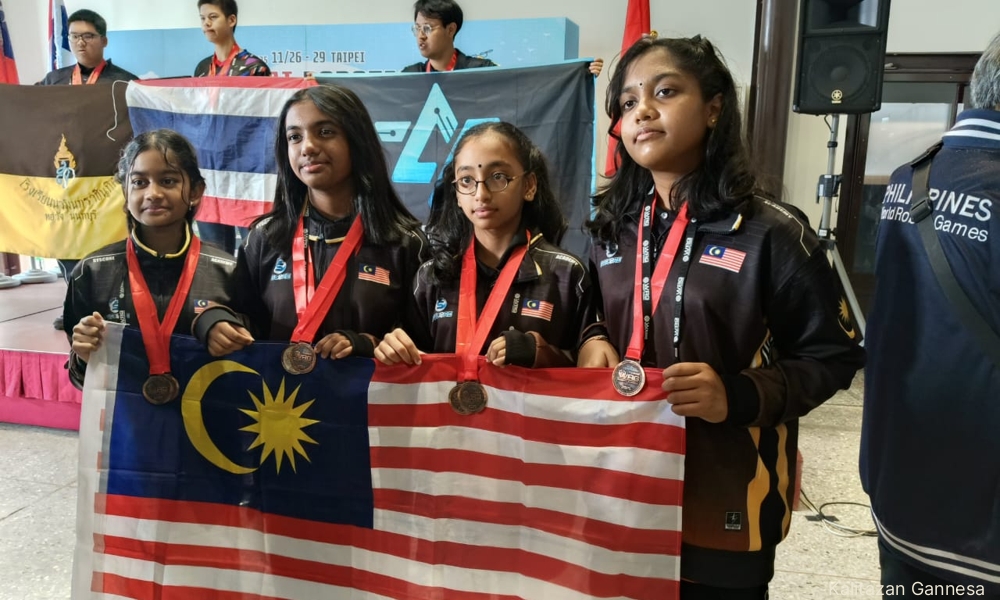
While Malaysia may not yet dominate the global robotics scene as some long-established tech nations do, Malaysian teams are increasingly holding their own, learning fast, and closing gaps through experience.
Last month, The Star reported that Malaysia cemented its 13th win in the 22nd International Final World Robot Olympiad (WRO) in Singapore, securing four gold medals, four silver medals, and two Awards for Excellence.
A Malaysian robotics team also secured a spot in the World Robotic Competition Grand Finals in Shenzhen, China, after a strong performance at the competition in Perth, Australia, Sinar Daily reported.
Limited access to robotics education
Despite growing success, Malaysia’s youth robotics scene continues to face structural challenges. Access remains uneven, with students in urban centres or near major training hubs enjoying far more opportunities than those in rural areas.
Participation in international competitions is also costly, and many students still rely heavily on parental funding for travel, accommodation, and logistics, limiting who can compete.
According to Syscore Academy managing director Kalitazan Gannesa, his students’ triumph in Taiwan was thanks to their parents’ commitment and their willingness to bear all expenses.
“We have supportive parents. They made all the arrangements for the tour and accommodation, so I only had to focus on the competition.
“It was difficult, but the parents were able to manage a lot of things,” he said.
While some groups are achieving strong results, ramping up robotics education nationwide in an inclusive manner remains a significant challenge.
Looking ahead, Kalitazan hopes to open the programme at Syscore to more students across the country and make robotics education more accessible to Malaysians.
“Next year, we want to open to all. We want to welcome many more Malaysian students to join the world competition.
“I think this year, we have already proved our success. So, now, we have a lot of media and NGOs spreading our success. I think that a lot of sponsors will come to help our students,” he added.
/file/publisher-c1a3f893382d2b2f8a9aa22a654d9c97/2025/12/7899914f3f9fc3aff15fdf31600b40e0.jpg)
/file/publisher-c1a3f893382d2b2f8a9aa22a654d9c97/2025/01/828d8e0fac4e62f8c0ae0b49e18f4674.jpg)
/file/publisher-c1a3f893382d2b2f8a9aa22a654d9c97/2023/11/e38d76de87f72d7904bf2f90b2b8df35.jpg)


Are you sure you want to delete this comment?
This action cannot be undone.