




Price hikes, not religion, key factor in Kedah
It is not a common sight in these parts but along the old trunk road from Sungai Petani to Alor Star, two bright flags – one of Argentine revolutionary Che Guevara and the other of Jamaican rasta artiste Bob Marley – flap merrily alongside the more conventional colours of PAS, BN and PKR.
It is not a common sight in these parts but along the old trunk road from Sungai Petani to Alor Star, two bright flags – one of Argentine revolutionary Che Guevara and the other of Jamaican rasta artiste Bob Marley – flap merrily alongside the more conventional colours of PAS, BN and PKR.
The proprietor of the vegetable farm where the flags were raised had a simple explanation for this display.
“We want to (appear) neutral and not be disturbed,” he explained.
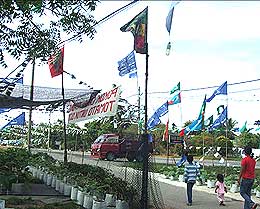 He and his farm workers claim to be BN supporters but said that opposition is not to be written off yet because the contest is “quite heated” this time round.
Surprisingly for a state that is very much a part of the Malay heartland, this new challenge to Umno’s control comes from the unlikely quarter of its Indian community. Indian voters have traditionally been BN supporters given that they find little to identify with in PAS’ campaign.
However, Hindraf activities in and around the capital city Kuala Lumpur has so mobilise the community that its impact is being felt up here in the north.
“I think 90 percent of the Indian voters in this state have now mixed feelings about BN,” said one middle-aged owner of a guesthouse in Alor Setar.
“The Indian voters’ strength may be small in total but as they are mainly concentrated in southern areas of the state like Kulim, they can make a difference,” he added.
Splitting the Indian votes
According to an Umno divisional leader, the breakdown of voters in Kedah is approximately 50,000 Indians, 160,000 Chinese and 600,000 Malays.
The proportion may be small overall but even this leader could not discount the effect that the negative publicity could have on marginal state constituencies such as Lunas and Bukit Selambau .
“Will it be enough for us to lose a seat? It is hard to say. I don’t think it would come to that but there is definitely a small group that will go over to the opposition,” he said.
The one thing that BN is banking on now is that Indian votes would not just go over to the opposition but would be split across the many parties representing the community’s interests thus minimising the effect of a possible swing.
“For the Indian community, there are many parties – there is the MIC, PPP, IPF, and now there is the choice of PKR.
“If some votes go to each party then it would not be so bad. Parties like IPF are not in the coalition but they still support us,” he added.
A matter of inflation
Aside from this new unknown in the equation, a noticeable shift in focus of this general election is the reduced emphasis on issues of religion. Instead, foremost on many voters’ minds is the impact of rising oil and commodity prices. Inflationary tendencies are evident even at the roadside stalls lining the trunk road.
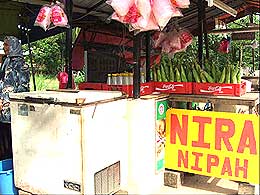 “Just two years ago, it cost us RM75 to buy a bag of corn. Now, the same bag costs more than RM90,” said Mak Ngah, a tradeswoman at one of a new row of stalls sponsored by the Mara smallholders’ cooperative.
“The middlemen tell us that it is because oil is more expensive and toll has gone up but I can only raise my prices by so much or I lose business,” she added.
The trickiness of this subject matter has somehow stumped political contestants as campaigning activities in the capital seems muted even though it is just two days to polling day.
“I don’t think the opposition can fairly criticise BN for these price increases because these are no longer local issues. They are global and they affect every country. Even if PAS takes over, there is no way that they can resolve this problem,” said Wan, a 27-year old Pemuda activist.
Furthermore, he added that the opposition’s track record in Kelantan is hardly enticing to voters if they were looking for economic advancement.
“Nothing has really changed in Kelantan. There is no investment, no development. Voters can see this and make their decision,” he explained.
Mutterings of discontent
Over at the fishermen’s village at Kuala Kedah, mutterings of discontent show that not all are entirely convinced by this explanation.
“Oil price may have gone up in the world but it does not explain why the government has raised other taxes like our land taxes.
“We cannot be compared to other countries because we are a country that produces everything. We have oil, we have palm oil, even corn.
“We put this administration in power but they do not seem to care for the rakyat. So we have to show this in our votes,” said Pak Samad, a 60-year old fisherman.
For Kedah which has benefited from years of benign patronage from the government as the home state of two former prime ministers, loyalty to the BN has traditionally been dependable but with tougher times around, even BN loyalists feel the jitters.
What’s more now with the challenge for the party to proof that it will not again overlook the needs of the state’s mostly rural-based, low-income Indian community.
There are 18 parliamentary and 36 state seats in Kedah. In 2004, BN won all but one parliamentary seats and 30 of the state seats. Opposition party PAS won the rest.
BN is expected to continue its dominance in the state this time too.


