


/file/attachments/orphans/fpiojasdpioasdopds_666286.png)

Saifuddin points to UNHCR 'online registration' as 'root cause' of refugee issue
PARLIAMENT | Home Minister Saifuddin Nasution Ismail has cited UNHCR’s online refugee registration process as the "root cause" behind Malaysia’s difficulties in managing refugees already in the country.
Speaking during Minister’s Question Time in the Dewan Rakyat today, Saifuddin said people could apply for refugee status from abroad and enter Malaysia before the UN refugee agency had decided on their applications.
PARLIAMENT | Home Minister Saifuddin Nasution Ismail has cited UNHCR’s online refugee registration process as the "root cause" behind Malaysia’s difficulties in managing refugees already in the country.
Speaking during Minister’s Question Time in the Dewan Rakyat today, Saifuddin said people could apply for refugee status from abroad and enter Malaysia before the UN refugee agency had decided on their applications.
“Now, because of UNHCR, applications for refugee status can be made online.
“A person may be in Yemen, Syria, Afghanistan or any country where there are push factors.
“Before UNHCR in Kuala Lumpur has even made a decision on the application, the person may come here first as a tourist on a social visit pass,” he said.
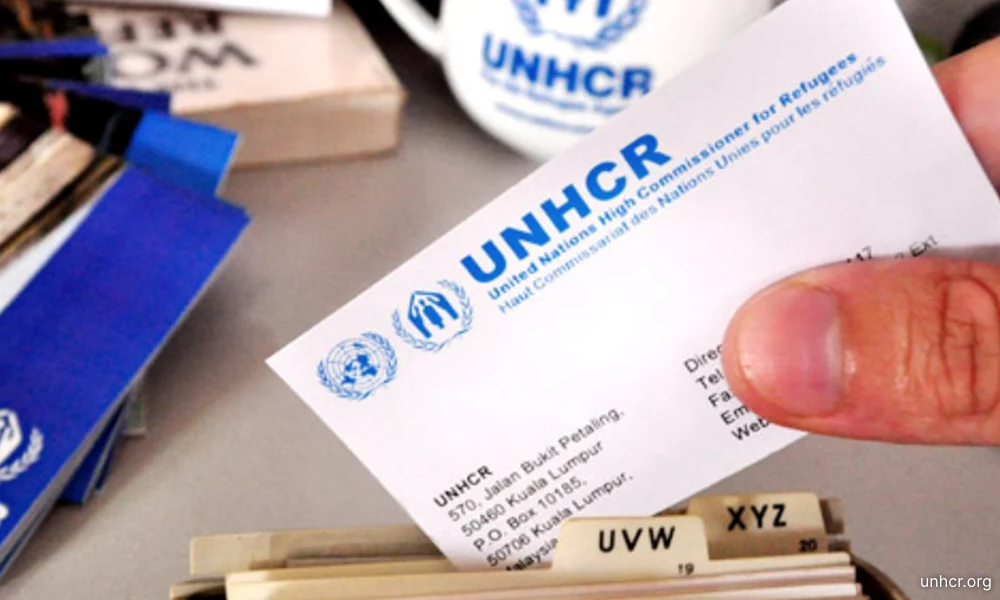
/file/publisher-c1a3f893382d2b2f8a9aa22a654d9c97/2022/10/8239807ab919b876680529a7e2aca988.jpg "Generic UNHCR N High Commission for Refugees Malaysia 081022")
According to Saifuddin, some applicants would later gather outside the UNHCR office in Kuala Lumpur to check on their applications.
“That is the reality. We are talking about the downstream problem. The upstream issue is the root cause,” he said.
Saifuddin was responding to Radzi Jidin (PN-Putrajaya), who asked whether the government’s Refugee Registration Document could itself become a “pull factor”.
He added that he and Foreign Minister Mohamad Hasan had raised their concerns through the cabinet and National Security Council.
'Don't take law into own hands'
Jimmy Puah (Harapan-Tebrau), meanwhile, raised concerns over viral videos showing individuals confronting Rohingya, demanding to see their UNHCR cards and behaving as though they had enforcement powers.
The incident comes amid growing hostility towards the Rohingya on Malaysian social media, including videos of self-styled vigilantes stopping and questioning members of the community in public.
/file/publisher-c1a3f893382d2b2f8a9aa22a654d9c97/2026/07/59b23c5cfe96a78cfacb2785624da10a.jpg "Majlis Bandaraya Alor Setar (MBAS) serbu sekolah warga rohingya shahab perdana alor setar kedah 030726")
Saifuddin urged Malaysians not to take enforcement into their own hands.
“If they find conduct or activities by those said to be refugees that are causing dissatisfaction among residents or communities, they should report the matter to the authorities.
“From a legal standpoint, the authorities are the police and other enforcement agencies,” he said.
“The best way to maintain order in a country is to leave such matters to those with the proper authority.
“In other words, avoid taking matters into your own hands.”
While acknowledging public unease over the presence of refugees, he said any action must remain within the law.
More complex situation
Saifuddin also referred to social media claims that some refugees had travelled from camps abroad using passports before entering Malaysia and later obtaining UNHCR documentation.
“I regard that as an allegation unless proven otherwise,” he said, adding that such claims should be referred to the authorities.
Radzi (below) had earlier asked whether Malaysia should revive an approach like the one used for Vietnamese refugees decades ago, when refugees were housed in designated camps.
/file/publisher-c1a3f893382d2b2f8a9aa22a654d9c97/2024/10/c599b64c04306df98ea9fe538be1b094.jpg "Persidangan Dewan Rakyat Mesyuarat Ketiga Penggal Ketiga parliamentary sitting October 24 241024 Radzi Jidin")
Saifuddin, in response, said the Vietnamese refugee issue was resolved differently because Malaysia eventually made repatriation a condition of supporting Vietnam’s admission into Asean.
“Vietnam agreed. So, the matter was resolved,” he said.
He noted, however, that Malaysia now faced a more complex situation involving refugees from multiple countries.
/file/attachments/orphans/homeministry1asdeesd2_674391.png)
/file/publisher-c1a3f893382d2b2f8a9aa22a654d9c97/2023/11/c34dada36ebd33f394e075c941bba6ab.jpg)
/file/publisher-c1a3f893382d2b2f8a9aa22a654d9c97/2025/11/71be424fa6e9d24c6f2f0bdf1648deaf.jpg)


this UN doing charity on the expenses of the host country
We should impose visa restrictions on these countries, just like how the US does it.
Report this comment
Are you sure you want to delete this comment?
This action cannot be undone.