


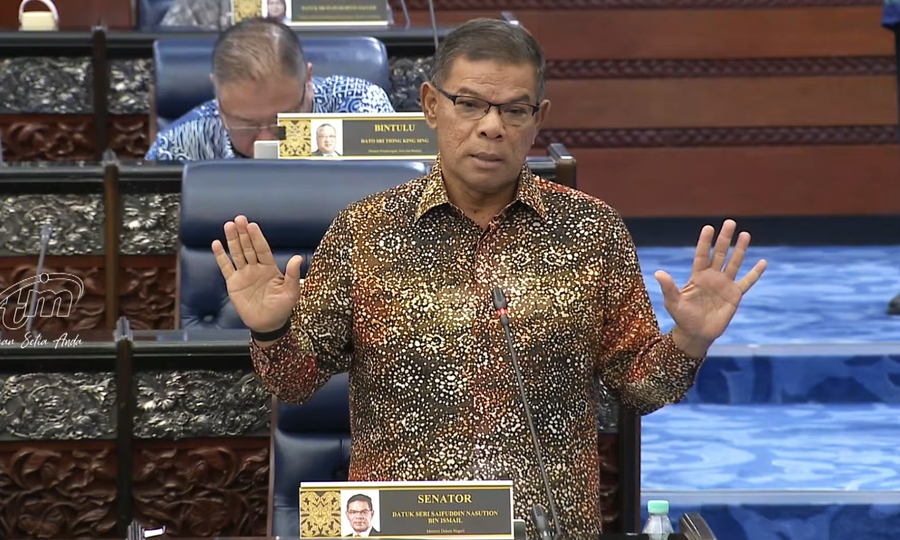

Home Ministry only implements pardon decisions, not decide them: Saifuddin
The Home Ministry is not in a position to comment on whether prisoners’ pardon petitions should be considered, as its role is only to carry out the Pardons Board’s decisions, said Home Minister Saifuddin Nasution Ismail.
He said this when asked to comment on a statement by Agriculture and Food Security Minister Mohamad Sabu, who proposed that all convicts be allowed to serve the latter half of their jail term at home.
Saifuddin pointed out that...
The Home Ministry is not in a position to comment on whether prisoners’ pardon petitions should be considered, as its role is only to carry out the Pardons Board’s decisions, said Home Minister Saifuddin Nasution Ismail.
He said this when asked to comment on a statement by Agriculture and Food Security Minister Mohamad Sabu, who proposed that all convicts be allowed to serve the latter half of their jail term at home.
Saifuddin pointed out that any individual is entitled by law to submit a pardon petition to the relevant authorities, but it is not the Home Ministry’s jurisdiction to consider such applications.
“The right to submit a pardon petition already exists under the law and is open to anyone, regardless of position or wealth. Whether it is the small man, the big man, the rich, the poor, a VIP, or an ordinary citizen, that right already exists under the law.
“When a pardon petition is submitted, it becomes the responsibility of the Pardons Board. At the federal level, the relevant body is responsible. At the state level, it is the ruling sultan.
“So, whether or not the pardon petition is discussed, considered, and decided upon, that is not within the Home Ministry’s scope of responsibility.
“But if a decision is made, our job is to carry it out. Whether the sentence is reduced, revoked, the person is released or placed at home, our job is to carry it out,” he told reporters after the Madani Kita Programme and the handover ceremony of the Rela Kampung Angkat Madani and Sekolah Angkat Madani in Sitiawan, Perak.
House arrest for all
Previously, Amanah president Mohamad pledged hand over his entire salary as a minister, totalling RM11,900, not including his allowance, to help fund civil society organisations (CSOs) so that they could push for a fair house arrest mechanism that benefits all prisoners.

Specifically, he proposed that prisoners be allowed to serve half of their jail term in prison before being transferred to house arrest.
He said this should be an option for prisoners convicted of all types of offences.
“As a commitment to this effort, I am prepared to hand over my entire salary as a minister until the dissolution of Parliament in this term to help fund the NGOs driving this cause.
“Justice must be upheld without discrimination, without selective privileges, and without double standards,” he said.
One pardon after another
Mohamad's proposal came after former prime minister Najib Abdul Razak was moved from Kajang Prison to his residence in Kuala Lumpur on Nov 10 to serve the remainder of his jail sentence in the SRC International case under house arrest.
The development followed a conditional pardon granted by Yang di-Pertuan Agong Sultan Ibrahim Sultan Iskandar in September.
Previously, another royal pardon in 2024 reduced Najib’s jail sentence from 12 years to six and reduced his fine from RM210 million to RM50 million.

In August 2022, the Federal Court upheld Najib’s conviction on seven charges linked to the misappropriation of RM42 million in SRC International funds.
In a separate case, the High Court last December convicted Najib on four counts of abuse of power and 21 counts of money laundering involving 1MDB funds.
He was sentenced to 15 years’ jail and fined RM11.38 billion, but has appealed the decision.
Should the appeal or a stay of execution application against the 1MDB sentence fail, Najib is set to go back to prison once his SRC jail term lapses in August 2028.





Report this comment
Are you sure you want to delete this comment?
This action cannot be undone.