


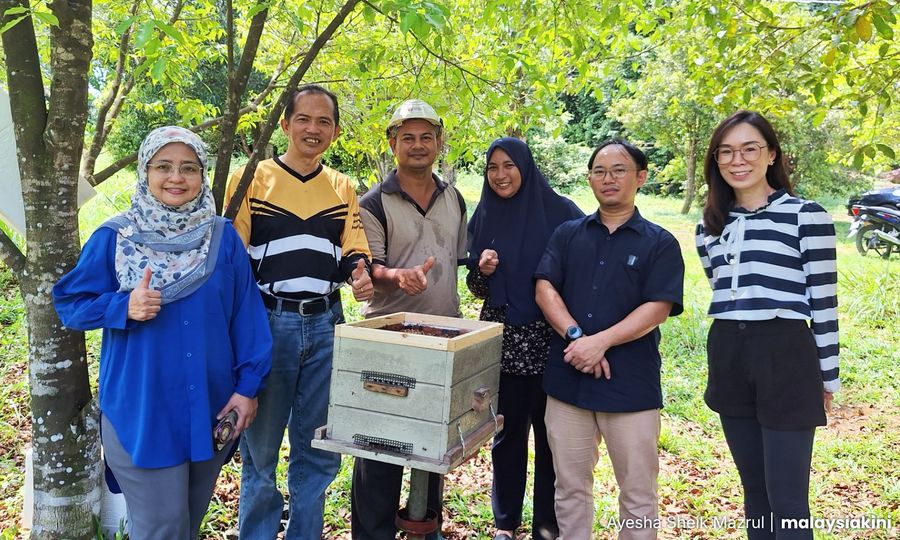

A hive of hope: Rescuing bees, one colony at a time
The first thing that strikes you is the smell. A strong, pungent diesel scent fills the air as volunteers from My Bee Saviour Association work to coax a colony of bees away from its hive.
The method is simple: introduce a smell the bees dislike, in the hope that they will abandon the spot and move elsewhere.
Nearby, bee rescuers Dennis Liew and Tan Chia Hui watch the colony's movements, carefully assessing the situation before deciding their next course of action.
Becoming a bee rescuer might not cross most people’s thoughts. But as a former...
The first thing that strikes you is the smell. A strong, pungent diesel scent fills the air as volunteers from My Bee Saviour Association work to coax a colony of bees away from its hive.
The method is simple: introduce a smell the bees dislike, hoping they will abandon the spot and move elsewhere.
Nearby, bee rescuers Dennis Liew and Tan Chia Hui watch the colony's movements, carefully assessing the situation before deciding their next move.
Becoming a bee rescuer might not cross most people’s thoughts. But as a former lebah kelulut (stingless bee) farmer, the decision to get involved with bees came naturally for Liew.
"When people find bees, they usually call the Fire and Rescue Department or the Civil Defence Department. Their standard operating procedures may require them to burn or spray the colony with pesticides.
"Seeing that happen, I felt sorry for the bees. So, I try to save them as much as I can," he said in an interview with Malaysiakini.
My Bee Saviour was initially founded in 2015 as an initiative under the Malaysian Agricultural Research and Development Institute (Mardi).
However, the group re-established itself as an NGO in 2019, focused on free bee rescue and relocation efforts.
In September this year, Universiti Putra Malaysia’s (UPM) forestry senior lecturer and entomology expert Norhisham Razi became the NGO’s president, with about 10 volunteers serving the group.
My Bee Saviour’s volunteers respond to calls from homeowners and communities who find bee colonies in their surroundings, working to determine whether the insects can be encouraged to leave or whether their hives need to be physically relocated.
Malaysiakini observed two rescue methods alongside the volunteers. The first involved using strong smells to encourage a colony to leave; the second required physically relocating its hive.
For the latter, volunteers carefully cut away the section of the branch supporting the hive before transporting it to a safer location where the colony could continue developing.
“Rescue efforts are not always straightforward, as we first need to identify the bee species and then determine the appropriate course of action,” Liew said.
Bees defensive, not offensive
Malaysia is home to several honeybee species, with the most commonly found being the Asian honeybee (Apis cerana), locally known as lebah kampung, as well as the red dwarf honeybee (Apis florea) and black dwarf honeybee (Apis andreniformis).
Another familiar species is the giant honeybee (Apis dorsata), widely known as the tualang bee.
Understanding the differences between these species is essential to rescue efforts, as their nesting habits and behaviour vary.
Much of the fear surrounding bees comes from the perception that they are naturally aggressive and will attack humans when approached.
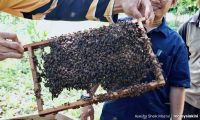
But the rescuers stressed that bees are defensive creatures that are largely driven by the need to protect their colonies. As long as people do not disturb their hives, most bees will leave them alone.
“One important precaution when encountering bees is to remain calm.
“Sudden movements, particularly swatting at bees or waving one's hands around, can be interpreted as a threat and trigger their defensive response.
“Instead of trying to chase them away, people are advised to stay still and give the bees space,” Liew said.
New home among fruit trees
After a rescue mission, bee colonies are often relocated to an area where they can continue living. One such place is an apiary at UPM, nestled among its fruit gardens.
During Malaysiakini’s visit, the extensive farm area contained 15 boxes housing colonies of different bee species that had been relocated from their original nesting sites.
Norhisham told the portal that the apiary was established in response to numerous complaints about bee colonies in communities across the Klang Valley.
He shared that the group received about 290 bee-related complaints across the Klang Valley between September and October.
“That works out to an average of about eight cases a day. And at My Bee Saviour, we also face a shortage of members (to handle these cases),” he said, adding that each rescue requires manpower to locate, handle and transport colonies to suitable sites.
And despite the apiary’s existence, finding appropriate locations to relocate rescued colonies remains a major challenge for the NGO, as potential sites are few and far between.
Meanwhile, Tan said although farms might seem like ideal destinations, they were not necessarily suitable for bees, especially when pesticides were widely used.
For this reason, she said relocation should not always be the primary focus. In some cases, persuading homeowners to reconsider their initial reaction to a bee colony may be more important than physically removing it.
Tan explained that people often assume bees must be moved somewhere else to survive, when their existing location may already be ideal.
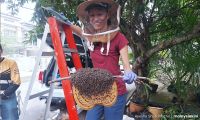
"(When we remove hives) many people ask whether we will bring the bees somewhere better. What they don’t consider is that a hive’s current location may already be its suitable location," Tan said.
An unexpected ‘housemate’
Touching on her experience in getting acquainted with My Bee Saviour, Noraziyah Mansor shared that the importance of bees became something she discovered much closer to home.
Fondly known as Umi among her community, the 62-year-old housewife said she knew little of bees until a colony settled in the library inside her house.
Rather than treating the unexpected visitors as a threat, she began researching their behaviour and why they had chosen her home as a nesting site. The more she learnt, the more fascinated she became.
"I felt touched, and there was also a sense of wonder about why they chose this house," she said, adding that her curiosity eventually led her to My Bee Saviour.
"I never expected there to be a group of people who would come and rescue bees. I thought it was wonderful that such a group existed," she added.
Her experience also changed the way she viewed animal rescue.
While people commonly rally around efforts to save domestic animals such as cats and dogs, Noraziyah questioned why bees should be treated any differently.
"Nowadays, people save cats, dogs and monkeys. All sorts of animals are being rescued. Why can't we save bees too?" she asked.
Although she is not actively volunteering with the group, Noraziyah was happy to be part of the community, sharing updates of her bee colony periodically on social media.
“And the experience has strengthened my belief that every living creature deserves the right to exist and should be treated with respect,” she added.
Lack of understanding
For Liew and Tan, the Malay adage "tak kenal maka tak cinta" (you cannot love what you do not know) captures much of the misunderstanding surrounding bees.
The lack of understanding can have serious consequences when a colony is discovered in a residential area.
Faced with unfamiliar hives and anxieties about being stung, homeowners may seek their immediate destruction without considering alternatives.
The volunteers hope to change that mindset, one conversation and rescue operation at a time.
But keeping the association's efforts going is not easy. With increasing requests for assistance and limited manpower, they need more people to help sustain their work.
Liew and Tan stressed that volunteering does not necessarily require climbing trees or handling hives.
“Those unable to participate in rescues can still help by educating homeowners and advising communities on how to respond to bee colonies.”
For the volunteers, the goal is not to relocate every colony, but to encourage a more informed response that considers both human safety and the survival of bees.
“Sometimes, all it takes is a little understanding to realise that the creatures we fear are not necessarily our enemies,” Tan added.
Those seeking help with bee-related issues can contact My Bee Saviour via its WhatsApp hotlines at +60 11-2073 3497 or +60 11-2073 3502.


Report this comment
Are you sure you want to delete this comment?
This action cannot be undone.