




ISA - one for the dustbin of history
I remember distinctly my earliest impression of Malaysian politics when I was just a scrappy secondary school boy in Kuching. It was one of revulsion at the injustices inflicted by the Internal Security Act, and the massive arrests of social and political activists in Sarawak under this law in the 1960s.
I remember distinctly my earliest impression of Malaysian politics when I was just a scrappy secondary school boy in Kuching. It was one of revulsion at the injustices inflicted by the Internal Security Act, and the massive arrests of social and political activists in Sarawak under this law in the 1960s.
I consoled myself that the country was in a real state of emergence then, with the security forces fighting an armed communist insurgency throughout the country. At times, there were almost daily reports of casualties suffered from both the belligerent parties on the radio (there was no television then).
Some of my former school mates and former teachers in my Chinese primary schools either disappeared into the jungle, or were arrested and detained under the ISA. Not being mature enough to take side, I reluctantly accepted that some kind extra-constitutional police powers were necessary.
Unfortunately, I was cursed with a superior education, in preparation for the Cambridge Overseas School Certificate. In Form Three history lessons, we had to study about the Glorious English Revolution, the Bill of Rights, the doctrine of separation of powers, and the general principle of fundamental civil and political liberties.
The arrest and indefinite detention of mere suspects without trial in an open court under the ISA were the most offensive insult to my budding political consciousness. It exemplified all that was unpalatable about the new nation state of Malaysia. That sentiment has persisted through till this day.
Of all the reasons why I went to the opposition party, the ISA was probably the most powerful motivation. A democracy that requires the ISA to maintain order remains as a Third World guided democracy. It needs room to grow and mature.
Exhilarating time
I was elected a member of p arliament in 1982. In 1986, the DAP won an unprecedented 24 seats.
It was an exhilarating time for political activism. The press was quite open and critical. It was jokingly said by an Umno MP in the House that the Star was owned by the MCA, run by the MIC, for the DAP. Educational, social, and environmental NGOs were making themselves heard. There was a whiff of spring in the air.
 In contrast, the BN was in tatters.
Umno was caught in one of their many extremely acrimonious party elections.
Then premier Dr Mahathir Mohamad must have felt control slipping out of his hand.
Then, there was this issue of the Education Ministry sending Malay teachers who did not know Mandarin to Chinese primary schools on teaching assignment. There was an emotional gathering of Chinese educationists, Chinese- based political parties and their supporters in a famous temple in KL.
Umno apparently took this as a challenge to their nationalist dominance over Malaysian political life. A mass rally was called to be held in KL to display Malay unity against perceived threat from the Chinese community. Seditious racist slogans were flying all over the place.
Then, a soldier with psychological disorder let off a few rounds of his firearms on Chow Kit Road. Rumours went wild about the possibility of racial riots, and people were stocking up food in the city.
A few days later, on October 24, 1987, the infamous Operation Lalang began.
I was in Parliament at about 2 pm, waiting for the question time to begin half an hour later. I got a call for help from an NGO friend, who informed me that Tan Kah Kheng had been arrested under the ISA. I rushed into the chamber to inform Lim Kit Siang, who told me that Lim Guan Eng had also been similarly detained at the Jalan Bandar Police Station.
That evening, Lim Kit Siang and Karpal Singh went to the police station in an attempt to see Lim Guan Eng. They too were roped in right there and then under the ISA. In the following days, 106 of the top opposition leaders, NGO activists, and the leading lights of social and educational movements were arrested and detained under the ISA. During that time, the constitutional amendment to strip the judiciary of their independence was tabled and passed.
The fear of the ISA
You could see how fear gripped the whole nation in those days. It was not only fear for racial riots, but fear for the ISA. Newspapers were muted overnight. Civil society evaporated into thin air. The nation was cowed. The ISA had succeeded in repressing dissent within the BN ruling coalition and the Malaysian society at large. It had preserved a much beleaguered status quo.
 When the police arrested Raja Petra Kamarudin, Teresa Kok, and a
Sin Chew
reporter last Friday, the natural question that popped up in my mind, as it would in the mind of many old hands in Malaysia, was whether this was another ISA dragnet to subdue a rising tide of opposition to the BN government.
There are many parallels between 1987 and 2008. The PM’s hold on power seems shaky. Umno is consumed in a self-destructive orgy of internal discord. The opposition and their supporters have grown increasingly defiant, with constant public demonstrations to display their displeasure at many issues plaguing the nation. Anwar Ibrahim is talking of a change of government through massive defections from the BN.
All that Umno need to do to restore their iron grip on the power centre is to instigate a few racially tinged incidents, and wait for their detractors to respond in vigorous and predictable manner. Surely, the Ahmad Ismail affair looked like that kind of bait. Then, the police can use these agent provocateurs to arrest as many opposition figures as they wish under the ISA in the name of preserving public security.
If that happens, I would not be surprised. The question is: will the nation be cowed this time, as in 1987?
More than 20 years later, we have new generations of politicians, journalists, and NGOs. The day after the arrest, there was a public outcry from all quarters that condemns the use of the ISA this time, in sharp contrast to the oppressive disappointing silence in 1987.
Six Cabinet ministers voiced their disagreement over the use of the ISA. Prominent leaders from BN component parties called for a review of the ISA. Even the usually servile leaders of the Chinese guilds and associations joined in the chorus of condemnation. Even the Mufti of Perlis argued against the ISA arrest on religious grounds!
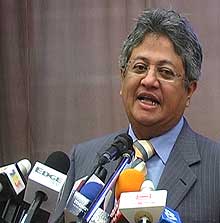 Finally, the
de facto
Law Minister Zaid Ibrahim resigned from his cabinet position, in protest against the ISA arrests, and in admission of his failure to institute judicial reform in the government.
There is apparently an undercurrent of seething outrage against the latest round of ISA abuses. The statement by Home Minister Syed Hamid Albar made him and the police look ludicrous in the eyes of the public. Once again, Raja Petra Kamarudin and Teresa Kok appeared as the martyred heroes.
This is something totally new in Malaysian politics. The ISA has now become a great liability for the ruling coalition, rather than the most effective instrument of intimidating the Malaysian society into acquiescent silence. We must have made great strides in the past 20 years in the evolution of democracy.
Again, the alternative media on the Internet made the crucial difference. Unlike in 1987, people have a forum now to disseminate information and rally public opinions on the net. The days of government monopoly on all political narratives have gone forever.
Police biggest loser
The March 8 general election has also pried open the gridlock of feudalistic political consciousness. People are now exposed to the prospect of new political sceneries in which the ISA is a hindrance to political progress, rather than a necessary evil in a multiracial society.
Finally, the quality of our multiracial citizenry has improved beyond measure. The racial narratives that has dominated our political discourse for half a century may still reside in the consciousness of many, but increasingly, more ordinary citizens are no linger gullible to the lies and the abuses when cracking the ISA whip in the name of maintaining public security and political stability.
The biggest loser in this current ISA fiasco is the police. The home minister has said that he had no part in the decision to detain the three people under the ISA. He has made the police look as if it is a power unto itself, acting without the approval of the minister in charge of home security, as if the police officers and men have acted on their own to repress political dissidents. With this kind of government, the police can never be professional and impartial in the discharge of their duties!
It appears that by 2008, the ISA has outlived its shelf life as a weapon of state terrorism. I now await anxiously the day when it will be repealed altogether. Then Malaysian democracy will have a bright future.


Report this comment
Are you sure you want to delete this comment?
This action cannot be undone.