




Pak Lah to defend Kepala Batas division post
A day after announcing that he was stepping down as Umno president in March, Abdullah Ahmad Badawi affirmed that he will defend his post as head of Kepala Batas Umno division.
A day after announcing that he was stepping down as Umno president in March, Abdullah Ahmad Badawi said that he will defend his post as head of Kepala Batas Umno division.
“Most likely ... most likely,” he said when asked on the matter at a press conference after launching the Institute for Advanced Islamic Studies (IAIS) in Selangor today.
“I’m sure they will not allow any one to take (my place),” added Abdullah, who is also Penang Umno liaison chief.
Under the initial power transition plan agreed between Abdullah and his deputy, Najib Abdul Razak, 55, the deputy premier will take over as soon as Abdullah steps down in mid-2010.
However, Abdullah announced his early departure yesterday in order to prevent the party from being tarnished further by leadership rifts.
He however assured the rakyat that he has much to do in the remaining five months, and as such will not go on any extended leave in that period.
“I have work to do,” he said referring to the reforms he initiated, which include strengthening the judiciary’s independence and giving more teeth to anti-corruption authorities.
Asked how he wants to be remembered, Abdullah explained that this was not as important as the reforms themselves in the areas of human capital, education and research, quality of life, and resolving socio-economic disparities.
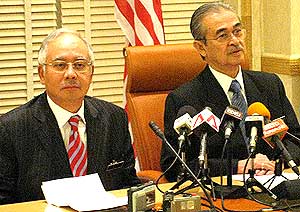 “Whatever I want to do is not with the view (or) to bear in mind that I’m doing this so that people remember me. That’s not my approach. My approach is what is needed today or ... in the future and I believe that (is what) my national mission is intended for,” he said.
“I am, at the moment, concentrating on what I need to do, which I have already announced yesterday. I want to make sure that these can be done. God-willing, it can be done.”
On the Umno division meetings which started today which will see the nomination of candidates to the party’s top posts, Abdullah said he hoped “there would be no fighting and squabbling.”
“It’s shameful,” he stressed.
Barring any complications in the party polls next March, Najib is widely tipped to succeed Abdullah as president. Many expect political stability to improve with this change.
Khairy: On my own merit
However, Umno deputy youth chief Khairy Jamaluddin, who was also present at the launch of IAIS, told reporters that party members should not be under the “illusion” that all of Umno’s and BN’s woes would be solved by this leadership change.
BN’s dismal general election performance was not due to Abdullah, said Khairy who is also his son-in-law, but due to a perception that 2004 poll promises were unfulfilled.
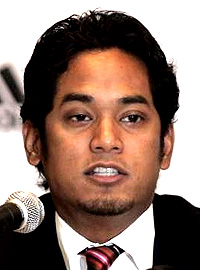 Unless the coalition and his party commit to the reforms, both will find themselves in a greater mess in the future, said Khairy.
While Khairy said he is saddened by Abdullah’s decision, he would be saddened far more if Abdullah's reform efforts lost steam.
Responding to detractors who blame him for Abdullah’s fate, Khairy rejected them and explained that it is easy to simplify matters and resort to demonising individuals rather than tackle larger problems.
He also said his own run for youth chief was based on his own merit and hope that his chances are not adversely affected by Abdullah's move.
On a different matter, Abdullah said he felt that the solution to long-standing problems like spouse conversion to Islam and contest over religious status of dead persons can be resolved with research and understanding.
“I don’t think the problem is so difficult that we cannot find a solution to it. With an open mind and attitude of moderation and understanding of the issues involved, I’m sure there will be some way out by way of a solution,” he said.
Thus, he said, the role of institutes such as IAIS were crucial to the resolution.
Abdullah had earlier in his speech said IAIS would be tasked to undertake research on issues involving Islamic law and public policy, good governance, democracy, civilisational studies, interfaith dialogue and Syariah reform.
Asked, however, whether the institute would look into reviewing the Internal Security Act given the preventive detention law has been opposed by groups on religious grounds, Abdullah said: “The ISA is not within the purview of this institute to look into.”


Are you sure you want to delete this comment?
This action cannot be undone.