




Q&A with Khalid Ibrahim
This is the Q&A of Selangor Menteri Besar Abdul Khalid Ibrahim's recent interview with MalaysiaIndru editor Ji Wi Kathaiah
This is the Q&A of Selangor Menteri Besar Abdul Khalid Ibrahim's recent interview with MalaysiaIndru editor Ji Wi Kathaiah
Malaysiakini: On the issue of the Wives of Selangor State Assemblymen and MPs Charity and Welfare Organisation (Balkis), there was some considerable outcry, but suddenly there is now silence. What’s the position now on the issue ?
Khalid Ibrahim: In writing to the Registry of Societies, we requested the ROS to make a decision as to whether Balkis will be liquidated or not. So far, we have not heard anything from them. But while we are doing that, we also identified the assets and resources of the state that were passed to Balkis in order for them to do their welfare projects. Among the things that need to be resolved is the ownership of land that they built a hostel on for the poor.
While this was being done, we also requested the Special Select Committee on Competence, Accountability and Transparency (Selcat) under the Selangor legislative assembly to conduct an inquiry into this issue of Balkis, because the powers of Selcat were not extended clearly to non-governmental bodies or non-governmental individuals, so it will be not very effective if these members or individuals or organisations do not appear at the inquiry.
So at this meeting of the state legislative assembly, we are introducing an enactment to protect the authority of the state legislative assembly, and if anybody tries to undermine the state legislative assembly, then the committee will be legally bound to report to the Attorney-General’s (state) office to take the necessary action against these individuals or institutions. So, following this approval or passing of this enactment, then the Selcat special committee will then start to proceed with their findings.
So the introduction of the enactment is on the way?
We have already moved. It’s registered and we have made a declaration on it, and in the next one or two days, the enactment will be tabled for approval at the state legislative assembly.
Another thing that you have promised is that upon assuming office, each one of you would declare your assets.
 The state requested that when we do our reporting, it is already personally audited. The exco has appointed Ernst and Young to look at the individual assets and liabilities and to keep it for public information. But for the Pakatan Rakyat states of Penang, Perak, Kedah, Kelantan, Selangor, we need to have a common basis on how to portray the reporting of the assets and liabilities. There are issues that need to be resolved. Like what the federal government is trying to do in getting the prime minister, the deputy prime minister and all the ministers and deputy ministers to be subject to the same format of information. A few Pakatan states requested Selangor to standardise all this.
The issue with declaring assets is this: the Pakatan elected representatives want to make sure that the information, especially on assets and ownership, will not lead to other issues in the future. An example is that there are worries that if they are high net worth individuals, their families will not be subject to kidnaps.
Or investigations.
Or investigations. All that needs to be resolved. As far as the state of Selangor is concerned, we are very open on this.
Yes. We expect you to lead on this.
We also respect the need to do it together. We will resolve these issues when we have our next meeting. There is a proposal for a meeting of all menteris besars and chief ministers of Pakatan states to resolve this issue.
People can expect something to happen soon?
 Yes. I volunteered to personally offer to declare my assets. There are others waiting. We will do it as soon as we have can do it together.
But we’ve already established another thing: Any purchase (by Pakatan senior officials) of assets since March 8 has to be declared. The earlier assets (purchased) may be a point of contention, but any purchase of assets after March 8 will have to be declared.
So following Deepavali, this will...
We have to get together to resolve this.
The sooner, the better. Some are quoting (Parti Sosialis Malaysia) PSM and (its chairperson) Nasir Hashim and saying ‘He has done it,’ (central committee member) Dr Michael D Jeyakumar has done it, why not these people?
We are dealing not with one group of people, we are dealing with many...
Has anybody declared anything so far?
No. I also personally have not been purchasing any assets so far.
But even about you, there were a lot of questions. They said you have to declare this and that, your bank accounts, your bank loans, and so on. These i ssues were raised...
That will be done.
When you took over, there was the issue of the bungalows that were built for exco members of the previous state administration. They are in delapidated conditions now. Has there been anything done to save public property?
Not really. I had the opportunity to visit the complex where they have the common hall, which was used for the occasion (to visit). We need to resolve the issue of the complex, because we have signed an agreement for people to take care of the building. As you know, if the building is not occupied, there will be more costs to that. We included those costs.
How much does it cost you
r treasury a month?For a year it went as high as maybe RM1,000 a month for each (bungalow in) the complex. But to date, our exco for housing (building structure administration and squatters) Iskandar (Abdul Samad) has assigned two units to each of the real estate (agency) to get them moving to get people to occupy the place.
To get tenants, you mean?
Tenants, or whatever they want, to occupy the place. By January 1, everything will be in place.
There’s always talk about how the worst corruption occurrs at the local councils. They have also not been people-friendly. People go there, the officers go on doing as they like, people wait outside for hours, and there are a lot of problems there. When Pakatan took over this state, people expected some good changes, but some are saying it has not changed as expected.
Unwinding 50 years of bad habits is not that easy. What we have done has been in two parts. One is the administration and team-building part, where everyone works on the development and workings of the local government.
The second part is in ensuring the decision-makers have no conflict of interests. What we have done is that non-exectuve members of local councils are not allowed to be in the tender committee. That means all paid officials are in the tender committees, but all selected (officials) will do the monitoring on all the processes and decision makings of the tender process. The other side, the rest of the council, will act as oversight.
The oversight committee makes sure everything’s in order. Once they have made the decision, they review and make sure that they are in order, and so forth. This has already started. Of course there are teething problems. Some of the non-executive officials selected felt that they were not being recognised. They say they can handle it. But we wanted to test this idea. The question of check and balance, we wanted to test it.
That, I think, has started to lead to more openness. The non-council members would say, I want the tender to be posted, I want it to be open. Why did you give this? There are a lot of questions. If we continue to do that, we will minimise (corruption). I’m not saying we can eliminate it, but we can minimise it.
But we get into some very complicated situations. There are some contracts worth RM20,000 and below that will not be totally done on a tender basis. If you tender everything, there is so much work to be done for a small job. So they have limited tender. Not open tenders, but limited tenders, for those contract of less than RM20,000.
 But there’s the problem with Class F contractors. Class F contractors are in limited numbers, and there was a huge uproar over the perception that we were giving the contracts back to the same people (who benefitted from the previous state administration).
I have requested (exco in charge of Islamic affairs, Malay culture, infrastructure and public amenities) Dr Hassan Mohd Ali to get all those interested in getting contracts of this nature to register with Selangor Public Works Department so that we can give opportunities to a lot of people who do not even have this Class F (status) as the federal government had closed this thing.
There will be opportunities for other people. It takes one or two months to get this going. We are trying to resolve it. But for tenders above that, (the open tender process) seems already in place.
Open and transparent tenders?
Open and I think we are very proud to say we get value for money. There is no such thing as people getting a tender and getting 30 or 40 percent out of it. We get value for money. Hopefully, if things are managed well, we not only save the local government money, but also, they get real work being done. Cutting grass, for example, they get real acres per amount of money they pay.
There was a tangle over the issue of billboards...
It’s a big issue. I don’t think it’s now an easy issue to solve because the contracts have been signed, and for whatever reason, the parties also have a right to take a case against the other party. But we established that it really is an unfair contact where you have an annual approval but can get it extend for 10 years. Which means you ignore the annual approval because you have it extended for 10 years with automatic (yearly) approvals.
But all these (reviews) require reading the agreements and so on. In the end, we decided that the issuance of TOLs (temporary occupation licence) for that will be done by the local councils. Before, it was done at the district office. Now there will be no duplicating. Now, we say, ‘No. Now, there’s only an annual contract.’
These are the small issue that we have to unwind. I think unwinding agreements is quite tedious.
Yes. If it is proven to have been fraudulently done, then...
Not only when it has been proven to be fraudulent, but also when they’re proven to have negative effects. Because of the bureaucracy, the so-called mandated delegation, some said they signed in good faith.
So we have an issue. Very quickly, before the end of the year, we should have resolve all this. A few local councils have resolved their problems.
Is anybody supervising all this very strictly?
Oh, yes. In fact, the local council members’ (contracts) are up for review. We say, ‘you are only appointed for one year subject to review. We understand the expectations and also the tasks of the councillors.
In view of the expectations of the people towards council members, there is a greater demand now that there be elected councillors.
I think the main reasons for not introducing elections for council members is the costs and administration of the elections. We would have liked this activity to be done by the Election Commission because of the costs and all that. Then it will be from the consolidated account (granted to the states from the federal government). After all, it is for the benefit of democracy.
Have you made such demands to the Election Commission?
Yes, we have, but they say they are still struggling with (handling) the general elections.
But they wasted money (RM2 million) by buying the indelible ink and not using it.
If we want people to do work, we cannot hit them that hard. They won’t talk to us...
But people expect you to have local council elections...
Yeah. We wanted to do that, but there is a cost to it.
If it is for a good purpose, then you must have it.
Yeah, but will the public be willing to pay for it? This is the bigger thing. I think there are local councils which have the economies of scale.
Why don’t they combine (to conduct elections?)
Because of the district zoning and allocations, you cannot.
Every year, every six months, we have the general meeting of states and federal govt with regards to local councils. We are working towards finding ways and means to resolve this problem of electability, and so forth.
What’s the reaction so far of the federal government?
It’s quite lukewarm.
In the Federal Territory, you are doing very well, with all these opposition people sitting there. They have already set a trend and a model for others to follow.
But even my experience as a parliamenterian at Bandar Tun Razak, I sometimes get frustrated and I have voiced my opinions of the quality of the (Kuala Lumpur) mayor...
Yes, he seems to be traveling overseas more often than...
... more than he is willing to work with parliamentarians and understand what the public wants a check and balance, if they feel the mayor is not telling them the real story. He has, in some ways, ignored all this. But in short..
The ten of you can bring him down, can’t you?
No. We have no power.
But as parliamentarians, you can raise the issue.
Yes. I think it’s getting on his nerves now. Coming back to this (issue of local elections), hopefully, we can class local councils in different groups (according to size), then we will do elections for the big ones and then on for the smaller ones. We are working on that.
By the time we are ready for the next general election, this can be arranged?
Well, we’ll see. I’m expecting it can be done.
The Indah Water sewerage services cost of RM6 per month. People are asking, when we pay assessment, all these charges for the services should be included.
I think we need really to review the privatisation of utilities. I think this is the bigger issue. I must say, the reason why our local councils do not have enough money for other things is due partly to the privatisation of waste disposal. At least one-third of it has gone to private pockets.
I have refused to pay because I told them my assessment includes payment for that service. For that, they have been sending me lawyer notices after lawyer notices.
But we, as a state, cannot act as individuals. We have to follow the steps. But I have voiced out and acted on it. We have to reorganise to make sure the customer (ratepayers) are taken care of. The customer must get value for money. Customers don’t mind paying, so long as they get what they pay for. That’s how we look at it.
As citizens when you have a problem, you should go straight to the government department. But still, even Pakatan says ‘We are solving the problems for this number of people. We got this done.’ Don’t you think this must be discouraged and encourage people to go straight to the government departments instead of through political parties?
I expect the civil servants to do their job for the people. That is my attitude. The more efficient they are, the more involvement is needed of other people. Of course, there are issues where government may not be able to appreciate. Civil servants are bound to the acts and ordinances, and all that. But that doesn’t mean they would not be able to collect all the issues and problems.
Having said that, there is also a case for the so-called councillors who are right now not elected or the assemblymen and parliamentarians to listen to these problems. The government servant will not have the luxury of time to listen to all irregular cases. For example, there is a dispute between two families with regards to the ownership of a land. When it comes to the civil servant, the civil servant will not have the luxury of time to listen to 20 people. Those issues need to be handled by people who are having a sense of how to do it. What we are going to do is, all the issues like paying rent and collecting pensions should not be handled by the assemblymen and so forth.
I think the concept for the future: the government goes to the people. The concept symbolised in the laptop. The district officer goes to the small village or coffee shop, opens his laptop, then resolves the issue. In the future, people will not go to the (government) office, the office comes to the people.
The people fear going to the government department.
The role of the KL mayor, for example, should be to go to the people rather than the people going to him. Then, the menteri besar can have a meeting not only at his office but he can go to Ijok and have his meeting there. But it takes a bit of time.
You try to create environment where people can go to the staff at the department to talk to them freely, but they fear making decisions (on their own).
Because they were not trained to decide. For example, if you go to the banks, it’s now an open thing and they will sort out for you your problems. We train the receptionist not to become only the receptionist, but to solve many of your cases and look at your problems.
We have not trained civil servants to do this. The way civil servants are assessed is on how many mistakes they make - not how much effort they do. As if when you don’t do wrong, and as long as you are not caught sleeping, you are alright. How do we change from that setting to the (optimal) productivity mode? Once people go into the productivity mode, there will be some error in what they’re doing.
I’m experiencing the limits of it. One of the greater limitations is the lack of information technology in this exercise. Once info-technology is incorporated in this exercise, then the implementation will become easier.
But for the technology to reach the ordinary people will take a longer time.
At one stage, people were saying it is impossible. But in 1979-1980, I had the experience of trying to record all the savers in Amanah Saham (Nasional). People said it cannot be done. After one year, I had 1.5 million clients. Manually, if you do it, you will be dead. But we showed: by Dec 30, we closed our accounts, updated all the books and accounts of unit holders by Dec 31, and by Jan 2, every account was updated and they were able to transact at any place in the whole of this country. It can be done. Of course, initially, it is a nightmare. But in the future...
Now we come to the issue of the expectations of Indians. I don’t want to make it an Indian matter but a Malaysian issue, where people think of the Pakatan having promised a lot with regards to licensing problems and a host of other issues. But now they say they seem to have been forgotten.
I think the issue is, we want to establish a system of priority of support: what we should do, who we should give priority to, and all that. Last time, the priority was what the government felt should be (the priority). If they wanted at one point to help the Indians, they’ll help the Indians. If they wanted to help the Chinese, they’ll help the Chinese. If they want to help the Malays, they’ll help the Malays.
What we are trying to establish a system where those people who need to be helped must be helped. Therefore, the requirement we set is to make sure that for the needy - we have benchmarked at those earning RM1,500 and below - I will have a database of such people and families. Then, I will give priority to those (earning) RM1,500 and below to be helped irrespective of colour or politics. That is starting to come into the picture.
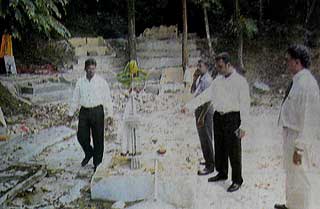
The Ampang temple demolition. I want to ask a specific question: Have you given instructions to all local councils that it shall not be done?
We have, we have. After the Ampang case, we went back to everyone (and said): any demolition of places of worship must get the approval of the exco. They cannot demolish, though they can identify (which should be demolished). They can work with these people, give them notice so that those seeking to establish a place of worship without approval or on government land or forest reserve will either have to move out or make an application to the state (to be approved). The exco will have a committee to review it. No approval will be given at the local council level.
We will standardise the forms and the trustees will have to write a letter to the state. We will fine them if they extend the temple without an application. Once they have applied, the exco committee will decide.
What about the Ampang temple demolition?
The demolition was only after the exco had decided (that no demolitions will occur without approval of the exco).
So you have given written directives to all local councils not to...
Not to demolish.
The deputy chair of the Ampang local council was suspended.
And he has already been reinstated.
Reinstated?
The exco for local councils suspended him for only one week.
So the suspension was meted out to him as a punishment?
 Well, from our point of view, he had acted beyond, outside the directive. But it doesn’t mean his services should be terminated... you play hockey and you start hitting people, the referee will ask you to rest for 20 minutes.
They are talking of temples being on a list to be demolished...
Chinese temples...
Indian temples...
No, no. What we are doing is basically trying to legalise. The question of monitoring, well, if you are not legalised, then you have a problem. This is what it’s all about. And anybody who is not on the list of legal temples will feel they will be demolished. If we do not legalise, then we’ll have a problem in the future. Let’s say they are on TOL land. The state may have to consider granting them the title. We do want people to start building temples and then trying to get these legalised.
Land is a state matter. When Tamil schools, or any school to be built in the state, is it the procedure for the education minister to require you to provide land? Have they made any such requests for you to provide land for such schools?
There are two or three ways of doing it. One way is when we develop more than 100 acres, then the planner will put, based on the ratio, three or four schools in the area. That’s one part of the equation.
There’s also the equation where we base the schools on the demographics of the area, and then we will put a certain allocation by the developer to the state for the purpose of the schools. That is part of the development process.
Why do we need the Federal government to get involved? Because of the funds, not for the land, but for the school itself. The state owns the land, the federal provides the funds for the building. That’s all there is to it. Usually, there will be enough planning in terms of the places.
So why are there so many complaints of Tamil schools not having enough land, without buildings, without funds...
I come from (plalntations group) Guthrie, where there were estate schools. The estate schools have always been temporary set ups. We have always given land for the schools. Land is not an issue. The issue is the location. Because of different families, the location may not be an ideal location for some members of the community.
But the Education Ministry sometimes says acquiring land is a troublesome job, the states are not willing to part with land...
If the state and federal governments are serious in their work, how on earth can you not acquire land? You have all the power at your disposal! They can acquire land on which a house stands and demolish it to make a road. There’s no issue (of government not be able to). It’s a question of whether you want to do it or not.
In the Rubber Research Institute Sungai Buloh estates measure 3,500-acre, they refuse to concede five acres for a school. Would you step in to do something about it?
The Rubber Research Institute is federally-owned, and acquiring federal land is different from acquiring private land.
The National Economi c Consultative Council (Mapen) in its report made excellent recommendations in 1991 (for the post New Economic Policy era), including for Indians. But it has, since then, been sidelined. It has never been implemented.
The real truth behind that is, I was a chairman of one of the committees in 1991. I advocated that the government should be responsible for the schools, and all that. But I was told that because of the political nature of Barisan Nasional, they refused to accept that.
Another recommendation was that the Indians be given the same sort of affirmative action (as bumiputeras)...
We had no objections to that.
Yes, it is there in the report.
But of course, you have to follow certain rules so that you can manage that. You cannot have schools placed in every estate where only 50 people are residing. We have to get a certain density. The MIC refused to accept this arrangement. We cannot recommend that Tamil schools be built in all Tamil estates where there are only 50 people. There have been instances of 50 children in five classes with two teachers for all five classes. This has happened. We know it. I protested and said this was no good, because the teacher teaching Standard 5 will also be teaching Standard 3 and Standard 1. The Standard 5 boys will learn Standard 3 lessons because they’re much easier.
Opposition Leader Anwar Ibrahim said he has the numbers needed to form a new government. Will you seek an audience with the King to show him proof that he has and ask him to decide?
We are working towards it. Anwar is very careful - we have to be very careful. Because any rushed action may end up in curtailing the democratic process. We do know Malaysia had that experience in 1969. It is not in our interests that by seeking to acquire government, people are deprived of democracy.
You think Barisan will resort to that kind of thing?
Well, you calculate the probability. You may say it is a small probability. But however small it is...
I’m among those who are not seeking to wrest control of the government at all costs. The people have to come first, and everything else should follow. Of course, we have a situation where once we do it, we have to go back to the people and decide whether you want us to be in power or not. There may have to be elections as early as possible to gain legitimate recognition for this new government.
 But of course, in politics, the game is fluid. I do not have any experience in this. Logically, I can think. But politics is not logical. Taking over a corporation, I can handle. But taking over a government, you are handling different sets of groups of people.
Anwar has got a feel for it. By any imagination, would people have said five years ago or predicted that PAS, DAP and PKR would get together? But it has been translated into reality. For that, we have to give him (Anwar) credit. He feels he wants the steps to be correct.
He has got an idealism such that if you can get to rule the federal government, it would be better. But I am of the opinion that we have to be careful, that by taking over government, you do not trade in democracy.
You think it’s a factor that Anwar wants to be prime minister before (former PM) Dr Mahathir Mohamad dies?
This is my personal opinion: Anwar has gone through that process of life. He has in some way forgiven Mahathir for whatever Mahathir has done to him. But that doesn’t mean he will not pursue his ambition. Those are two different things. He wants to pursue his ambitions, but he has forgiven Mahathir publicly and, sometimes, even privately. Of course, he is not the same. I would have worst (feelings against Mahathir) if I were in his shoes and gone through that. But his ambition is that he wants to become a statesman.
I don’t think Anwar wants to hit back at him. If he wanted to hit him back, you do not have to be a public figure to do all that. But I think Mahathir should also appreciate the wisdom and maturity that Anwar has undergone. He has been trained by Mahathir through his own ways, of putting him through prison, and so on.
Anwar is a leader, you cannot take that away from him. Let him try. If he feels that doesn’t fit into the agenda, then good luck.
Related story:


Are you sure you want to delete this comment?
This action cannot be undone.