




A civilised national conversation, please!
The recent spates and bursts of hot air over the issues of Malay dominance, the social contract, and the proposal to teach all Malaysian students in Bahasa Malaysia go to show how deeply rooted the idea of race is in our public domain.
Frankly, I am not that much perturbed by all these outbreaks of racial chest thumping and communal posturing. The air in the Malaysian sky is bound to be filled with racial rhetoric during the period in the run-up to an Umno party election.
The recent spates and bursts of hot air over the issues of Malay dominance, the social contract, and the proposal to teach all Malaysian students in Bahasa Malaysia go to show how deeply rooted the idea of race is in our public domain.
Frankly, I am not that much perturbed by all these outbreaks of racial chest thumping and communal posturing. The air in the Malaysian sky is bound to be filled with racial rhetoric during the period in the run-up to an Umno party election.
Umno is still the most dominant force in Malaysian politics, and as long as the party is in power at the federal level, we must expect Malaysian politics to be richly tinged in racial colours and hues. As long as the Malaysian population is divided into Malays and non-Malays, national unity will forever remain as a delusion. There is no cure to our national schizophrenia.
Recently, as I surfed the Internet, I came upon a blogger for a self-professed ‘Malay NGO” who asked the question “Why are the Chinese and the Indians so anti-social?” He went on to name me as an archetypal example of such an anti-social Chinese for an article I wrote for Malaysiakini on Merdeka celebration, describing me as “a Chinese who has migrated to Sarawak and became MP”!
I was more amused than irritated by his reductive and simplistic perception of me as a member of an ethnic group only while stereotyping me in racial term alone. It would be useless to try to engage such a person in a dialogue. It would be equally futile to remind him that there are many Malaysians outside the three major ethnic groups he mentioned, such as the Orang Asli and the indigenous communities of Sabah and Sarawak. These fellow Malaysians probably do not feature much in his political imagination.
Racism is dehumanising
The greatest tragedy in Malaysia is that most citizens still perceive politics with their race-tinted glasses. It is tragic because racism is dehumanising; it erases the individuality which is also part of the essence of our humanity. Each of us is greater than our membership in any ethnic community. While we cannot choose our parents, we can choose who we want to be as individuals.
Those familiar with the philosophy of morals will know that the freedom to choose is the pre-requisite for the concept of mor al and legal responsibility. That is why an insane person will not be punished with a death sentence for even murder. Instead, he would be sent to a sanatorium for treatment. In that sense, killing in self-defence can also be exonerated in a court of law.
Therefore, nobody should be rewarded or punished for his ethnicity, over which he has no choice. This is the moral argument against violation of human rights and discrimination based on the colour of anybody’s skin, creed, or religious belief.
But we do live in a very complex multi-racial society, in which linguistic, cultural, and religious conflicts are bound to exist. As long as people are still incl ined to cling to their ethnic identity as the core of their personal identity, and as long as politicians find such ethnic sentiment a fertile ground for mass mobilisation, racism will always sway our citizens’ political judgement, no matter how much I loathe it personally.
 The problem is not that inter-ethnic conflicts exist.
The problem is how political leaders and the ordinary citizens a
pproach those problems with the aim of reaching compromises and consensus.
The problem is not that inter-ethnic conflicts exist.
The problem is how political leaders and the ordinary citizens a
pproach those problems with the aim of reaching compromises and consensus.
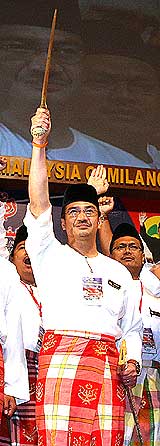
As long as we seek peaceful means of solving our problems, and our system of parliamentary democracy does provide a forum for such means, then we are alright. The first consensus we should reach is the banishmen t of all violent means in the expression, articulation, and settlement of our inter-ethnic conflicts. The waving of keris or any symbolic weapons must be discouraged ( photo ). Hate crimes must be condemned by all Malaysians.
If peaceful long-term assimilation is the ideal in the spectrum of race relation, then genocide has to be the extreme end at the other pole of this continuum.
The term “genocide” was first coined by the Polish-Jewish scholar and activist Raphael Lemkin (1900 – 1959) in 1943 to characterise the massacre of 6 million Jews and other minorities by Nazi Germany during WW2. The word is derived from two elements, the first from the Greek word genos meaning tribe or family, and the second from its Latin root word –cide meaning killing, or massacre.
After the Great War, the United Nations Convention on the Prevention and Punishment of the Crime of Genocide of 1948 has made genocide a crime against humanity. When the horror of the Holocaust was revealed at the Nuremburg Trial, the world seemed to be saying to the crime of genocide, “Never again”.
Unfortunately, it did happen again and again in an apathetic world, in Cambodia, Bosnia, Rwanda, and now in Darfur. In the case of Rwanda, 800,000 to a million Tutsis were killed over a period of 100 days by the Hutu soldiers and their Para-military groups, many with the machete only. After WW2, ethnic clashes have claimed more innocent lives than any other cause of conflicts.
(For those interested in the topic, Donald Horowitz’s monumental Ethnic Groups in Conflict makes for compulsory reading.)
I doubt if the devil’s seed of genocide will ever take root in Malaysia. This is not because our government is so wise in using the ISA to arrest racists and extremists, as was claimed by the Home Minister on Aljazeera during the RPK interview. It is, I surmise, simply that Malaysians have been exposed to one another’s cultures for a long time; they have had plenty of opportunities to adjust themselves with a polyglot and diversified way of life. Most of all, Malaysians are very nice people at heart. They are unlikely to be extreme racists - even if they are riled up by racist politicians.
Many citizens are thinking in private
I mention genocide as the extreme case of racist attacks to emphasise my point of banishing violence in our race relation. But this should also imply the banishing the use of linguistic violence as well. In this sense, any threat of any race running amok and repeating the May 13 is unethical and should never be uttered by anyone.
In short, opinion makers who do influence public thinking ought to take our conversation on race to a higher level from our traditional confrontational modal. The purpose of such a national conversation ought not be to win merely, through the employment of rhetoric, name-calling, profane demonisation, labelling, and downright ridicule, which are so rampant on the Internet. Above all, racism ought not to be rewarded with reverse racism.
In this, I agree with many of my fellow commentators that Mukhriz’s view on vernacular schools is indeed a common view held by many thoughtful Malays and more than a few non-Malays. Irrespective of his parentage, he is making public what many citizens are thinking in private.
It is all too easy to rule his view out as just another conspiracy by an ultra Malay nationalist to wipe out mother-tongue education. Frankly, I have yet to understand his views entirely.
 It would be less than prudent therefore, to immediately accuse him of sedition, and to make police reports, especially for those of us who hate the Sedition Act as one of those laws that belittle the intelligence of common Malaysians.
For those who claim to speak up for non-Malays who love their mother-tongue education, Mukhriz’s controversial statement can also be an opportunity to engage him and many Malaysians who think like him in a reasonable open-ended and friendly debate, not only on the medium of instruction in schools only, but also on a number of issues surrounding education and national unity.
Again, the purpose of such a public conversation is not to win political points only, but to unfold the complexity of the many ways of looking at education, the state of which at the moment is moribund at best. Eventually, one hopes that the debate will open up the discussion, so that at the end of it, the emerging views – for the national audience at least – will be greater the sum of its parts.
At the end of the day, participants in this emotional debate may still disagree, but they may have a better understanding of their own positions, and the positions of their perceived opponents. Above all, this sort of courteous, friendly, and reasoned conversation can only serve to enlighten their constituents that discussion on so-called sensitive topics need not be carried out in the usual virulent visceral and highly antagonistic manner.
That, I say, is the best way forward for a multiracial democracy like Malaysia.
SIM KWANG YANG was Bandar Kuching MP from 1982-1995. He can be reached at kenyalang578@yahoo.com


Are you sure you want to delete this comment?
This action cannot be undone.