




Day 2,926: Victory at last for village folks
Among Malaysian citizens of Chinese descent, mother-tongue education has attained the kind of iconic status that approaches that of a religion. Ever since the early days of Independence,
it has always been one of the most controversial, emotive and sensitive political issues in every general election.
There have been many individuals who project themselves as heroes in this long war to preserve and develop Chinese vernacular education in Malaysia. Though most Chinese citizens are united in support of educating their young in their mother tongue, the Chinese community are sometimes their own worst enemy.
Already there has been a protracted intellectual genocide going on at the New Era College in Kajang, and Dr Kua Kia Soong’s head had rolled off the chopping block .
 This year though, there is happy news for a change. The Sekolah Jenis Kebangsaan (Cina) Damansara would be reopened together with all the other schools in Malaysia, after eight years of closure.
The school will have a new name though; it will be known as SJK(C) Chung Hwa Damansara.
Among Malaysian citizens of Chinese descent, mother-tongue education has attained the kind of iconic status that approaches that of a religion. Ever since the early days of Independence,
it has always been one of the most controversial, emotive and sensitive political issues in every general election.
There have been many individuals who project themselves as heroes in this long war to preserve and develop Chinese vernacular education in Malaysia. Though most Chinese citizens are united in support of educating their young in their mother tongue, the Chinese community are sometimes their own worst enemy.
Already there has been a protracted intellectual genocide going on at the New Era College in Kajang, and Dr Kua Kia Soong’s head had rolled off the chopping block .
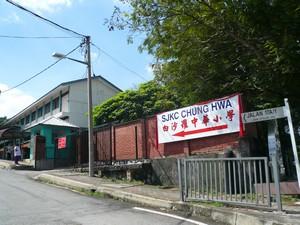 This year though, there is happy news for a change. The Sekolah Jenis Kebangsaan (Cina) Damansara would be reopened together with all the other schools in Malaysia, after eight years of closure.
The school will have a new name though; it will be known as SJK(C) Chung Hwa Damansara.
The reopening of the school marks an end to over 2,925 days of local community activism that has grabbed the attention and extraordinary support of the entire national Chinese population. The heart-warming story deserves to be told.
School built in the 1930s
The SJK(C) Damansara was founded in the 1930s to cater for the needs of the residents of Kampong Baru Damansara in Section 17, Petaling Jaya, at a time when there was only jungle surrounding the village. Over the years, massive urban development has mushroomed around the village, and the school has become beastly over-crowded.
In 1999, 1,422 students were registered at the school sitting on a 0.8 acre site, when by all existing standards the school could accommodate only 400 students. At the request of the Parents-Teachers Association, the Education Ministry closed down the original school and relocated all the students to a brand new school four or five kilometres away near Tropicana.
 School children from the local community at the Damansara New Village turned up at the old school gate on Jan 2, 2001 for a new school year, and found it locked. They did it for a few
more days, to the increasing dismay and frustration of the parents.
Under normal circumstances, most other Chinese parents would just sigh and give up; they are known to be pragmatic and “realistic”. Then they will just make expensive and inconvenient arrangements to send their kids to the new school.
But elegance often resides in simplicity. These villagers are simple folk, and they are not likely to be wealthy. But the parents have all gone to this humble school, and it is more than just a building. It is the depository of their childhood, an icon in their collective memory as a closely-knit community, and the symbol of their enlightenment as they attained literacy. They call the school affectionately as their “Mother School”. One ought not to abandon one’s mother when she is in distress.
So they did something quite revolutionary for the Chinese community. They decided to take the fate of their children’s education into their own hands. They decided to fight for the right of their village school for existence.
Villagers went on nationwide campaign
Under the leadership of the village chief, whole families turn out in full force for nightly meetings for weeks on hand, for briefing, mobilisation, and discussions on strategy and action plan. On many occasions, such meetings lasted well into the night. Housewives endured the hardship of going to bed at one or two in the morning, only to wake up early to do the numerous chores in the house.
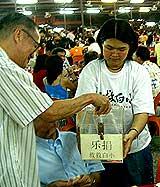 They formed the Save Our School (SOS) action committee. Parents and children would travel all over the peninsula during weekends and public holidays on their own expense, protesting, campaigning, seeking donations, and in the process, they persuaded 150,000 Malaysians to sign a petition for the reopening of the SJK(C) Damansara in their village. They have done that for eight long years.
(I crossed path with them in more than one by-elections in the past. Sometimes, I was called on to help the opposition candidate in various parts of the country, and these SOS people would appear out of nowhere. I was amazed at how these “simple villagers” had turned out to be fearsome, well-trained, well-organised, effective, and persuasive campaigners for their cause!)
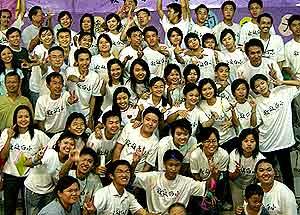 Before long, they had whipped a new frenzy of support across the entire Chinese community in Malaysia. The Chinese-based parties all claim to be behind their effort, as Chinese parties are wont to do on such an emotional issue. The Chinese papers would like to publicise their activities more, but had been told by powers higher up to hush up the SOS success. The Chinese guilds and associations have all thrown in their support.
There is a huge billboard placed over the front entrance of the Selangor Chinese Assembly Hall at Kampong Atap in KL city centre, counting day by day the number of days for which the SJK(C) Damansara has been closed. It has become a landmark of sort in Kuala Lumpur, a reminder of Chinese education under siege.
A makeshift temple school
Meanwhile, the SOS committee did another extraordinary thing. They decided to run a primary school in their village anyway, in the hall of the Ruan Liang Temple.
They engaged teachers on their own, and started with small classes. It was quite chaotic at first, since the classes were separated by a mere canvass, and what is said in one classroom could be heard clearly in another. It was much later that they brought in a couple of air-conditioned containers, and they even installed a computer lab.
 The students were not recognised by the Education Ministry of course. For the purpose of taking government-administered examinations, the SOS people had to resort to hooking on other recognised schools for their children to take official examinations, suffering untold humiliation and bureaucratic traps in the process. But they persisted. Since the early days, more than 70 students have graduated from the temple schools.
Finally, a light appeared at the end of the tunnel. Just before the March 8 general election, there were political noises that the SJK(C) Damansara could be reopened. The opportunity arose when a Perak Chinese school had to close down, because they had only one Chinese student left. The licence or the permit could thus be transferred to the Damansara school, and hence the new name.
So finally, the primary school in the Damansara New Village reopened on Monday after eight long years of lobbying. The villagers can now go back to their business of making a living and raising their family. I suppose they would all heave a huge sigh of relief, but they remain nonplused in public. Why should they rejoice, they claimed, when they were getting merely what was their right in the first place?
When politicians from both the opposition and the ruling parties began to make their appearance in their village school lately, they said their struggle was not political, but an educational one. They welcome all political parties for their support. Quoting a famous saying by Teng Siaw Ping the great Chinese leader, they said they could not care less whether the cat is a white cat or a black cat, as long as the cat could catch mice!
No new schools allowed
Of course, the issue of the SJK(C) Damansara has heavy political implication. When
their old school was relocated, they could not have classes at the old site in the village for a simple reason: it is an unwritten policy of the Umno-dominated government that the number of Chinese primary schools can only be decreased, and never be increased in Malaysia. No new Chinese primary schools are permitted.
Commentators in the Chinese press also tend to see the struggle of the SOS campaign as a meaningful chapter in the struggle for Chinese education. Through the last eight years, the Chinese youths have been exposed once again to the spirit of the movement. Once again, they are reminded of the overwhelming odds against which they have to triumph, just to get an education in their mother tongue.
But I see it as more than just a success story for Chinese education.
Here you have, some simple village folks who are unlikely to be highly educated, but who have successfully launched a sustained and effective national campaign for a school in their village with the sort of single-minded civic consciousness that is indeed rare in Malaysia. In the process, they have faced down many prominent people in authority and police riot squads. They have found political wisdom and courage in themselves.
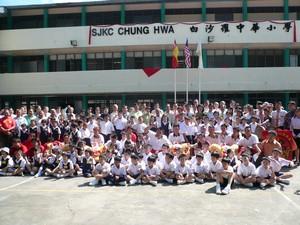 In Malaysia, when any community is in trouble of any sort, they always tend to fall prey to the dependence syndrome, hoping for heroes from somewhere to rescue them. But the Damansara villagers need no such hero; they knew that the power to change things around lay in their own hands.
In that sense, those villagers are a shining example for communities of all ethnic origins. They should have been awarded Malaysians of the Year by organisations that are in the habit of handing out such awards.
Malaysia would be a better place, if all its citizens emulate the fine example of the Damansara New Villagers.
SIM KWANG YANG was Bandar Kuching MP from 1982-1995. He can be reached at kenyalang578@hotmail.com.


Are you sure you want to delete this comment?
This action cannot be undone.