




Landmines in Sarawak, Part 3
As thousands of Sarawakians of all races converge on Bintulu on February 21 for the 'Friends of PKR' dinner, the question in the mind of many people in the Land of the Hornbill is this: C an Anwar Ibrahim be trusted?
There are other similar doubts. For instance, even if the Pakatan Rakyat coalition can take power in the next general election, what is there to guarantee that they would not be as corrupt as the previous BN government? Can we find a single clean Sarawak leader to take office as the chief minister of Sarawak?
As thousands of Sarawakians of all races converge on Bintulu on Feb 21 for the 'Friends of PKR' dinner, the question in the mind of many people in the Land of the Hornbill is this: C an Anwar Ibrahim be trusted?
 There are other similar doubts.
For instance, even if the Pakatan Rakyat coalition can take power in the next general election, what is there to guarantee that they would not be as corrupt as the previous BN government?
Can we find a single clean Sarawak leader to take office as the chief minister of Sarawak?
There are other similar doubts.
For instance, even if the Pakatan Rakyat coalition can take power in the next general election, what is there to guarantee that they would not be as corrupt as the previous BN government?
Can we find a single clean Sarawak leader to take office as the chief minister of Sarawak?
In his famous book Pedagogy of the Oppressed , Paolo Fierre observed that in an oppressed society, the first aspiration of the oppressed is to join th e rank of the oppressors. You find ample examples of these oppressed-turn-oppressors in the BN YBs in Sarawak.
I will now add a corollary to his proposition.
The second aspiration of the oppressed is to wish for a prophet or a revolutionary army to descend from the heavens and deliver them to redemption. Their top political leader must be completely trustworthy, honest, clean, courageous, and in short, perfect.
A leader must be dependable for a rakyat that is addicted to compulsive dependence on others for their own deliverance.
Trust is a social contract
But the entire Westminster model of parliamentary democracy has evolved for the past few hundred years on a deep dis trust for people with power.
That is why we have the Doctrine of Separation of Powers between the legislative, executive, and judicial branches of government. That is why we have periodic general elections. That is why we clamour for a free press, and all the other instruments of checks and balances against abuse of powers.
Of course, as participants in this political process, a certain amount of trust is required of us, or else the social fabric of our polity will collapse. But for the democracy to stay healthy, that trust of the rakyat for their political leaders must neit her be total nor unconditional. It is a social contract that must be reviewed and renewed every so often.
We also have to see what is most needed in Sarawak p olitically – and in the whole of Malaysia for that matter.
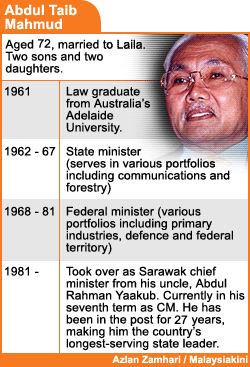 The root of our political helplessness in improving our own lot in Sarawak is the almost absolute rule by one man controlling the whole state government – Abdul Taib Mahmud.
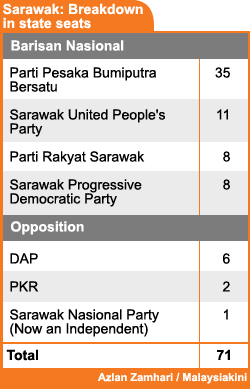
Sarawak is a one-party state. During general elections, the ruling BN can mobilise their unfair advantage to make sure this virtual Rule of Man continues forever.
The solution is not to find another political titan to replace Taib Mahmud, for that will only perpetuates the Rule of Man. The solution is to bring change so that the Rule of Law will prevail in the end.
For the Rule of Law to triumph, we need to rebuild and reform our political institutions. We have to change the rules of the games.
The voters must stop depending on their leaders. They must turn around and make these leaders work for them. We need a two-coalition system, to make alternative governmen t possible in Sarawak first. Without that option, Sarawakians will have no real political choice, even if they go to vote regularly.
I suspect that in the subconscious psyche of many Sarawakians, they do not believe that opposition parties can defeat the BN in the state general election.
This is a psychological hurdle that has to be cleared first. At least, what was always assumed to be impossible has been made possible in Penang, Selangor, Kedah, and Perak in March last year.
Once alternative state government is realised, the adversaries on both sides of the political divide will have to woo th e voters, and not the other way round. By choosing wisely between the two offers, the voters will be empowered; they will become the true masters of their collective destiny.
If the Pakatan Rakyat state governments in Penang, Perak, Selangor, and Kedah do not deliver their goods of good governance, they too can be kicked out in the next elections (or perhaps sooner, as in the case of Perak today).
They cannot be corrupt like their predecessors. The same principle applies to Sarawak. B ut here, we must dethrone the BN from their virtual monopoly of power in the state first.
The enemy of our enemy is our friend, for now at least. For now, PKR and their allies fit the bill.
A social contract with Anwar
How about Anwar Ibrahim, with his heavy and colourful political baggage?
He is a charismatic leader, who is also a tool of history at work. He needs the support of Sarawakians and Sabahans badly, to realise his dream of entering Putrajaya as a victor. This is the critical time when Sarawakians and Sabahans can renegotiate a new social contract with him, if we help him reali se his dream.
He has to promise the changes that need to be made in Sarawak, if the Pakatan coalition comes to power in Sarawak. The oil royalty will be increased, the Sarawak Land Code will have to be amended to give land tenure to NCR land, socio-economic development of Sarawak will have to be given sharp focus, and so on. He has indeed promised some of these demands already.
 Likewise, Sarawakians also need Anwar and his powerful Pakatan coalition in West Malaysia.
We need to help him take power at the federal level, to remove Umno, the source of power behind the Sarawak BN.
Without a change of federal government, an opposition held state government in Sarawak will be a lame duck.
Likewise, Sarawakians also need Anwar and his powerful Pakatan coalition in West Malaysia.
We need to help him take power at the federal level, to remove Umno, the source of power behind the Sarawak BN.
Without a change of federal government, an opposition held state government in Sarawak will be a lame duck.
But personality does count, when it comes to making historic changes. Washington, Lincoln, and Obama are those outstanding personalities who appeared at the right place at the right time to change American history.
I believe Anwar is such a personality.
At the moment, he is the one who is both the fulcrum and the catalyst for the unlikely bed-fellows in Pakatan Rakyat to forge a common front against the might of the Barisan Nasional. He has also successfully rallied a common platform for a rainbow coalition of civil society groups and NGOs to pool their strength against the ruling BN coalition. He is playing a role that no other single Malaysian can fill.
The idea that he puts forth for the PKR is one of Ketuanan Rakyat (People’s Dominance), to replace Umno’s policy of Ketuanan Melayu (Malay Dominance).
Despite half a century of racial politics perpetuate d by Umno, Anwar is the fir st political leader to propose this trans-ethnic agenda. It is a sign of great courage and enlightenment for a man nurtured first by religion, and then by the communal politics of Umno.
 I know Anwar when he was a leader in Abim.
I was elected to the Dewan Rakyat together with him in 1982.
I bumped into
him constantly in that august House through three terms of my membership.
I always found him engaging, courteous, and friendly.
I know Anwar when he was a leader in Abim.
I was elected to the Dewan Rakyat together with him in 1982.
I bumped into
him constantly in that august House through three terms of my membership.
I always found him engaging, courteous, and friendly.
But I am not qualified to vouch for his personal integrity in public life.
He, like all political leaders of our time, will be judged by the people of Malaysia by ongoing events in the country. Ultimately, he will be judged by history.
But for the moment, my tentative assessment is that Anwar is the most likely person to bring meaningful change to our politics of corruption and abuse of power.
At the end of the day, the real question is not whether we can trust An war or his Pakatan coalition.
The real question lies in whether we can trust ourselves, our own judgement in the face of extreme confusion.
Ca n we change our own thinking from one of scepticism against all things political, and turn to optimism, hope, and concern? Can we change from being a spectator forever regretting the state of affairs on the sideline to become active agents of change ourselves? As Barack Obama said on his campaign trail, “We are the change that we seek.”
The Perak imbroglio
As for the wild fire spreading in Perak, I am not that perturbed.
Such dramatic stories of political betrayal and counter-betrayal are only to be expected in a country beset by all the uncertainties amidst a period of radical transition. Sarawakians and Sabahans have seen that happen many times in their state politics in the past.
 There, I believe the correct parliamentary conventio
n in most Commonwealth countries is for a motion of no-confidence to be moved in the Perak State Assembly.
There, I believe the correct parliamentary conventio
n in most Commonwealth countries is for a motion of no-confidence to be moved in the Perak State Assembly.
If it is passed, then the menteri besar should recommend to the Sultan for the State Assembly to be dissolved in order to make way for a state election.
That sort of upheaval only goes to show that people who control power are not likely to surrender that power willingly. It does mean that that kind of power has to be pried open by the rakyat from the clenched fists of the oppressors over a period of time after many setbacks. The road to democracy is a long and winding road. Great things in life never come easy.
The same can be said of the change in Sarawak. We must start with ourselves first.
SIM KWANG YANG was opposition MP for Bandar Kuching from 1982 to 1995.
He can be reached at kenyalang578@hotmail.com.


