




Sabah fishermen up in arms over foreign intrusion
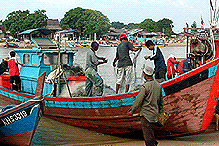
Intrusion and competition from foreign fishing vessels are affecting the livelihood of Sabah fishermen and the state government wants to put a stop to it.
Intrusion and competition from foreign fishing vessels are affecting the livelihood of Sabah fishermen and the state government wants to put a stop to it.
The deal with the federal government recently was that Sabah companies would be allowed to engage foreign fishing vessels to undertake deep-sea fishing i.e. generally considered as beyond 30 nautical miles from the coastline. Already, one local company which has obtained a deep-sea fishing licence in this manner has so far engaged at least 10 Vietnamese fishing vessels which can be found anchored in Likas Bay, Kota Kinabalu.
Now, 15,000 local fishermen are crying foul that the foreign fishing vessels ostensibly licensed for deep-sea fishing are in fact allowing themselves free rein even in Sabah waters and further threatening their already dwindling catches in recent years.
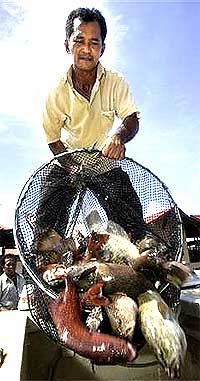
There have also been reports that the foreign fishermen have been offering live turtles for sale at RM400 each.
 Other reports suggest that shark finning is taking place i.e. just taking the fins of the shark and throwing it back into the sea to bleed to death, “a cruel and wasteful practice although legal in many places”. Already, State Tourism, Culture and Environment Minister Masidi Manjun has publicly called on the Fisheries Department to investigate claims of shark and whale processing activities reportedly taking place around Pulau Mabul, a world-renowned diving spot, off Semporna.
“To allow these foreign fishing vessels to come to our shore waters means we now have to compete with them,” explained Arsani Arsat, the chairperson of the United Sabah Fisheries and Boat Owners Association (Usfboa). “Yet, we have never applied to fish in the waters of these countries.”
“Even LKIM (Fisheries Development Authority of Malaysia) have expressed serious concern over the steep decline in catches (among local fishermen).”
Arsani was commenting on local media reports about the more frequent sighting of foreign fishing vessels, so far from Vietnam only, in the waters off Kota Kinabalu. He hopes “someone in authority will explain why local fishermen are no longer being given priority to ply their trade in the country’s inner waters”.
The Sabah coastline stretches for 1,800 km around northern Borneo and takes in three seas viz. the South China Sea, the Sulu Sea and the Sulawesi Sea.
10 licences issued
It was not so long ago that the Vietnamese in particular were regularly hauled to court for poaching in local waters. Their haul even included protected species like turtles. Their modus operandi was to have a “mother ship” lurking in a relatively safe zone nearby while smaller vessels did the poaching and transferred their catch to the mother ship before the marine enforcement boats caught up with them.
In the past, these foreign fishermen had their boats and catch confiscated and fined the mandatory RM1 million. Generally, the owners of the boats refused to pay the fine and preferred to let their men do a stretch behind bars instead.
 It is understood that although approval to fish in Sabah waters must come from the federal government, it can only be obtained upon the recommendation of the State Fisheries Director.
State Fisheries Director Rayner Steul Galid confirmed that the licences to the foreign fishing vessels, sighted in local waters, was issued by the Federal Fisheries director-general based on the recommendation of the State Fisheries Department. So far, the federal government has issued 10 licences each in the following categories: deep-sea trawling (Pukat Tunda); Purse-Sine net (Pukat Jerut) and long-line fishing licences to local companies.
Local companies have been allowed to hire Vietnamese crew members, who specialise in long-line fishing, for a period of three years after which “the companies should gradually replace the foreigners with locals”.
“Action would be taken if the vessels are found operating less than 30 nautical miles from the shore. They can catch any type of fish within their particular area using long-line fishing except the whale shark,” warned Galid.
“If found guilty in court, they can be fined up to RM50,000 and their boats would be confiscated. Local fishermen should be the eyes and ears of local authorities and report to the department if they come across any suspicious activities taking place in our waters.
“The department recognises the important role and contributions of local fishermen and small breeders besides small and medium enterprises in our efforts to develop the state’s fisheries.”
RM7 million incentive
He disclosed that incentives worth RM7 million will be given to local fishermen this year in the form of boats, outboard motors, seaweed drying platforms, seaweed seed and fishing equipment such as nets.
Wilfred Lingham, a former top civil servant in environmental affairs and head of a local angling body, thinks that foreign fishing vessels should confine themselves to the waters beyond 70 nautical miles and even local fishermen should be encouraged to move beyond 30 nautical miles from the coastline. “The long liners are vessels designed to fish at any depth with baited hooks numbering 3,000 or more for each vessel. The Vietnamese are well-seasoned and have even been fishing in the Spratlys and Layang Layang,” said Lingham. “Thirty nautical miles is not very far these days and it will severely affect the livelihood of thousands of local coastal fishermen. Local fishermen who sink an average of two or three hooks a time can never match the catch of a longline boat.”
“The longliners are like vacuum cleaners of the seas. They suck in all the live fish wherever they operate, from bottom dwellers to pelagic, sea turtles and sharks.”
The scavenging role of the sharks – their food range from planktons to crabs to sea urchins and clams – keep the marine environment clean and they help maintain healthy marine populations because they eat up decomposing animals, according to Lingham.
He also worries that the foreigners will deplete the rich fishing grounds around Menggalum Island, a favourite with anglers and for sea sports, which is within the 30 nautical miles limit from the coastline.
Figures kept by the State Fisheries Department show that overall the state produced 230,000 metric tones of fish and fishery products by the end of last year, despite local fishermen complaining that their catches have been getting smaller over the years. The department is confident that the target of 250,000 metric tones of fish and fish products by 2010 will be met.


Report this comment
Are you sure you want to delete this comment?
This action cannot be undone.