




World Cup fever!
It was, admittedly, not the best game to showcase the World Cup. England, quarterfinalists at the last World Cup, ranked ninth in the world and stuffed full of players from Chelsea, Liverpool and Real Madrid, struggled against world number 51 Trinidad & Tobago, whose team was largely made up of players from the lower tiers of the English divisions.
Of course, where the World Cup is concerned, it isn't all about the football. The World Cup is more like a festival - one in which many people can participate in, even if their own teams are not actually playing. Take our own country. I have given up hoping for Malaysia to make the cut, but this hasn't stopped us from taking part - even if it means staying up till 3am to watch some matches and consequently spending the rest of the day in a blur.
It was, admittedly, not the best game to showcase the World Cup. England, quarterfinalists at the last World Cup, ranked ninth in the world and stuffed full of players from Chelsea, Liverpool and Real Madrid, struggled against world number 51 Trinidad & Tobago, whose team was largely made up of players from the lower tiers of the English divisions.
Of course, where the World Cup is concerned, it isn't all about the football. The World Cup is more like a festival - one in which many people can participate in, even if their own teams are not actually playing. Take our own country. I have given up hoping for Malaysia to make the cut, but this hasn't stopped us from taking part - even if it means staying up till 3am to watch some matches and consequently spending the rest of the day in a blur.
It's everywhere
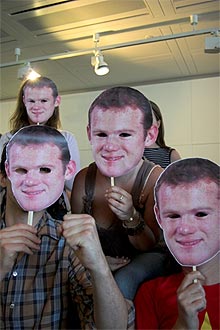 The World Cup fever is even greater in countries that have teams playing in it. Pity the person who hates football in England - you would have to make a very determined effort indeed to escape it, as it is all over the media. Newspapers carry World Cup supplements, and two major broadcasters, the BBC and ITV, have cleared their schedules in order to broadcast most of the matches.
Many households sport the English flag, and it seems like every other car is also proudly flying the flag. The English, after playing down their national pride for generations, have finally found a cause around which they can gather - the national football team.
Being as I am, both a supporter of the England team as well as an observer of English life, it has not escaped my notice that although the English can lean towards self-deprecation when it comes to celebrating their successes and achievements, nevertheless when it comes to the football team, expectations are always sky-high. It is not enough to merely get to the semi-finals, no, England must - and will - win the World Cup. Does it matter that England's performances so far have been far from convincing? Does it matter that there are other teams - like Argentina - who are playing like true champions and thus likely to scupper the English dream? No, as far as the fans are concerned, the team is good enough to win the Cup, and win it they will.
No wonder the Scottish are so fed up with the hysteria that infects the English when the World Cup comes along (especially when they themselves have failed to qualify). When Wayne Rooney, England's star striker, broke his metatarsal six weeks before the Cup, there was feverish speculation in the nation about whether he would get well in time or not. This was interspersed with the regular airings of songs which lamented about "40 years of hurt" since the Cup was won in 1966, and regular commentaries that confidently stated that "this was England's best chance at winning the World Cup".
There was even a political furore over the World Cup when it emerged that Gordon Brown, the (Scottish) Chancellor of the Exchequer, admitted that he would support the English team. The Scots - and many Englishmen - were scathing of the Chancellor's support. As far as the Scots were concerned, no self-respecting Scotsman should support the English team. Scotland's First Minister publicly announced that he would be backing Trinidad & Tobago, not England, and there were many cynical Englishmen who saw the Chancellor's support as nothing more than a calculated move to make himself more likeable to English voters.
Excitement
 Still, Scottish sour grapes have not dampened English enthusiasm. Such is the support for the team that many literally drop everything to watch their heroes in action. One of my colleagues has taken two weeks off so that he can watch the football (I only hope his fiance is also a football fan). Thousands of England supporters have gone to Germany, whether they have tickets or not. Many of those who have got tickets will have spent thousands of pounds, especially those who obtained tickets from the black market (tickets for the England v Trinidad & Tobago match reportedly changed hands for more than four times the face value). Amongst the many flags that adorned the Frankfurt stadium where England played their first match was one that implored: "Claire, please don't give birth yet". Back in Britain, a bride had to entertain her guests by herself after her new husband went to a pub to watch the match.
Meanwhile, businesses have realised that they would be better off trying to accommodate their workers' enthusiasm for the team. One of the UK's supermarket chains, Asda, allowed its employees to take up to two weeks' unpaid leave for the duration of the World Cup. Many offices also installed television sets so that staff could watch the match at work. In all, 35 million were glued to their television sets yelling the team on during the second England match; at work, at home, in restaurants and in pubs.
What is it though, that makes the World Cup so special?
For a start, football is probably about the only sport that can truly lay claim to being a global game. Despite the offside rule, football is probably the simplest game that can be played and understood. A game of football only needs some players and something round that can be kicked around (Pele himself started out by fashioning a ball out of his socks). There is no need for sticks, and unlike rugby, you don't need to be a beefcake to play it either.
Furthermore, because football is so accessible, you don't need to be a rich country to excel. The USA may be the world's richest nation, but it has yet to progress beyond the quarterfinals in the World Cup. By contrast, football's ruling hierarchy comprises of a mixture of countries like Brazil, Argentina and Holland, and every four years other countries have a chance for football glory. Take Angola, for example. It has only just emerged from a war that ravaged entire generations. Angola realistically has no chance of winning the Cup, but the team have garnered respect from other countries from the way they play their football. By contrast, safe, rich and comfortable Canada didn't even manage to qualify - even though they belong to the CONCACAF group, which is arguably one of the easier routes into the World Cup.
Football's accessibility also means it can be the glue that sticks a nation. Where the politicians have failed, the football team has succeeded. England supporters come in all shades - many of England's ethnic minorities have proudly rallied behind the flag and declared themselves English, which is no mean feat for a nation that frequently agonises over race and community relations. Speaking to The Sunday Times, Aki Sadiq said: "First and foremost, we're all English, born and bred. Second, we're all England fans and we'll sing and follow our team anywhere. I'm a Muslim and I don't drink with the rest of the boys but it makes no difference. They get legless along with everyone else and I stay sober. These lads who I've grown up with and played football with are part of my family, I don't see their colour and they don't see mine."
Similarly, the World Cup has also allowed the Germans to rediscover and express their national pride. Germans are joyfully embracing the flag that so many shunned in the aftermath of the Second World War. Finally, Germans can take pride in their nation without having it tainted by associations with Nazism. The World Cup is allowing Germany to throw off its burden of history, and become a normal nation again.
Politics free
The World Cup is also, as The Economist puts it, "wonderfully difficult to manipulate for political purposes". Unlike the Olympics, which frequently mirrored what was going on in the political world, the World Cup is only concerned with what happens during that one month. The World Cup is about football, and only football. The USA may be the world's sole superpower, but that counts for nothing in the World Cup. Serbia-Montenegro may have just decided on an amicable divorce, but they remain a united nation for the World Cup. Furthermore, whilst a country may decide to boycott the Olympics (as many did during the Cold War), no nation would ever give up a place in the World Cup - Iran for instance, relished its clash with the USA during France '98, which incidentally ended in a 1-2 loss for the Great Satan.
And of course, one of the best thing about the World Cup is, well, the football. It may be a clich, but football truly is a game of two halves. There are times when a match amounts to little more than a master-class, as Serbia-Montenegro v Argentina demonstrated. There are also times when an underdog manages to completely humiliate a team that is far superior to it. Who would have thought that South Korea would not only reach the semi-finals, but also beat Italy and Spain in the process four years ago? On paper, England looked like it was in the easiest group during the current campaign, but reality proved different. At one point, Trinidad & Tobago, the smallest country in the World Cup, actually had a very real chance of going through to the second round.
Whether detractors like it or not, people do go completely crazy over football. What other sport do you know of that has sparked a war between two countries? Yet that is exactly what happened in 1969, when tensions between Honduras and El Salvador broke into all-out war during their World Cup qualifying campaign. A ceasefire was declared after four days, but it took them more than a decade to finally settle on a peace agreement. After all that, El Salvador won none of their group matches and didn't go any further in the World Cup.
What's more, two men from Uzbekistan have travelled 6,500km to Berlin by bike just to get Oliver Kahn's autograph (he's not even in the German first team). A couple of inmates in a Bulgarian jail have sewn up their mouths and refused to eat until prison officials install a TV set in their cells so that they can watch the World Cup.
You could be a goatherd in the middle of nowhere. Or you could be like me, with my family back home in Malaysia. I watched that second England match at work. But I knew that when I yelled in frustration, my yells were amplified not just there at work, but also up and down the country. I knew that my brother in KL - an ardent England fan - was probably shouting at the exact moment I was. It's all one big party, and you don't need to have tickets, or be a football guru, to take part. And that to me, is the true beauty of the World Cup.
Photo credits: Remez Media
FARAH FAHMY works and lives in London.


Are you sure you want to delete this comment?
This action cannot be undone.