




Where the gaps are big in a flat world...
ONE of the most important messages a reader can grasp from 'Flat World, Big Gaps' is that the majority of people are suffering from poverty and inequality because corporations have ascended to the top of the food chain and taken over the position once held by governments.
And it is precisely for this reason 'Flat World, Big Gaps' was written. People must realise that they have to play their role economically as well in order to compete in the globalization era.
There is a connection between this book and the documentary The Corporation by Mark Ackbar and Jennifer Abbot which I watched recently.
 It's simple mathematics - large portions of the earth's wealth are enjoyed only by the minorities of the global population. And these minorities virtually constitute the corporate communities and the rest would make up as state figures, with affiliations, one way or the other, to the corporate communities.
"Corporations were once relatively insignificant" narrates Jennifer Abbot in the beginning of the film. Yet today we see Corporations as modern gods appearing in every aspects of political and social life and with this man-made divine status, become the most powerful and significant institution in civilization virtually shaping every policies, national and international.
How is this so? With the introduction of industrialism and a hegemonizing Eurocentric definition of 'progress' promulgated and imposed once through colonialism and now via powerful Anglo-Western mass media, Corporations have ascended to the top of the food chain and taken over the position once held by governments, democratic or not.
Political control
With Corporation's divine status, they prey on political institutions which have total political control and when we talk of politics here, I mean the public mind. States would then be the most significant tool to push forth their marketing strategy all in the name of profit. Globalisation, a euphemism for global domination thus becomes an ideological means to attain this and what better ways to do this if not via governments? Thus it becomes a national and international agenda propagated by State officials controlled by corporate interests from the back like droning puppet shows.
Now that we have understood the basic mechanism of corporate-state relations, we also must know that there are governments opposing it. (usually because they or their friends are not getting any part of the pie, not so because of the people).
How do corporations then overcome this 'barrier'? We can see this done via what I would call 'finance politics' better known as lobbying.
"The Gap spent millions in financing the Bush elections campaign" said Naomi Klein, author of No Logo . Lobbying would then help them to handpick figures that would help smoothen the ride towards achieving their goals and if you have the President of the most powerful militaristic country in the world on your side, convenience is the word that springs out. And when this President have powerful friends (note: former corporate CEO's and presidents) as directors of powerful international institutions like the World Bank and the IMF, global domination doesn't sound so impossible anymore.
Of course the term global domination cannot be simply used, it's too often used by villains in super hero comics and James Bond films. So they mask it as 'trade liberalization', 'globalization', 'structural adjustments' and all these terms you'll find in the economy textbooks.
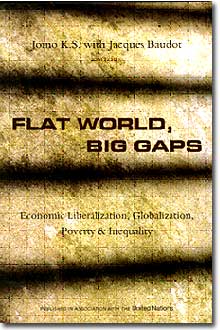
'Flat World, Big Gaps' critically considers the impact of economic liberalization and globalization on inequality and poverty.
Inequality trends
The first half surveys the major analytical issues in the recent study of global inequalities. After a brief survey of different approaches to international income inequalities, the second chapter notes that indicators of economic growth performance as well as international economic inequities have deteriorated in the last quarter-century compared to the 1960s and 1970s. The following three chapters critically consider recent trends as well as their implications from different perspectives.
High global inequalities mean that a very small share of economic growth - which often exacerbates living conditions for the poor - actually trickles down to the poor, who make up half the world's population.
The second half of the volume surveys recent inequality trends in various parts of the world including the OECD, the USA, Eastern Europe and the CIS economies, Latin America, the Middle East and North Africa, sub-Saharan Africa, India, East Asia and China.
'Flat World, Big Gaps' is available at bookstores in the Klang Valley as well as from Kinibooks . It is priced at RM60.
'Flat World Big Gaps', edited by Jomo K.S. and Jacques Baudot was chosen as the book of the month (April 2007) by Kinibooks.
SYED JAYMAL ZAHIID is currently a business development executive with Gerak Budaya.


Are you sure you want to delete this comment?
This action cannot be undone.