




Table that police watchdog bill now!
At last, there will soon be an outfit more powerful than the Malaysian police force in our part of the galaxy. No, it's not R2-D2 or C-3PO. It's called IPCMC - the Independent Police Complaints and Misconduct Commission.
The IPCMC is arguably the most powerful watchdog ever proposed in this country. Unlike existing agencies, it reports not to the prime minister but directly to Parliament. This ensures its investigations are made public, instead of vanishing into some Putrajaya black hole.
At last, there will soon be an outfit more powerful than the Malaysian police force in our part of the galaxy. No, it's not R2-D2 or C-3PO. It's called IPCMC - the Independent Police Complaints and Misconduct Commission.
The IPCMC is arguably the most powerful watchdog ever proposed in this country. Unlike existing agencies, it reports not to the prime minister but directly to Parliament. This ensures its investigations are made public, instead of vanishing into some Putrajaya black hole.
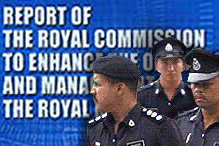 The recent Royal Police Commission, on top of
its 125 recommendations
to reform the force, has done the government a big favour by attaching
a ready-made bill
to its final report.
The recent Royal Police Commission, on top of
its 125 recommendations
to reform the force, has done the government a big favour by attaching
a ready-made bill
to its final report.
This was painstakingly drafted by the team of commissioners, many of whom are legal experts. All Prime Minister Abdullah Ahmad Badawi has to do is to table the 49-page bill in Parliament for debate, and hopefully, a speedy passage.
According to the draft bill, the IPCMC will consist of seven members - a chairperson, two deputy chairpersons and four commissioners. They are to be backed by a squad of investigators and legal advisers.
For some unexplained reasons, the chairperson is required to have at least 10 years of legal background. He or she can serve for up to six years, or two terms.
Police officers - whether active or retired - need not apply. They are banned from sitting on the commission. So, too, are members of parliament or state assemblies.
All-powerful body
The aim of this all-powerful police watchdog is simple - to ensure vigilant oversight of our rather tainted men and women in blue. Its main task is to probe complaints against the force, in particular corruption and other serious misconduct.
It exercises wide powers, enough to strike fear among the errant cops.
The commission can investigate allegations of misconduct even when the offences occur outside the country or when the police officer is off-duty. Retired cops, too, are not immune to prosecution.
The commission can inspect lock-ups, raid police stations and other government offices.
 Most importantly, the commission can launch an investigation on its own initiative. It can even take over the investigation of a complaint from the country's top cop, the inspector-general of police.
It has the authority to intercept or listen to any form of communication.
In conducting its investigation, the commission will work, where appropriate, with the Anti-Corruption Agency, the Auditor-General, the Securities Commission, Bank Negara and police forces overseas.
The commission can hold either public or private hearings as part of its investigation. And it is empowered to issue warrants of arrest for those who have been summoned but fail to appear at its hearings.
Interestingly, witnesses are compelled to answer all questions and produce relevant documents at such hearings. Those who refuse to cooperate with the commission can be punished with a fine up to RM10,000 or serve a prison sentence of up to two years.
If need be, the commission has the right to demand that a prisoner be brought to a hearing.
Witness protection
Recognising that potential witnesses may come under harassment and intimidation, the IPCMC has the powers to provide protection to its witnesses. Furthermore, it can grant immunity to them.
Those found trying to prevent witnesses from appearing before the commission are liable, on conviction, to a jail term of up to two years. It is also an offence for employers (read: senior cops) to victimise their employees for assisting the commission.
The commission can mete out two types of punishment - disciplinary and criminal.
Should a police officer be found guilty of committing disciplinary offences, the commission has the right, among others, to demote or sack the errant cop.
For criminal offences, such cases will be referred to the courts and if convicted, guilty cops can be slapped with either a jail sentence or a fine, or both.
Well, all these sound nice and good. Some reformers may prefer even stronger measures to be built into the draft bill. But perhaps, given the prevailing circumstances, this is as good as it gets.
The real fear, however, is that the government may lose its resolve to table the draft bill in its original form. It is expected that efforts will be made to water down the bill and turn the IMCPC into another toothless tiger - like Suhakam . We cannot, and must not, let this happen.
Parliament is due to resume its sitting for one month on June 20.
The draft bill is ready. Table it now before the forces of resistance can regroup and strike back. And before more of our gallant 'Jedis' join the dark side.


