




Simon says UM needs critical thinking
In the absence of a philosophy department, can Universiti Malaya (UM) be considered a university let alone the nation's premier ivory tower?
In the absence of a philosophy department, can Universiti Malaya (UM) be considered a university let alone the nation's premier ivory tower?
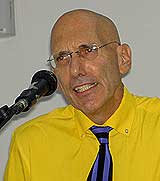 This question was raised by UM visiting scholar Prof Thomas W Simon during his public lecture at the university last week. The lecture was titled 'Ten Truths about University Malaya'.
Simon, from the Illinois State University, stressed on the importance for the nation's oldest and most prestigious university to have a philosophy department.
"(There is) something wrong with University Malaya because it does not have a formal philosophy department," said the academic, who has been in Malaysia for nearly a year.
"I think I have to wave my flag here (on) how important philosophy is. You don't even have to call it philosophy but just call it some kind of critical thinking," added the practicing attorney, who also holds a PhD in philosophy.
Citing the controversy over the caricatures of Prophet Muhammad, Simon said he saw little critical thinking involved.
Undergo changes
In view of this, he recommended that UM undergo structural and innovative changes to incorporate more critical thinking in its curriculum.
Simon said he was disappointed when he first arrived at UM and learnt that the university did not have a philosophy department. He then decided to uncover the reasons for this.
Initially, he thought that religion or the nation's Islamic background was the reason but his research revealed that even De La Salle University - a Catholic university in Manila and Tarbiat Moderas University in Tehran - formed after the Islamic revolution - have philosophy departments.
Simon said that he was not convinced of the argument that Islam does not emphasise on philosophy since there were many philosophers in the Islamic civilisation.
No questions
Simon also expressed disappointment with the academic community in UM.
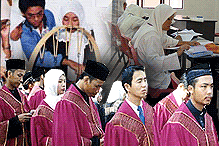 "We come out of the classes and we were disappointed because no student wants to talk or discuss. We come out from a session like this and nobody asks questions," he noted.
He also took a swipe at the Times Higher Education Supplement (THES) ranking , which saw UM sliding down the ladder.
"The ranking is very much a business scam," said the academic, adding that his research showed that none of the criteria used in the survey can pass the test of academic scrutiny.
"It is indeed sad if anybody takes this seriously," he said.
To illustrate his point, Simon said the University of California Berkeley was ranked 21 in the United States by US News 2004 but THES ranked it No 2 in the world.
He concluded that different surveys yield different rankings and the reliability of the rankings correlate with the narrowness of scope. Hence the reliability of THES which has the largest scope (universities worldwide) is low.
QS Quacquarelli Symonds - which designed and conducted the THES survey - ranked UM at 169, a drop of 80 spots from the previous year.
The dismal ranking saw the university come under serious fire from critics.
The two-hour public lecture held by UM's Centre for Civilisational Dialogue was attended by some 30 people, including the newly appointed UM vice- chancellor Rafiah Salim .


Report this comment
Are you sure you want to delete this comment?
This action cannot be undone.