




The Ming Court Affair, Pt 4
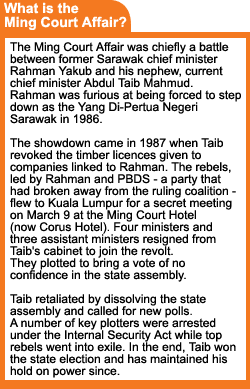
special report By now an Orwellian sense of a superior force at work had Daniel Tajem more intent on an imperative - preserving the unity of his Parti Bansa Dayak Sarawak (PBDS) in the brewing maelstrom in Sarawak politics than on hypotheticals, such as assuring a position of significance for himself and PBDS in the post-Taib era. He already heard that Noor Tahir, a Melanau Muslim, was slated to become chief minister if Taib were removed. Rumour also began to filter through that Tajem would not have a place in a Noor Tahir-led state cabinet.
special report By now an Orwellian sense of a superior force at work had Daniel Tajem more intent on an imperative - preserving the unity of his Parti Bansa Dayak Sarawak (PBDS) in the brewing maelstrom in Sarawak politics than on hypotheticals, such as assuring a position of significance for himself and PBDS in the post-Taib era. He already heard that Noor Tahir, a Melanau Muslim, was slated to become chief minister if Taib were removed. Rumour also began to filter through that Tajem would not have a place in a Noor Tahir-led state cabinet.
In the churning currents Tajem knew which way to shift his feet even if he had only a hazy notion of a final destination. As state assemblymen and parliamentary representatives from SNAP, PBDS and Party Bumiputera Bersatu (PBB) flew into Kuala Lumpur from Kuching and assembled at the Ming Court all of Monday, and as signatures on a petition to the Sarawak Governor expressing no confidence in the chief minister were being canvassed, Tajem prepared himself for a PBDS supreme council meeting in president Leo Moggie's house in a plush quarter of Kuala Lumpur on Tuesday evening.
 The meeting began with Moggie telling the assembled members that the PBDS would have to go with Tun Rahman's anti-Taib faction or he would quit as president. A month earlier, at the PBDS triennial delegates conference in Kuching, Moggie had been elected to his second term as president with Tajem as deputy. The party was beginning to display cohesion after its inauguration in December 1983, following internecine strife in SNAP dating from Moggie's failed attempt at being SNAP president in 1981 (he was defeated for the top post by James Wong) and Tajem's expulsion from the same party in 1982.
The previous day at the Ming Court, most of the PBDS representatives were in the unenviable position of being neither neglected wallflowers nor meddling gatecrashers. In Moggie's house, as opinions were canvassed around table, the majority were non-committal, including Dr James Jemut Masing, a vice-president and rising star of the party. Only Gramong Juna voiced the opinion that if the effort to remove Taib were only a matter of supplanting one leader with another, with no change in policy, the exercise for PBDS would be futile. Tajem then interposed to say that the supreme council should go with its president for the sake of unity. He said Moggie had only the previous month been re-endorsed as party chief, so his resignation in the event of the supreme council's refusal to support the move to remove Taib, would send the wrong signal to the Dayak community. The decision to support the Tun Rahman-led rebellion turned on an intuition rather than on reasoned calculation. The intuition here was that the party president knew best.
 In the event, Tajem's backing for his chief swung the supreme council to the decision to make common cause with the anti-Taib faction. Tajem and Moggie had been friends from schooldays in the 1950s in Kuching. Though older by some five years, Anglican Tajem, who had started school later, had finished upper secondary school in St Thomas in Kuching at about the same time as Catholic Moggie completed his upper secondary education at St Joseph's School. Both were top schools in Kuching, attracting the cream of the crop being prepared for tertiary education. Tajem had always tended to defer to Moggie, the son of an Iban
tuai rumah
(head of a longhouse) from Kanowit, deep in the Iban hinterland. Tajem, born into grinding poverty in an Iban enclave near Kuching, emerged from humbler circumstances than Moggie, a factor that tended to make the former defer to Dayak luminaries from less straitened circumstances.
In the event, Tajem's backing for his chief swung the supreme council to the decision to make common cause with the anti-Taib faction. Tajem and Moggie had been friends from schooldays in the 1950s in Kuching. Though older by some five years, Anglican Tajem, who had started school later, had finished upper secondary school in St Thomas in Kuching at about the same time as Catholic Moggie completed his upper secondary education at St Joseph's School. Both were top schools in Kuching, attracting the cream of the crop being prepared for tertiary education. Tajem had always tended to defer to Moggie, the son of an Iban
tuai rumah
(head of a longhouse) from Kanowit, deep in the Iban hinterland. Tajem, born into grinding poverty in an Iban enclave near Kuching, emerged from humbler circumstances than Moggie, a factor that tended to make the former defer to Dayak luminaries from less straitened circumstances.
After helping to swing the PBDS supreme council in favour of ousting Taib, Tajem, detailed to brief Prime Minister Dr Mahathir Mohamad, prepared for the one-on-one meeting the next day. It turned out to be a short 15-minute encounter, held in the PM's chambers in Parliament House. Dr Mahathir, who was himself readying to be challenged for the presidency of UMNO, the dominant party in the federal Barisan Nasional (BN) coalition, at party elections scheduled for late April 1987, told his visitor that he happened to be in a bout of busyness and thus could afford Tajem little time. Tajem dispensed with preliminaries and went straight to the point. A group, he informed the premier, of discontented Sarawak BN component party representatives, constituting a majority of the 48-member State Assembly (DUN), and including four state cabinet ministers and three assistant ministers, had signed a petition to be presented to the Governor expressing no confidence in Taib. He said the disgruntled faction considered Rahman their mentor.
Keep politicking in Sarawak
Dr Mahathir, adept at keeping his true feelings concealed when occasion required, was a study in nonchalant neutrality. He tersely advised Tajem to keep the anti-Taib politicking within Sarawak and to do whatever the faction wanted provided it was within the law. If the anti-Taib faction went outside the law, Dr Mahathir said they would be dealt with according to the law. Lawyer Tajem did not see anything amiss in the PM's admonition and left the brief meeting satisfied there was no signal from the federal BN leadership that the move to remove Taib was frowned upon.
Historically, no move to change the chief minister in Sarawak, or for that matter Sabah, could succeed without Kuala Lumpur's approval. At this stage of the attempt to remove Taib, the faction against him had no inkling of how Dr Mahathir felt about the matter. The faction felt that if they commanded a majority of state assemblymen, KL would simply have to come around to their view of the matter.
 In the event, matters turned out to be not that simple. Years later Moggie would tell intimates of Dr Mahathir's actual feelings towards Tun Rahman. The PM had a dim view of the former education minister whom Dr Mahathir faulted for a too-fast implementation of the policy to change the medium of instruction in the Malaysian education system from English to Bahasa Malaysia in 1971. Rahman had been education minister in the late 1960s. To curry favour with Umno's Malay language champions, Rahman connived at the agitation launched by then University of Malaya (UM) student leader Anwar Ibrahim which saw Malay Language Society students daub paint on English language road and other signs in the university's campus in Pantai in 1968. Dr Mahathir saw that agitation as directly conducive to the rise of Anwar Ibrahim as student leader. That rise would present Dr Mahathir with his first crisis when he became education minister in Prime Minister Tun Abdul Razak's cabinet after the August 1974 general elections.
Falling rubber prices in November 1974 saw Anwar Ibrahim, then president of the Malaysian Muslim Youth Movement (better known by its Malay acronym, Abim) lead demonstrations in Baling, in Kedah, in sympathy with impoverished rubber tappers against the government. Those demonstrations, in Baling and in Tasik Biru in Johore, would find an echo in serious student disturbances in the UM, led by Anwar acolytes. Police entered the UM campus in a controversial infringement of campus autonomy to arrest student agitators. Dr Mahathir, inclined to look askance at student agitation and those who foment it, would trace his problems of November 1974 to the language ferment in UM in 1968. Also, Dr Mahathir was aware that Rahman, as chief minister of Sarawak (1970-81) and as Governor (1981-86), had publicly expressed disgruntlement at the low 5% royalty paid by Petronas to Sarawak for oil and gas deposits in Bintulu.
In the event, Rahman's overtures to obtain Dr Mahathir's backing for the anti-Taib faction he led were spurned by the federal BN leader. This was a signal that the attempt to topple Taib did not enjoy KL's favour. This would bode ill for the anti-Taib rebels.
Tomorrow: The concluding Pt 5 of the Ming Court Affair


Report this comment
Are you sure you want to delete this comment?
This action cannot be undone.