




Red devils, yellow hordes
If you ask what the heck is going on in Thailand today, you'd be puzzled by the question, let alone the by the responses you'd get. Because the reality is that scores of things happening in Thailand at any one time or around the clock. But if you ask, specifically, what the heck is going on in Thailand politically, then you would likely hear the blame shifting to Thaksin Shinawatra.
If you ask what the heck is going on in Thailand today, you'd be puzzled by the question, let alone the by the responses you'd get. Because the reality is that scores of things happening in Thailand at any one time or around the clock. But if you ask, specifically, what the heck is going on in Thailand politically, then you would likely hear the blame shifting to Thaksin Shinawatra.
The former billionaire premier, who sold his telephone company for a ridiculous few billion dollars to Singapore Telecoms a few years ago, had tried to evade paying taxes.
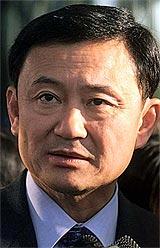 That was not the first straw of the way Thaksin
(right)
had laid siege to Thailand and acted as though he were a benevolent dictator with ‘democratic' stripes painted over him. The first straw came in the way he used his wealth to buy rural votes to augment his corrupt regime whilst he pilfered the country and enriched himself, his family and his cronies.
That was not the first straw of the way Thaksin
(right)
had laid siege to Thailand and acted as though he were a benevolent dictator with ‘democratic' stripes painted over him. The first straw came in the way he used his wealth to buy rural votes to augment his corrupt regime whilst he pilfered the country and enriched himself, his family and his cronies.
And when push came to shove, he fled the country like a yellow dog when the Thai military, having had enough and acting on King Bhumibol Adulyadej's orders, unceremoniously purged him four years ago.
Since his ignominious escape, not dissimilar to the Philippine's rogue dictator Ferdinand Marcos or Indonesia's Suharto, Thaksin has been spoiling for a fight from abroad - the United Kingdom, somewhere in the Middle East, China, sometimes; wherever his enormous wealth carries his calling card - with the incumbent government of Abhisit Vejjajiva.
Abhisit, by the way, is presented by Thailand's media as a suave, urbane intellect who also claims to be a genuine democrat, and backed by his yellow-shirt horde of urbanized supporters.
But Abhisit has lost his way. And he's losing it even more. In case you need a refresher: Thailand is a little like a one-horse town, only with two horses: one is yellow, the other is Thaksin's red-shirt army of rural peasant supporters. Thaksin called in his chips on the red army and they've been doing battle with Abhisit's yellow team in and around Bangkok.
A few supporters on either side have been killed. A few more have been brutally battered by the Thai military and police. Most of them are the red shirts. But that has been filed away as collateral damage. It's the same story when Thaksin, as premier, had ordered his police to shoot and kill drug dealers in Thailand and ask questions later.
So, in itself, such actions are warrantable, even excusable, given the heat of political battle, especially the open guerrilla warfare and mob mentality that has been licensed by both teams' leaders.
Again, the same thing in the south of Thailand: every time the Muslim minority there agitates for separate statehood, the Thai military and police bludgeon them to death or shoot them in the head.
What's going on in Thailand?
So what is going on in Thailand? If you're as cynical as I am, you'd say: nothing much; this is standard fare. After all, it is the Third World. And never mind the glitzy glass towers that dot Bangkok in a chimera of coming-of-age industrialism or economic sophistication. It's rubbish. It's rubbish because the modern or post-modern glitz belies the nasty, bloody-minded politics on the ground.
The barbarity of politics, such as in Thailand, such as in much of the Third World or developing world, leaves so much to be desired. It has to be abhorred. Condemned. This is not about the renaissance of Asian civilization. It is not about whether Asians can think, either.
Because in Thailand, a microcosm of the developing world's ongoing problems inherited from the past, civilizational thinking is clearly - fundamentally - absent. And cut the cockamamie that politics in Thailand is an expression of civil society's rise and rise. Bollocks.
Clearly - fundamentally - there is a moral void in Thai politics, just as there is one in all the developing countries. And, before you start whining about how unfair I am, the same thing can be found in the first world too. Yes, the West, and in degrees, and, yes, in relativities.
 But is it good enough, in Thailand where a monarchy has held sway over national politics, a monarchy that is so revered you'd think King Bhumibol is god (with a small ‘g', thank you, since I am an atheist)?
You'd think Thailand's king would step up and say to his subjects: enough, already; we must change if we're going to save ourselves and salvage our souls. Crikey, it just won't happen.
The moral compass has long disappeared. It won't happen because politics has become bigger than the royal family. As it has in Japan. As it has in most other places where monarchies still think they rule by default. They're delusional. Not convinced? Look at the Catholic Church today.
The vile politics of its priests (not everybody, of course) has overtaken Catholicism in such a way that it has swamped Christianity into irreparable damage, and all because of the sickening sexual predatory behavior of its priests. Even the Papal's protection of its priesthood is in question.
The Pope (above) has been linked to shielding the carnal sins of his pedophilic robed flock when he had known all along some of them, under his charge, had committed heinous crimes against innocent, young boys in their care.
Red shirts dogfight yellow shirts
Back to Thailand. Politics hasn't overshot itself. It has overgrown all prevailing sanity of fairness and truth. Madness is being ruled more and more by frenzy for greed and power. Red shirts dogfight yellow shirts every day in street battles and mind games. Abhisit must be wondering how he is going to contain the growing fallout of this political nightmare before it snares him of his prime ministership at the next poll.
If he thinks his popularity is certain, as is the popularity of his yellow brigade, then he's in for a shock - and sooner than he thinks.
Because politics isn't always national-ised in developing countries, where genuine democratic checks-and-balances do not exist or are less than transparent. Politics is highly localized. It is in Thailand.
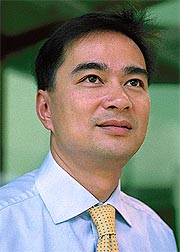 This leaves open the possibility - no, probability - of money politics and electoral fraud writ large. Abhisit
(left)
is not hugely assured of his clout in urban electorates. He may seem popular but this could be a cruel illusion when polling day comes. For this reason he has taken on the mantle of Thaksin: to be seen as moderate and genuinely democratic on the one hand, and populist on the other. It just won't wash.
This leaves open the possibility - no, probability - of money politics and electoral fraud writ large. Abhisit
(left)
is not hugely assured of his clout in urban electorates. He may seem popular but this could be a cruel illusion when polling day comes. For this reason he has taken on the mantle of Thaksin: to be seen as moderate and genuinely democratic on the one hand, and populist on the other. It just won't wash.
Certainly it won't wash in rural Thailand, where most voters have been brainwashed enough and bought over by Thaksin's baht-for-votes scams. And it's still happening. Worse, it could spill over into the outer urban centers of Thailand's cities and townships.
Which leaves Abhisit with few options today as he talks and talks of polls later this year. Either he goes all out with a genuine hearts-and-minds campaign and blows the country's budget bottom-line into red sky - the standard fare of all politicians everywhere, by making wild and woolly promises of greatness - or he buys the votes of Thailand's peasantry and others.
Because if you look at the way politics between the yellow and red brigades is being played out in Bangkok itself, Abhisit, if he were truthful, would admit that he is being surrounded, literally, by the anti-government red shirts. They are swamping the yellow shirts by a ratio of two-to-one.
At least. Numbers count in politics. So, too, the images that would be streaming across television sets all over Thailand, especially in Thailand's rural provinces. Abhisit knows he needs Thailand's provinces to cross over to his side, but he has no guarantees if Thaksin's wealth keeps pouring into villages unchecked.
MANJIT BHATIA, an academician and writer, is also research director of AsiaRisk, a political, economic and risk analysis consultancy in Australia. He specialises in international economics and politics, with a focus on the Asia-Pacific.


